 C. Custer · · 5 min read
Are you ready to subscribe to a gaming PC? Because I'm sure as hell not.
On Wednesday, we wrote about Project Christine, the modular gaming PC that Razer unveiled at CES. In the article, my colleague Mary-Anne expressed more than a little skepticism — “I hate this on first sight,” she wrote — and at first I thought she was out of her mind. A gaming PC where upgrading your graphics card is as easy as pulling one module out and clicking another into place? Why wouldn’t we want that?
Then I read this article by Ben Kuchera on Polygon. I think it has the opposite effect of what he was intending, because now I agree with Mary-Anne.
Before I start, I want to make it clear that while I disagree with Kuchera here, I have a ton of respect for him and his work. I’ve been following him since his Ars Technica days and I think he’s truly one of the best in the business. I also think he got this one very, very wrong, though.
In the article, Kuchera makes the case for Project Christine being the genesis of a gaming PC subscription model. Razer is considering this approach, and while it hasn’t announced pricing, Kuchera says he’d pay up to $60 a month after the upfront costs of buying the initial system. He writes (emphasis added):
The subscription model is attractive for a few different reasons. It seems easier to digest the idea of a monthly payment than to pay for each major upgrade as a lump sum, and pragmatically I can see selling my wife on the idea of a subscription service that would always make sure I have an able gaming PC much more easily than the conversation that would come from spending $720 on a new CPU, GPU and RAM to keep my system current. The buying decision is removed with a subscription; you merely upgrade when it’s appropriate.
That final sentence is exactly the issue I have with subscription models in general: the decision-making power, or at least some of it, is removed from the hands of the consumer. I find that terrifying.
Now, to be fair, Kuchera points out that a subscription-based approach to PC gaming isn’t for everyone; it’s a trade-off of money and freedom for the time you save not having to tinker with your PC yourself. But is that trade-off really worth it?
If Project Christine continues to offer the best components in perpetuity, then it might be. But there’s no way of guaranteeing that, and that’s where the problem is. Let’s say you “subscribe” to this new Razer PC, and after a couple years, it’s time to upgrade your components. You’ve been paying $60/month, so you’ve got about $1,400 in the bank to upgrade your system with.
Subscription-based PC hardware will cost you more
$1,400 will buy a lot of power if you’re shopping for the best components from every brand, price-comparing, and looking at different sales and deals across the web. But with a subscription-based PC, you’re likely going to end up getting less for your money because your upgrades will be coming from the limited subset of brands that are also Razer partners. So if some other company comes out with an incredible new component you want in your rig but they’re not partners with Razer, you’re out of luck. If you save money on your own, you can buy anything you want. But with a subscription model, you’re locked into Razer’s program until you decide to stop paying and cut your losses.
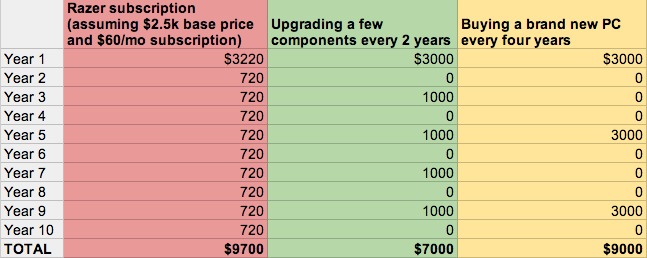
These numbers are all hypothetical, of course, but I thought it would be interesting to take a look at how much you’d end up paying over a decade of PC gaming using Kuchera’s proposed subscription method as opposed to more traditional upgrade paths. So I made two comparisons; one to the cost of adding about $1,000 worth of new components to your PC every other year, or just straight-up buying $3,000 worth of new PC every fourth year. Turns out both of these approaches are cheaper than the subscription model:
Your money isn’t the only thing at stake
Introducing Project Christine, Razer’s modular gaming PC concept




Stay updated on the go with our mobile app.
Get latest insights with smoother, more personalized experience through TIA mobile app.









