
Summary:
- With the rise of agentic AI, it’s now possible for agents to independently orchestrate complex financial workflows such as verifying deliveries, managing foreign exchange rates, and executing payments.
- However, the adoption of agentic finance is hindered by fragmented traditional financial systems, tight security controls, and the “black box” nature of AI.
- To overcome these hurdles, Sunrate is developing modular, AI-native platforms that embed governance, compliance, and orchestration directly into the payment process.
- Learn more about Sunrate and how it’s enabling agentic AI in financial infrastructure here.
Imagine a world where a Singaporean company importing supplies from Malaysia could deploy an AI agent, operating within predefined constraints, to automatically track and verify deliveries before releasing a payment. Maybe the agent could even work with a team of other agents to keep tabs on how paying for that order could be affected by cash flow, foreign exchange (FX) rates, and transfer methods – all the human needs to do is review its actions.
That might sound too good to be true, but this future is not that far off.
Embedded within existing payments networks, AI payment agents have the potential to make transactions more efficient, customized, and secure. According to global payments and treasury management platform Sunrate, B2B agentic payment volumes are projected to grow by 335% annually over the next five years.

Li Yilong, head of AI at Sunrate / Photo credit: Sunrate
While the adoption of agentic finance is still at an early stage, Li Yilong, Sunrate’s head of AI, says there is a “clear shift” in how AI is being used in payments, which “sits at the intersection of data, workflows, compliance, liquidity, and decision-making.”
“Today, many businesses are using AI as a simple productivity tool, but the next step is for it to start executing and orchestrating workflows,” Li notes.
Barriers to reality
While an agentic future seems likely, a lot more needs to be done to make it a reality. Despite the excitement around AI, there remains significant concern within most companies around how much agents can be trusted.
“When AI generates a recommendation, a human can review it before taking action. But if an AI agent is authorized to execute a financial transaction, the stakes are very different,” Li explains. “In traditional payments, we are accustomed to knowing which person or system initiated a transaction. With agentic payments, we need to establish a clear chain between the business, the agent, its authorization, its intent, and the eventual action.”
Without establishing the right guardrails and infrastructure for these agents, businesses will struggle to trust the ecosystem enough to reap the benefits of agentic finance.

Photo credit: Armmy Picca / Shutterstock
AI agents can also be limited by legacy financial infrastructure. These systems tend to be fragmented, running on siloed software or discrete platforms.
To some extent, these structural constraints are part of how traditional finance protects against fraud. This fragmentation isn’t necessarily a problem if there’s a human to coordinate them, but they can create barriers for agent-led transactions.
At the same time, it’s not feasible to do away with the checks and constraints that are needed to ensure AI agents are operating within what they’ve been given permission to do.
“Autonomy without accountability will not work in financial services,” Li notes.
Many of these systems were also not designed to cope with the transaction volumes generated by AI agents working simultaneously and at scale.
Put together, these limit how far agentic finance can operate. Li highlights four main issues:
- Static authorization: Agents are limited from making a particular decision because they lack the authorization to independently make transactions. Humans can’t “delegate” their authorizations to agents, especially for things like payment limits or approval requirements.
- Inability to support multiparty orchestration: Payments usually involve multiple stakeholders, but agents typically only see one piece of the puzzle.
- Tight security controls: These prevent agents from having access to financial credentials. There isn’t always room in existing systems to define a way for agents to access important information in a controlled manner.
- Poor auditability: Many AI models are “black boxes,” which means users are unable to find out how a model internally works to perform its tasks. This may prevent businesses from understanding an agent’s identity, intent, decision-making, and actions.
A comprehensive yet modular approach to AI
In a bid to tackle these challenges, Sunrate has begun working on agentic finance through Sunrate.AI, an AI-native infrastructure for global payments.
“If AI agents are going to participate in financial operations, we cannot simply bolt an AI interface onto infrastructure that was designed for humans,” Li says.
Sunrate’s goal is to build infrastructure that allows businesses to delegate financial operations to AI agents with confidence, but always within a framework that they can trust and control.
Sunrate.AI was deliberately designed as a modular but coordinated ecosystem that allows enterprises to “move toward more complex end-to-end workflows without creating a single, monolithic AI system,” Li explains.
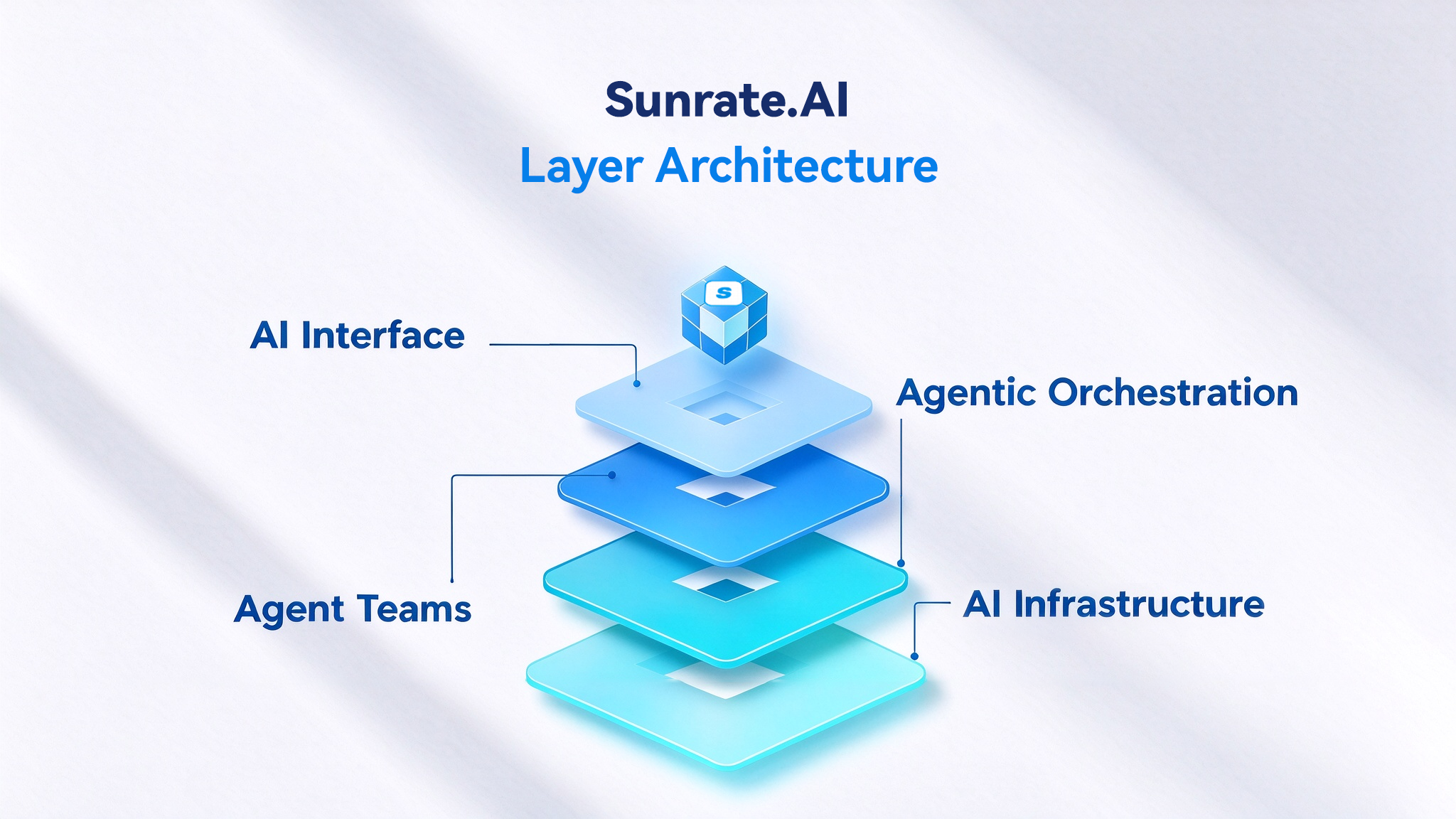
Image credit: Sunrate
Its architecture comprises four layers:
- The AI interface, which connects users and systems to the rest of the agentic tech stack.
- The agent teams, which comprise different specialized agents that handle specific financial tasks such as customer support, onboarding, compliance checks, task orchestration, collaboration, and FX guidance.
- The agentic execution layer, which coordinates agents, tools, workflows, approvals, and system actions.
- The AI infrastructure, which provides the foundational modeling and governance needed to run agentic workflows securely and reliably.
Tackling agentic finance barriers
These layers work together to streamline how companies deploy agentic payments, connecting AI agents with the data sources, payment capabilities, workflows, controls, and intelligence they need to perform.
“For agentic finance to work at scale, these disconnected capabilities need to be brought together through a governed orchestration layer,” says Li. This layer not only bridges different financial processes but also assigns specific tasks to specialized agents to ensure the workflows move smoothly.
The orchestration layer is also key to addressing fragmentation issues by serving agents with just enough business and transaction information to make useful decisions and coordinate with multiple systems.
These systems are supported by a robust, underlying memory architecture that allows agents to consistently pull data about their customers in order to deliver personalized and relevant experiences.

Photo credit: Sunrate
“Sunrate.AI’s context engineering brings together relevant transaction information, applicable policies, authorization boundaries, and the results of earlier steps around a specific business objective. This gives each agent the context it needs for its part of the task,” Li explains.
For example, if you’re making a cross-border payment, a payment agent and an FX agent would need to coordinate across payment requirements, exchange rate information, and processing status for the same transaction. Context is updated as the task progresses and goes from agent to agent, enabling them to execute it efficiently.
With any AI model, data security and auditability are top concerns for users, which is why Sunrate.AI’s platform has embedded access and compliance controls, real-time monitoring, and continuous auditing directly into its operations.
“Sunrate.AI is designed to let agents access financial capabilities within clearly defined boundaries and interact with systems through controlled tools, while sensitive credentials are managed by the underlying execution infrastructure,” Li says. “Each action is subject to the relevant identity, permission, and business-rule checks.”
It also enhances auditability by establishing a complete record of the task, from the business request to the execution outcome. This tracks the agents involved as well as the relevant inputs, authorizations, tool calls, and more.
Recording each task enables traceability without needing to unpack a model’s entire reasoning framework. In this way, Sunrate aims to build greater trust in agentic finance by establishing a process that involves humans at crucial junctures.
Agents interpret business objectives, break them down into tasks, and coordinate the required capabilities. The execution layer then uses explicit rules to check proposed actions against enterprise-defined constraints, such as transaction limits and permitted actions.
Necessary approvals must be obtained before the task can be performed, and anything out of the ordinary will have to undergo human review. Following the execution, the outcome must be checked against the company’s own guardrails to ensure the task was completed.
“This allows enterprises to progressively expand the scope of tasks delegated to agents while retaining control over key decisions and financial actions,” Li says.
Building an agent-human partnership
Though Sunrate.AI was only launched a few months ago, the solution is already being deployed for onboarding and customer support. The company is also developing other services such as payment and FX agents, both of which are being trialed in a sandbox environment.
“The most important measure of success is not whether an individual AI agent performs a task faster, but whether we can progressively connect these capabilities into an end-to-end financial workflow – from onboarding and compliance through to payments, FX, and reconciliation,” says Li.
AI has generated a significant amount of anxiety around how it will change the role for humans in the world. Li stresses that AI agents aren’t here to replace humans but to work with them.
From his perspective, financial operations will increasingly be run by agents but with humans “setting the objectives, policies, and boundaries.”
“A finance professional could define an objective and constraints for his agent to complete a task, and the agent will coordinate all those underlying processes, only coming back if a decision falls outside of its authority or if it runs into an exception requiring human judgement,” he suggests. “That’s a world where humans define intent and governance, and AI handles the complexity of execution.”
Founded in 2016, Sunrate is a leading global payment and treasure management platform for businesses. It’s also the developer of Sunrate.AI, an AI-native infrastructure designed to blend traditional payments with agentic capabilities. By rethinking the very foundations of traditional banking, Sunrate.AI aims to resolve challenges such as payment delays, operational inefficiencies, hidden costs, and regulatory complexity.
Learn more about how Sunrate is driving the future of agentic finance here.
This content was produced by Tech in Asia Studios, which connects brands with Asia’s tech community. Learn more about partnering with Tech in Asia Studios.
Stay updated on the go with our mobile app.
Get latest insights with smoother, more personalized experience through TIA mobile app.
Recommended reads
 High car costs give Singapore a robotaxi edge: Waymo founder
 Automating premium hotel kitchens with sensors
 Who pays for AI in your language?
 MoneySmart grows revenue by 26% in 2025, but AI threatens margins
 The truth about AI language models: No one wants to pay for them
 Tracking AI hiring in Singapore: OpenAI, Anthropic, and more
 Korea’s physical AI ambitions meet the factory’s bottom line
 SEA financials tracker: Moladin’s revenue rises 6% in 2025
 On‑demand services lift Line Man Wongnai’s 2025 revenue to $544m
 Flipkart’s costly late push into quick commerce and food delivery





Editing by Stefanie Yeo, Jonathan Chew, and Lorenzo Kyle Subido
(And yes, we’re serious about ethics and transparency. More information here.)






📅 Upcoming Events
30-31 March 2027
Upskill Fest