
Picture this: You’re lying on your sofa, scrolling through Netflix. Your recommendations are full of Korean romance dramas – exactly what you like. After all, the platform knows what other shows you’ve watched and has an idea of your preferences.
This experience mirrors that on many other platforms, whether it’s Shopee, Spotify, or your supermarket app. Personalized experiences have become the norm in today’s digital landscape.
“Businesses are under intense pressure to stand out in a digital world where experiences are increasingly commoditized and customer trust is harder to earn and maintain,” says Harshana Ariyaratne, chief marketing officer at data and identity management firm Affinidi.

Harshana Ariyaratne, chief marketing officer at Affinidi / Photo credit: Affinidi
“Differentiation through personalization is no longer optional – it’s essential. Without it, companies risk blending into the sea of competitors offering similar products and services.”
However, achieving effective personalization – and this differentiation – is becoming more complex as businesses balance delivering customer value with growing concerns around data privacy and security.
Success now depends on finding a balance between personalization and privacy, integrating customer data across the digital journey, and moving away from traditional data collection methods like cookie tracking.
But how close are companies to achieving this? And what can they do to make sure they’re primed for success?
Here are five insights into the current landscape.
1. Hyper-personalization is the key to customer loyalty
Customers today expect that businesses will meet them where they are, with tailored experiences that resonate with their needs.
According to a McKinsey report, getting personalization right can significantly enhance customer loyalty and satisfaction, while failing to do so can lead to higher churn and lower engagement.

Photo credit: oatawa / Shutterstock
It’s no surprise then, that 58% of the businesses surveyed for an International Data Corporation (IDC) InfoBrief, produced in partnership with Affinidi, seek to differentiate themselves by prioritizing hyper-personalized products and services. However, the same survey also found that only 32.8% of businesses can anticipate their customers’ needs and drive value-centric, highly personalized services.
This gap between what customers want and what businesses are doing is a clear opportunity for companies to refine their customer data strategies to engage in more meaningful, value-driven interactions that keep customers coming back.
2. The privacy and personalization trade-off
A rising number of data breaches and growing concerns around data privacy and security have left businesses in a difficult situation. How do they collect the necessary data to deliver personalized experiences while protecting customer privacy?
The IDC InfoBrief highlights this tension – 55.5% of businesses surveyed shared that they find data collection and management to be a key challenge. Similarly, 58.5% indicated they struggle with security concerns from customers during registration, hindering the onboarding experience.
To build trust and unlock the full potential of customer value and personalization, companies need transparent data practices that prioritize customer consent and security, making customers feel safe in sharing their information.
3. Value outcomes are increasingly critical
Businesses need to look at the big picture to create better experiences for their customers. Today, personalization goes beyond just offering product recommendations – customers expect experiences that generate tangible value for them.
For example, loyalty programs could, with customer consent, use people’s travel preferences to offer tailored perks like seat upgrades or special offers.

Photo credit: Chay_Tee / Shutterstock
However, while IDC’s InfoBrief found that 42.3% of businesses understand the importance of delivering great customer experiences, only 13.8% focus on the end value outcomes they aim to achieve from these experiences.
Subsequently, many firms might fail to implement the right organizational structure or processes, resulting in data silos that limit the effectiveness of personalization efforts.
To truly unlock customer value, businesses need to integrate front, middle, and back-office functions to provide consistent, high-quality interactions.
“Businesses need to rethink processes and leverage new solutions to foster greater trust, reduce vulnerabilities, and ultimately unlock more significant customer value,” says Affinidi’s Ariyaratne.
4. Embracing open standards to address the barriers to personalization
While businesses recognize the importance of personalization, many face challenges in executing it effectively. According to IDC’s InfoBrief, data fragmentation, scalability issues, and siloed systems are the key barriers. These challenges often stem from businesses relying on closed, proprietary technologies that often restrict innovation.
The InfoBrief posits that open standards will be the way forward to help businesses operate more flexibly.
“With open standards, businesses are better positioned to adopt and integrate new technologies, ensuring their systems evolve in line with market needs and technological advancements,” Ariyaratne shares. “This approach encourages collaboration and interoperability, effectively aligning digital strategies with customer demands.”
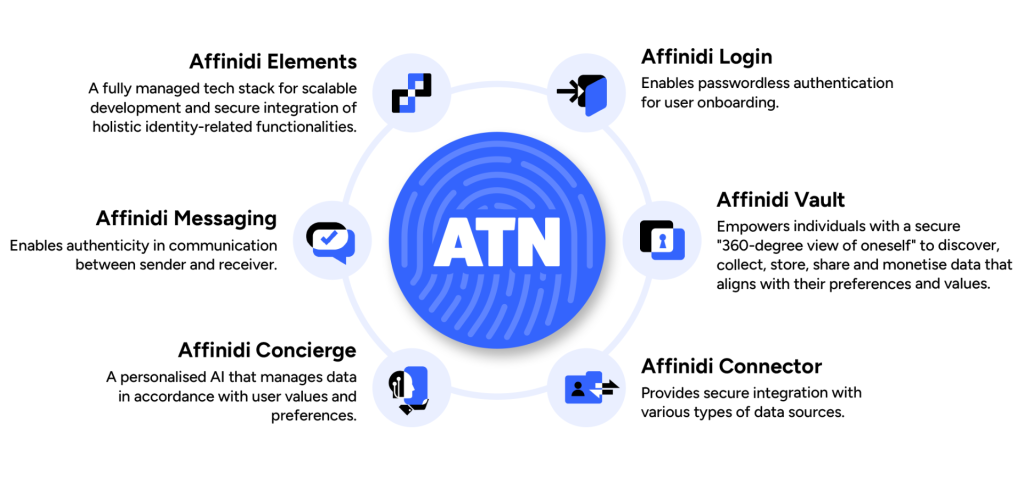
The Affinidi Trust Network / Photo credit: Affinidi
Affinidi leverages open standards in the development of its own solutions, offering a unified approach known collectively as the Affinidi Trust Network, a suite of specialized products, services, and tools that helps businesses leverage holistic identity management and zero-party data. This offers a secure and streamlined approach to gathering customer data, onboarding, identity verification, and consent management, while enabling customers to have complete control of their personal information.
“This empowers companies to stay agile, build trust, and continuously innovate in their pursuit of new standards for customer experiences,” Ariyaratne adds.
5. Holistic identity is the way forward
Another significant barrier to personalization lies in customer trust. After all, if a customer doesn’t trust a company with their data, personalized services are impossible.
That’s where holistic identity comes into the picture. It aims to “flip the script” on customer identity management, enabling customers to store and manage their own personal data.
Businesses need to rethink processes and leverage new solutions to foster greater trust, reduce vulnerabilities, and ultimately unlock more significant customer value.
By doing so, businesses can foster trust and unlock new levels of personalization, says Ariyaratne. Customers are more likely to engage with brands when they feel their data is handled with care, ultimately leading to stronger relationships and more meaningful interactions.
Affinidi aims to drive the adoption of holistic identity solutions with its Trust Network and revolutionize the way businesses interact with customers. By putting control back into the hands of individuals, it aims to enhance the relationship between businesses and customers while ensuring compliance and privacy.
Unlocking the future of personalization
Leveraging new approaches around data collection and management, while building services to be future-ready, will allow companies to unlock the value of customer data, with consent, and leverage personalization to gain new opportunities to connect with and serve their customers.
“This next level of personalization leads to more meaningful interactions and increased customer loyalty,” says Ariyaratne.
On the other side of the equation, by putting customers in control of their data and ensuring transparency at every stage, Affinidi helps companies foster trust and drive meaningful engagements in today’s competitive landscape.
“Users will become active participants in their digital experiences,” says Ariyaratne. “The road ahead for both businesses and consumers is one of mutual benefit, marked by enhanced trust and greater empowerment.”
Affinidi is a technology company dedicated to changing data ownership for good. By placing control back into the hands of users, its solutions strengthen trust to foster strong communities.
Find out more about Affinidi on its website.
This content was produced by Tech in Asia Studios, which connects brands with Asia’s tech community. Learn more about partnering with Tech in Asia Studios.
Stay updated on the go with our mobile app.
Get latest insights with smoother, more personalized experience through TIA mobile app.
Recommended reads
 Indonesian AI startup goes global
 Forrest Li on scaling Sea, building smarter bots, and founder grit
 An AI assistant that joins sales calls and scores team skills
 SGX’s CEO says it doesn’t need a unicorn to win
 SMEs want AI too, but not the kind Big Tech is selling
 Oatside’s alt-milk rise hits a profitable gear
 Alibaba’s financial health in 12 charts
 Asia’s telcos bundle AI into mobile plans. Will it pay off?
 M-Daq chases bigger clients as revenue falls, losses grow
 VC tracker: Accel raises US$3.5b, including US$550m for India





Editing by Jonathan Chew, Winston Zhang, and Jaclyn Tiu
(And yes, we’re serious about ethics and transparency. More information here.)





