- Premium Content It takes our newsroom weeks - if not months - to investigate and produce stories for our premium content. You can’t find them anywhere else.
 Scott Shuey · · 9 min read
Does Huobi have a ticking time bomb on its hands?
Huobi Global, the trading platform created by Chinese cryptocurrency entrepreneur Justin Sun, is sitting on a powder keg, analysts warn.
A proof of reserve or snapshot of assets released by Huobi shows that as of November 12, 2022, it holds over 9.7 billion Tron tokens (TRX), which are valued at US$544 million. According to CoinGecko, Huobi has US$2.88 billion in exchange reserves.
There is nothing illegal or unethical about Huobi using TRX as an asset, but holding that much has raised concerns that it might share the fate of UST and FTX, the two biggest crypto meltdowns of 2022.
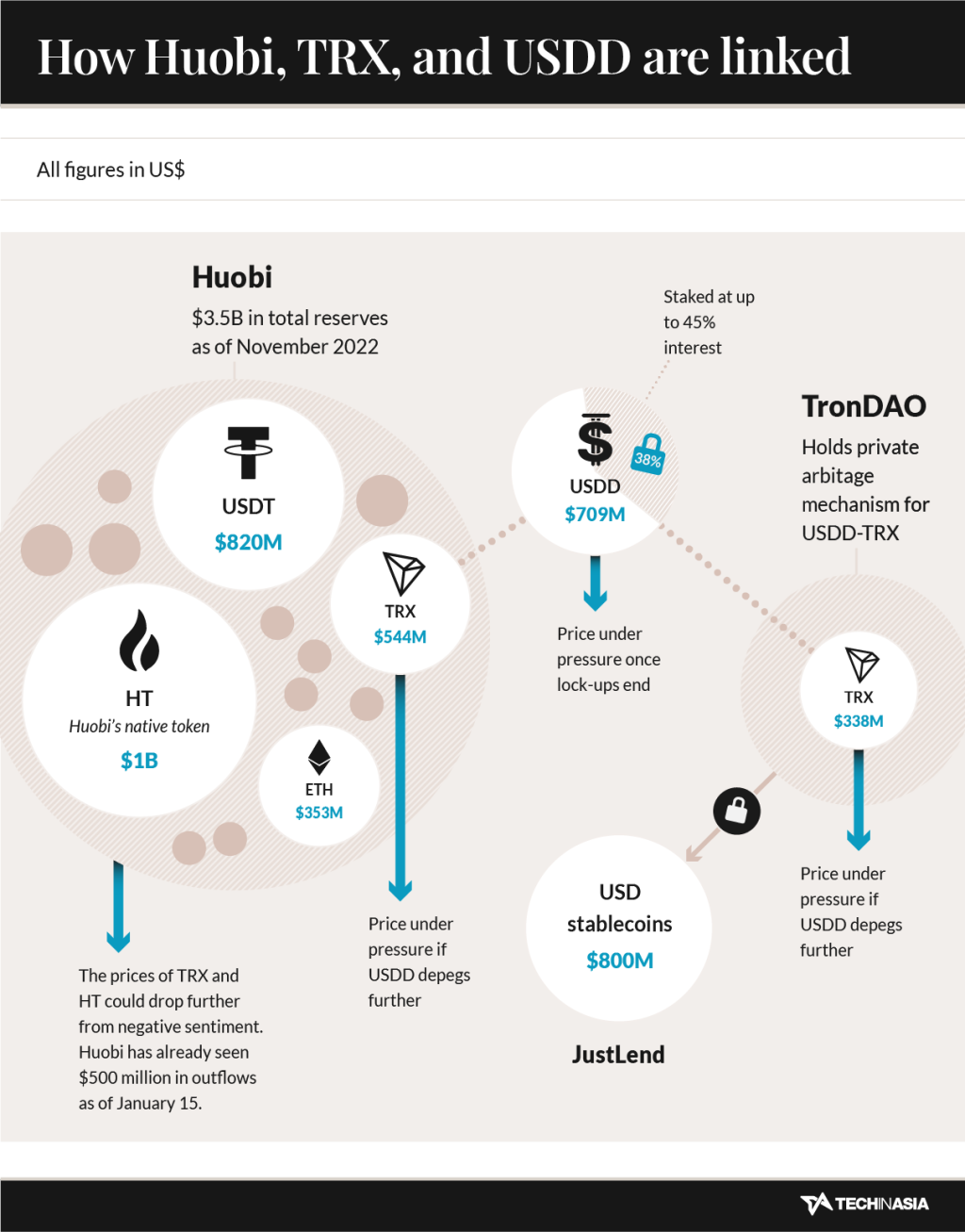
Image credit: Timmy Loen
First, TRX is issued by the Tron network, and both Tron and Huobi are suspected of being majority-controlled by Sun. Holding such a high volume of a token issued by a sister company is drawing comparisons to the FTX and Alameda Research collapse in November.
Second, TRX has a sister token: USDD, which is an algorithmic stablecoin with a market capitalization of US$709 million. The pair is modeled after Terraform Labs’ UST and Luna. When UST depegged in May, it went bust and wiped out almost US$60 billion in value in just a few days, triggering a crypto winter.
This is a worrying development for Huobi, which has already seen hundreds of millions of dollars worth of tokens pulled over the past week following the announcement of impending layoffs. If USDD collapses, it could take TRX with it, raising questions of insolvency at the exchange.
What’s the problem with USDD?
USDD has depegged twice in 2022. The first instance was in June, when it fell to US$0.945 just one month after the crash of UST. USDD was able to repeg six weeks later.
The second time was in November: It dropped to US$0.971 and has remained depegged since. The TronDAO, which oversees both USDD and TRX, considers USDD to be unpegged if it deviates more than 3% from US$1.
The depeg itself is not the biggest concern at the moment. Analysts say it would be difficult for USDD to depeg further in the short term. At least US$269 million in USDD or almost 38% of its available tokens are currently staked in interest earning protocols, with some offering over 45% returns, thus limiting a sell-off.
“I don’t see a massive USDD sell-off because a lot of it is still locked. I doubt many people use it as a payment method similar to Tether. Rather, most only hold it for the massive annual percentage yield (APY),” Omor Ibne Ehsan, a financial writer for InvestorPlace based in Dhaka, Bangladesh, told Tech in Asia.
There is talk Sun may not see a need to repeg. During the first depeg, Coinsider founder Justin Ting speculated that there are two good reasons for leaving USDD unpegged. It both preserves Tron’s liquidity and punishes anyone attempting to short the token, something Sun has done previously.
Sun is “waiting for market participants to realize their error (of shorting) and then bid up USDD so it goes back to US$1 without him having to lift a finger. That way, he can save his capital and improve the reputation of a stablecoin, which would be a win for him,” Ting said.
Tech in Asia reached out to Huobi, TronDAO, and Sun for comment, but we did not receive any reply.
Undercapitalized
A case of when, not if
What it means for TRX and Huobi
Which will go first: Huobi or USDD?
Stay ahead in Asia’s tech landscape
This is premium content. Subscribe to read the full story.
Just eight months after UST crashed, another algorithmic stablecoin faces issues. This one could take down global exchange Huobi.
We know this is not ideal. ⌛ Sign up in 20 seconds. Cancel anytime.
Our subscriber community includes professionals from these companies:





Stay updated on the go with our mobile app.
Get latest insights with smoother, more personalized experience through TIA mobile app.