Ezra Ferraz · · 4 min read
Call center agents can work from home in their pajamas with Kallfly
Though the business processing outsourcing industry is worth US$66 billion and is one of the Philippines’ most promising, few startups have set their sights on it. There is, of course, Kalibrr, led by CEO Paul Rivera, which seeks to change the way that companies recruit and hire, beginning with the BPO industry. But no other notable attempts to shake up the BPO industry other than Kalibrr had been made until JDFI incubee Kallfly stepped onto the scene this past summer.
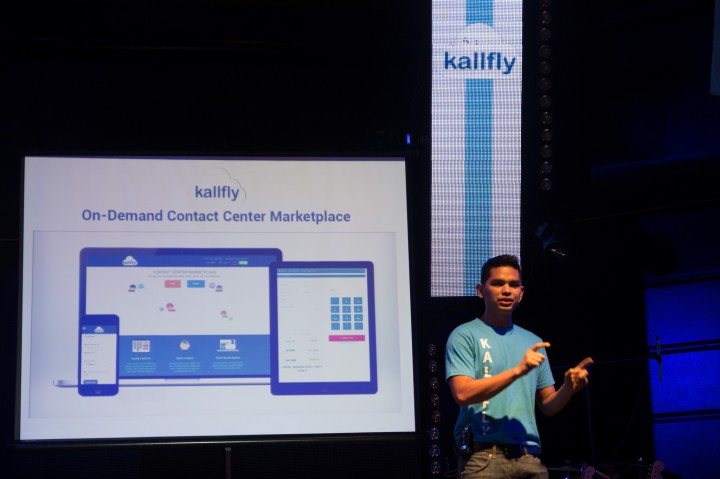
Mark Lapuz pitching Kallfly.
Kallfly targets the call centers themselves. Implicit in its business model is the idea that the current BPO system is needlessly inefficient for both companies abroad and call center agents locally. Foreign companies do not need to commit to large, long-term contracts with huge brick-and-mortar BPOs. Similarly, call center agents do not need to slog through Manila traffic and typhoon-prone weather to physically get to a BPO, when all the technology necessary to do their job is available right in their own homes (for the record, it’s a laptop, a decent Internet connection, and in some cases, a headset and a quiet room).
Call center agents can instead work through the Kallfly platform, which will allow them to freelance for business owners in need of on-demand call center services. Yes, this means that agents can work from home in their pajamas. And yes, that’s damn awesome.
See: Kalibrr is 1st Filipino startup to get into premiere startup accelerator Y Combinator
Battling the incumbents
While Kallfly may be the first company of its kind in the Philippines, the startup does have international competition. Kallfly CEO Mark Anthony Lapuz feels that they have an edge over competitors that have grown too big for their own good.
In particular, Lapuz names Arise and Liveops, as competitors who offer similar services – a cloud-based contact center marketplace that focuses on the United States, Cananda, and the United Kingdom. “With their closed ecosystem that caters to only large corporations in an environment of controlled campaign and agent hiring, it takes time for on-boarding and approval,” Lapuz suggests.

Kallfly co-founders Vince Loremia (left) and Mark Lapuz (right)
In contrast, Kallfly can set companies up with a call center almost as quickly as you agree to their terms of service with a quick checkmark. Kallfly’s speed is due to its system: rather than have an entire call center ecosystem built for you, you can simply select your ideal freelancer from a pre-vetted pool of experienced, home-based call center agents, all of whom work on an hourly rate.
The Kallfly system is also efficient because of its underlying technology. “With the power of Amazon Web Services and WebRTC, we can bring the VOIP (Voice Over Internet Protocol) and Telephony to a new level of experience,” Lapuz says. “And with our open contact center marketplace, we now enable businesses to hire agents and operate their own call center instantly.”
Gaining momentum
Has the efficiency of Kallfly gotten it good traction? Lapuz says that most of Kallfly’s customers were acquired over the course of JDFI’s 100-day acceleration program. They reached out to businesspeople in their own professional network, and in a touch of suave salesmanship, called them through the Kallfly platform itself.
Still, no matter how impressive their technology is, and even with the backing of JDFI Asia, it’s still challenging for Kallfly to gain the attention, much less the trust, of other companies who may be an ocean or two away. The Kallfly team has thus availed of every marketing channel available to them, including both Google Adwords and Facebook advertisements, along with old-fashioned hustling at meetups, events, and conferences.
For the moment, the numbers are good. Kallfly boasts 510 experienced, home-based agents who service nine paying clients, and there are as many as 25 more business owners in the sales pipeline. Of those 25 owners, three of them will provide seven hours of work a day for at least ten agents. “Over the last few weeks, we have much more solidified our problem-solution and market fit,” Lapuz concludes.





Stay updated on the go with our mobile app.
Get latest insights with smoother, more personalized experience through TIA mobile app.