
Given the recent climate, tech companies fundraising through both public and private markets find themselves working harder for every dollar of capital.
Investors are holding back due to the uncertainty but that cannot last. Inevitably, they’ll have to decide where to deploy their money next.
Southeast Asia certainly deserves a longer look, argues growth equity firm Asia Partners in its latest Internet Report on the region. (Check out past editions, published annually, here.)
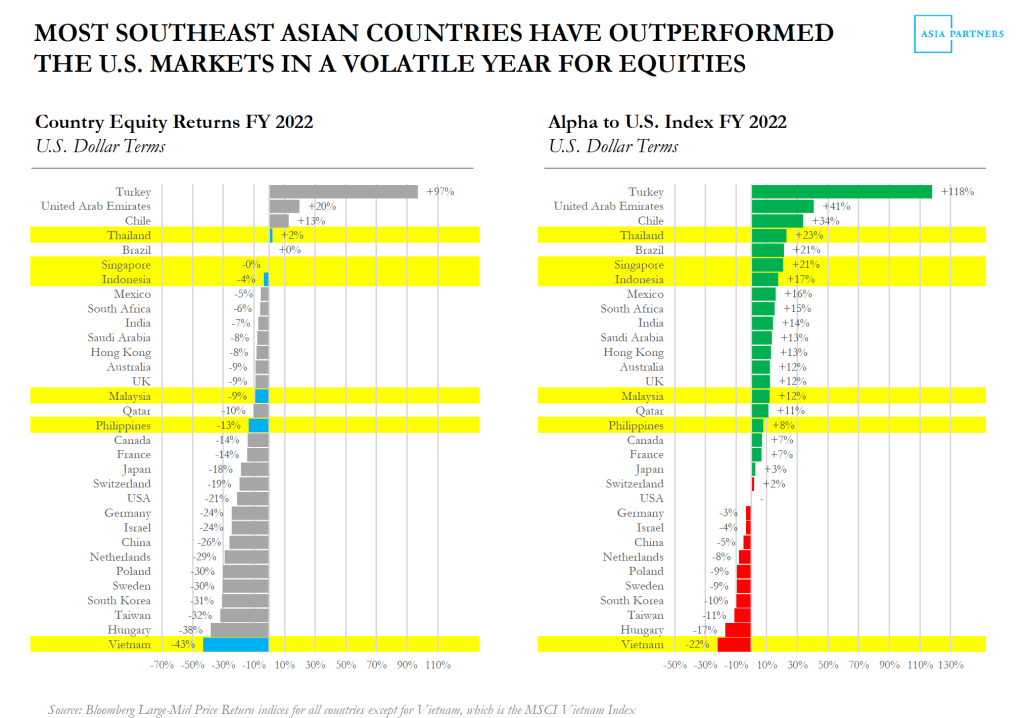
The reasons are many, but here’s a nugget: Equity returns in all Southeast Asian countries (with the exception of Vietnam) have outperformed the US markets despite a volatile 2022.
The full report (which you can download here), containing some 330-plus pages of analysis and data, is well worth your time. But as always, this article will give you a summary of the report’s key insights.
This year, we’ll focus on where and when the next breakout IPOs might be found in Southeast Asia.
Watch your VIX
Perhaps a predictor of when tech listings might happen is the CBOE Volatility Index, or VIX in short. Investopedia describes VIX as a “real-time market index representing the market’s expectations for volatility.”
Generally, the higher the VIX, the stronger “the level of risk, fear, or stress” in the market, which naturally makes it less conducive for public listings.
But where’s the pain threshold? Asia Partners has found that capital raised by tech IPOs “drop off dramatically above a VIX of 25.”
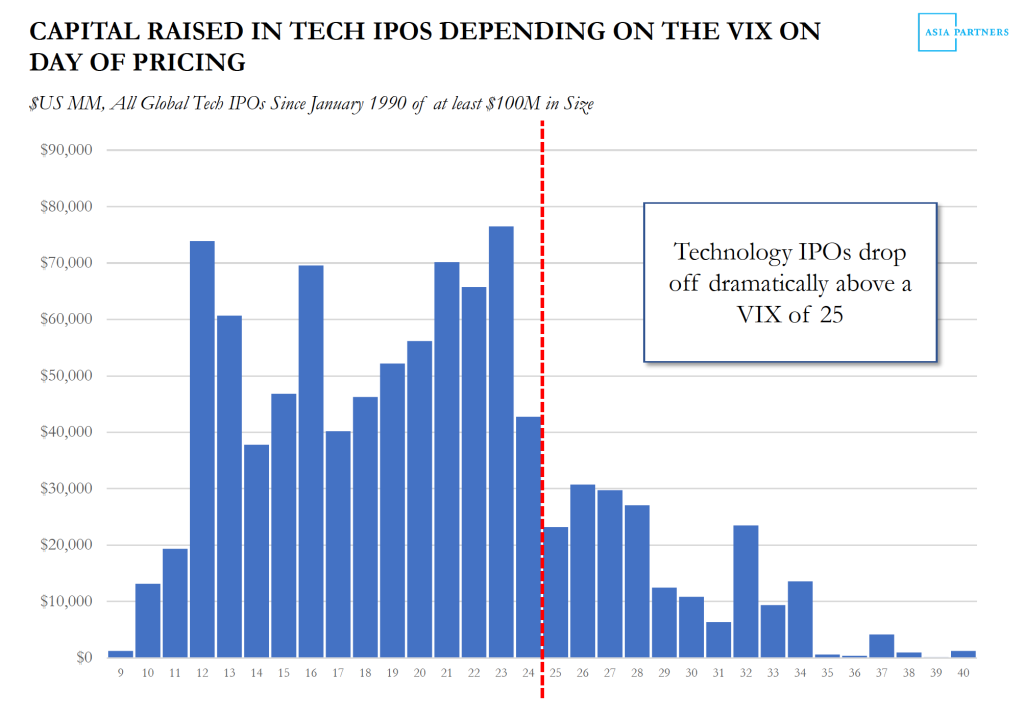
Predictably, periods of elevated VIX figures roughly correspond to dry spells in capital raised by IPOs globally.
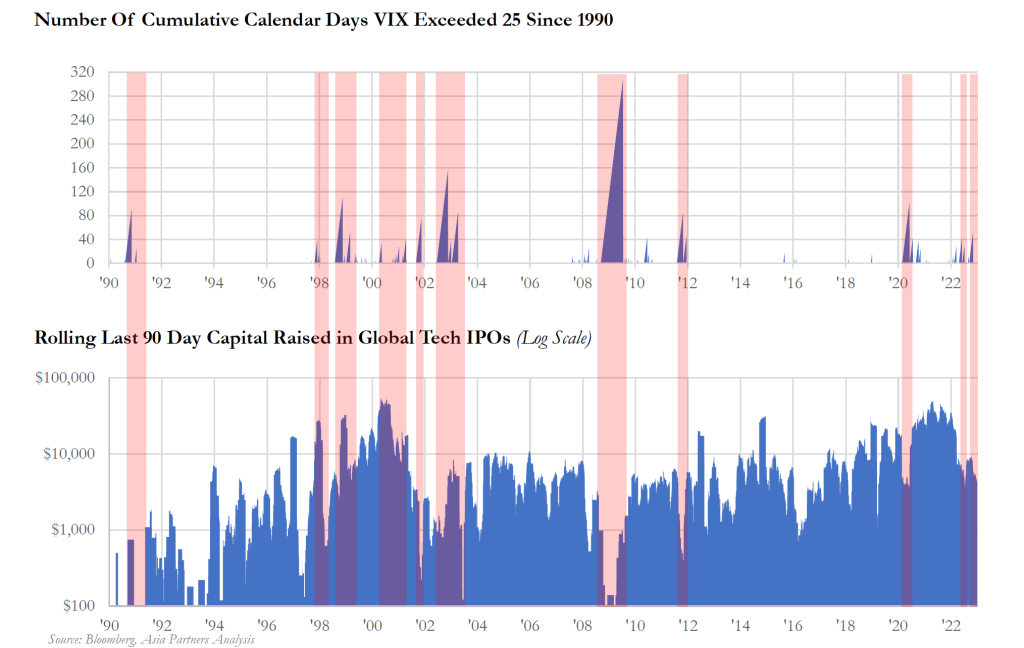
Although the VIX has fallen below 25 since November of last year, we may not necessarily see a huge wave of IPOs in 2023.
Granted, Vietnamese gaming giant VNG and electric vehicle maker VinFast as well as Indian babycare brand Mamaearth are gearing up for their public listings, but many investment bankers and tech companies may still be waiting for blue skies before pulling the trigger.
The lingering recession cloud
While economists and analysts may disagree on the size and scope of a recession, a commonly held view is that we have not felt the brunt of it.
An inversion of the US Treasury yield curve is found to predict recessions by six to 24 months in all but one instance.
Because the curve inverted in July last year, there’s a chance that we will enter a recession between January 2023 and July 2025.
How do we know we’re in one? Although a decline in a country’s gross domestic product is the orthodox indicator, we can also take a look at the earnings per share of the S&P 500 stock market index, which takes a hit during a downturn.
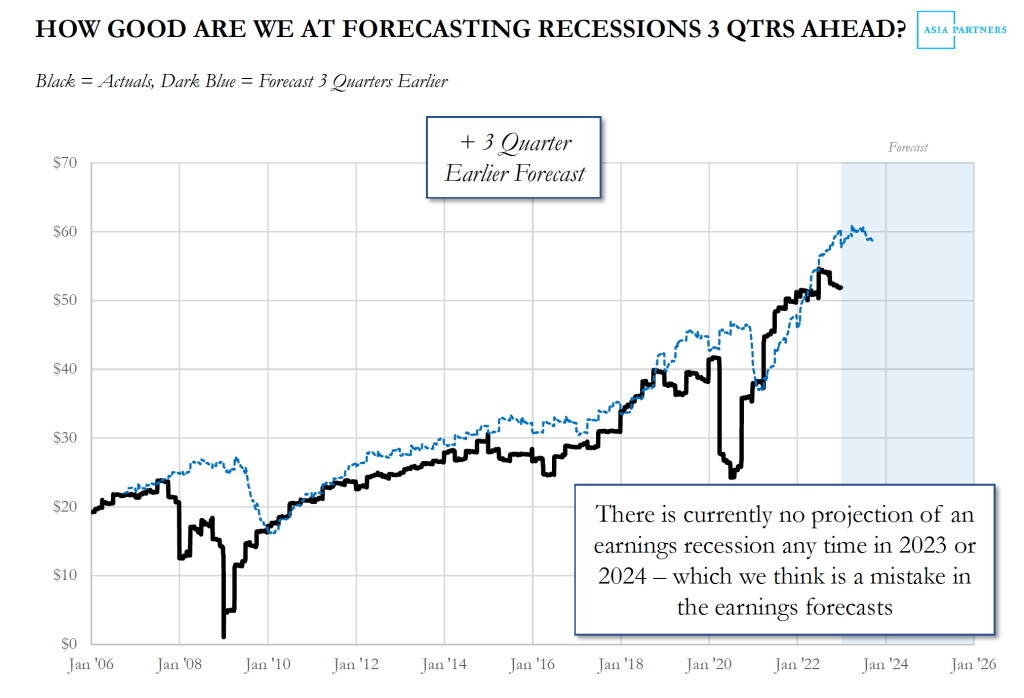
Notably, we’ve not seen a recession plunge yet, nor are the projections anticipating one – which Asia Partners contends could be a mistake.
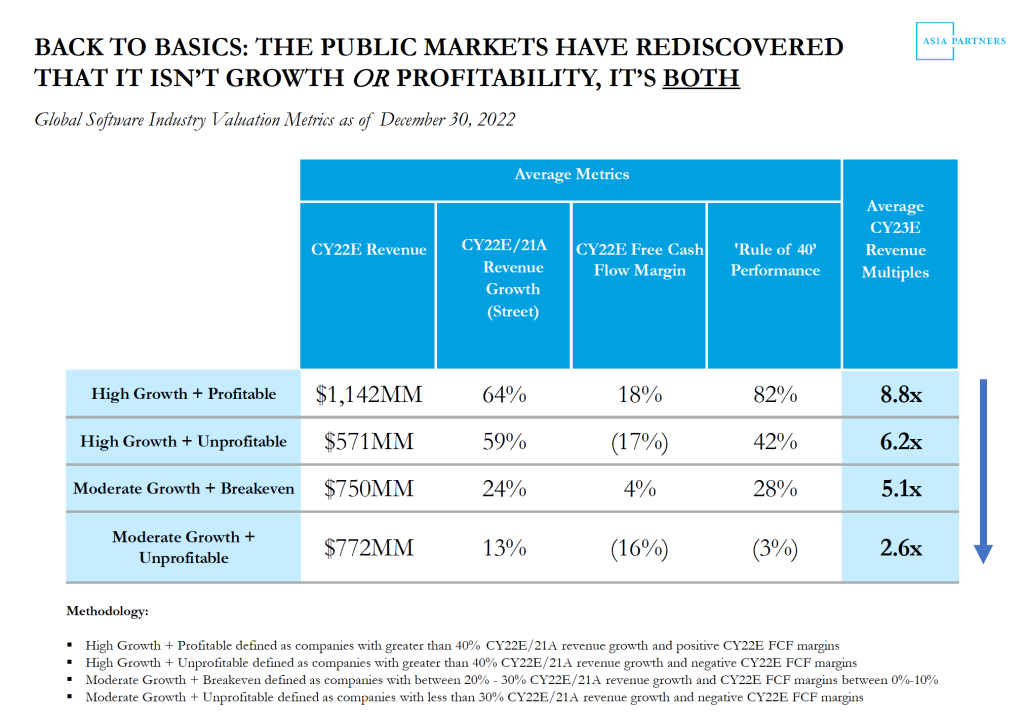
What does this mean for tech companies? The shadow of a recession means that capital will remain scarce and that markets will favor high-growth companies that are profitable over those that are not.
The rise of “frugaltech”?
Looking at Southeast Asia, who are the likely IPO candidates that will emerge in the years to come? We can make some predictions a few years out based on a couple indicators.
One, Asia Partners believes that China provides a roadmap for Southeast Asia’s tech industry.
It’s like piecing together a jigsaw puzzle: If there was a major listing in an industry vertical in China but the lack of an equivalent in Southeast Asia, you can bet that some company will fill that vacuum in the near future.
And two, the inflation rate. To be specific, a period of high inflation can signal which companies are likely to thrive.
Asia Partners notes that companies providing affordable consumer products and services tend to create substantial value after price hikes. The 1991 spike, for example, saw Costco, Home Depot, Walmart, and Southwest Airlines deliver outsized returns for investors.
Closer to home, Indonesian convenient store chain Alfamart has seen its stock price nearly triple over the past year.
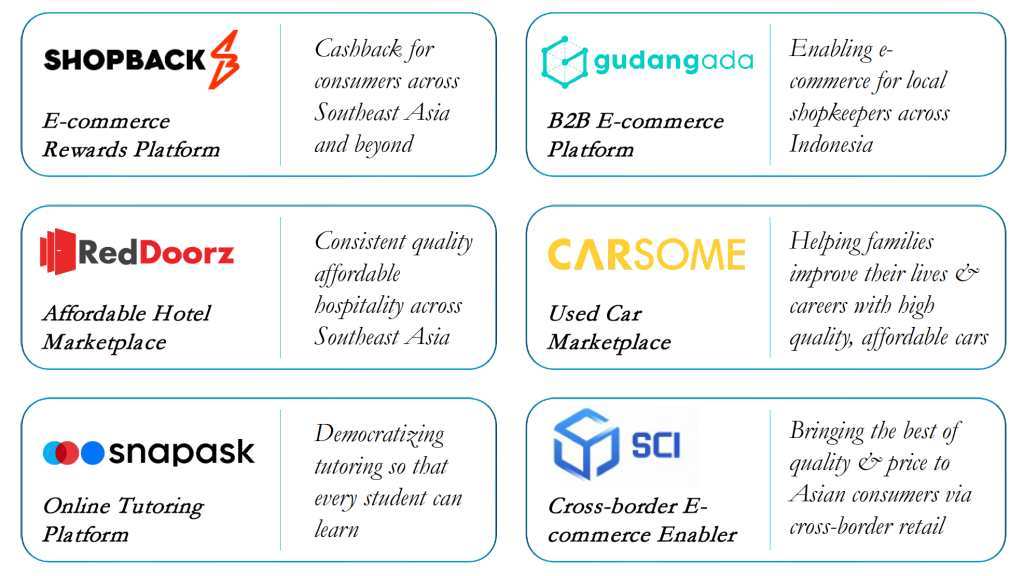
With this trend in mind, Asia Partners believes that “frugaltech” – internet platforms that help consumers save cost – will prosper in the coming years.
Naturally, it considers a number of its investees as frugaltech firms that also fit into the China roadmap nicely:
It’s the people, stupid
Any discussion about a region’s potential would be incomplete without considering the people that tech companies serve and the people that work within these firms. Both groups provide room for optimism.
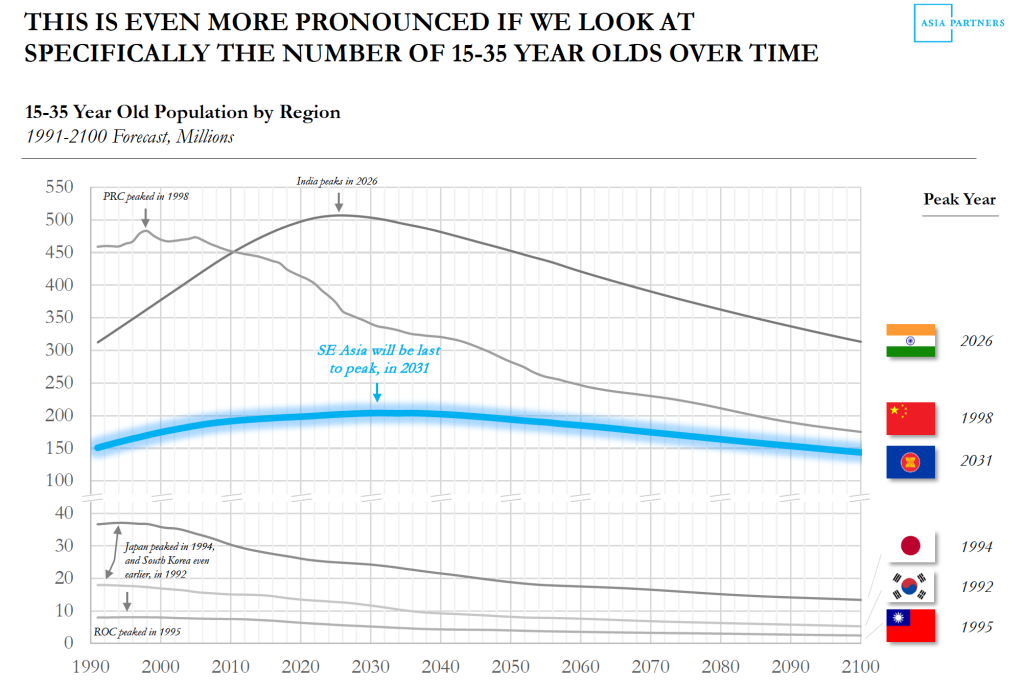
Zooming out, we see that the population of the coveted 15- to 35-year-old age group in Southeast Asia is estimated to peak in 2031.
If we look closer at individual countries, we find that Indonesia’s and the Philippines’ youth populations will peak in 2032 and 2055, respectively.
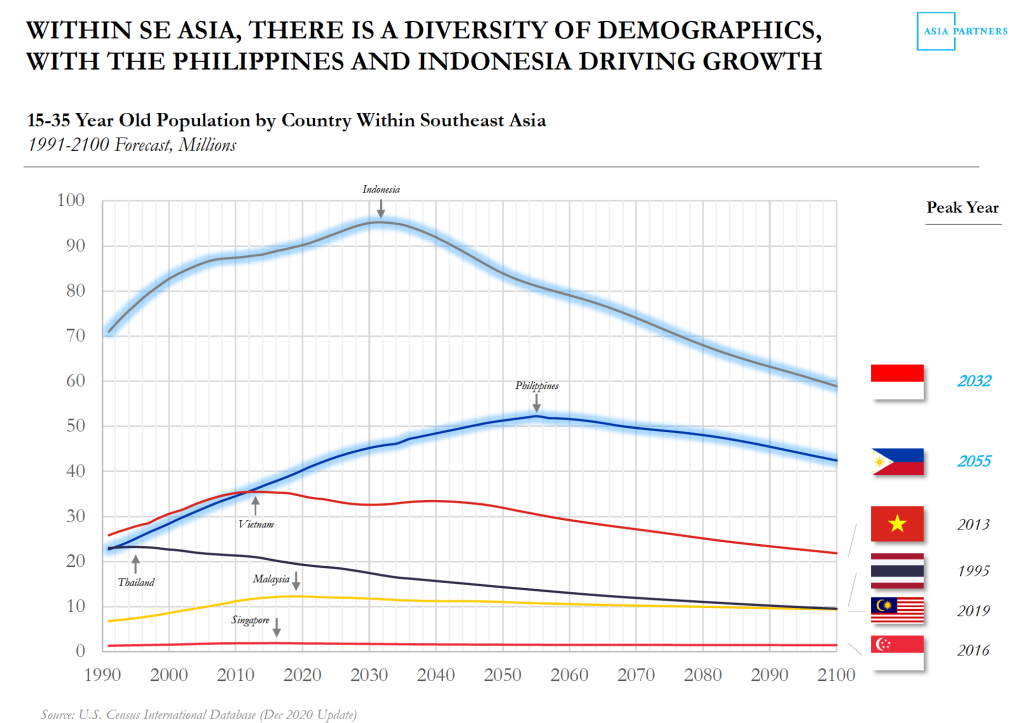
The data indicates a growing market for tech companies and, potentially, a larger population of salaried workers with spending power.
It could also signal a coming demographic dividend, in which falling fertility rates combine with declining death rates to create an economy with accelerated productivity and development growth.
On the talent front, Asia Partners observes that Southeast Asia has a sizable pool of over a thousand startup founders and CEOs hailing from top universities in India and China, with most of them residing in Singapore.
It’s also noticed more poaching between Southeast Asian tech companies, a contrast from years ago where the talent inflow would hail mostly from management consulting firms, IT services, and telcos.
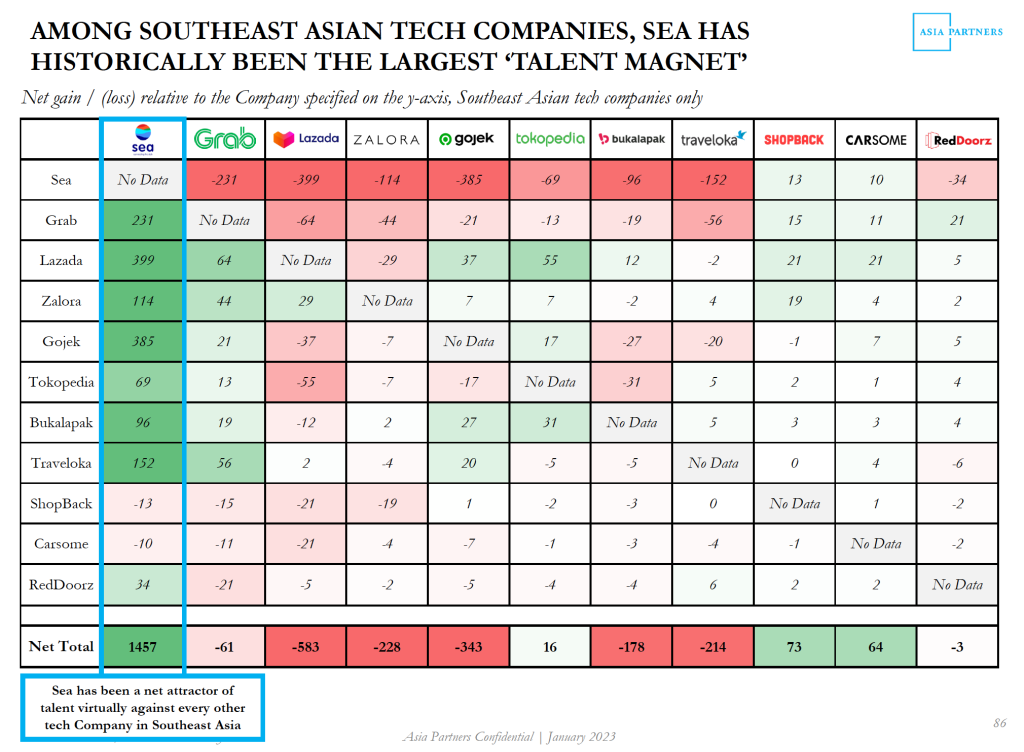
Sea Group, in particular, has poached liberally from Grab, Tokopedia, Lazada, and Gojek. Recently, however, Sea is seeing an exodus of talent to ByteDance.
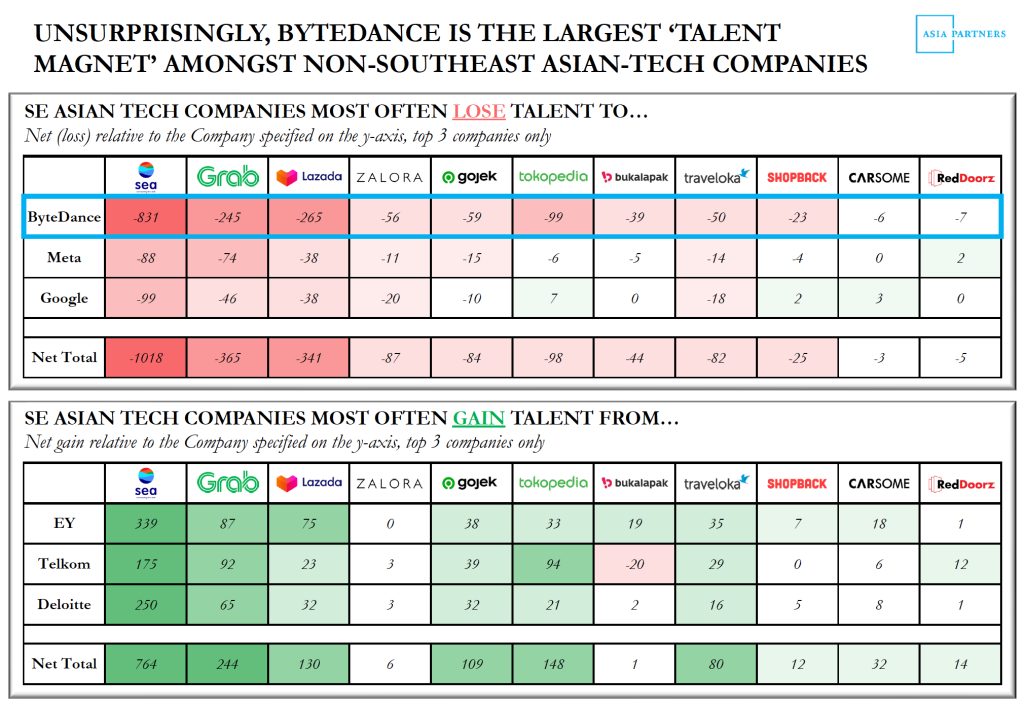
While no company wants to lose its top talent to poachers, the circulation of staff could be a win for the ecosystem as it creates a stronger pool of next-generation founders and tech workers that have absorbed knowhow from major tech firms.
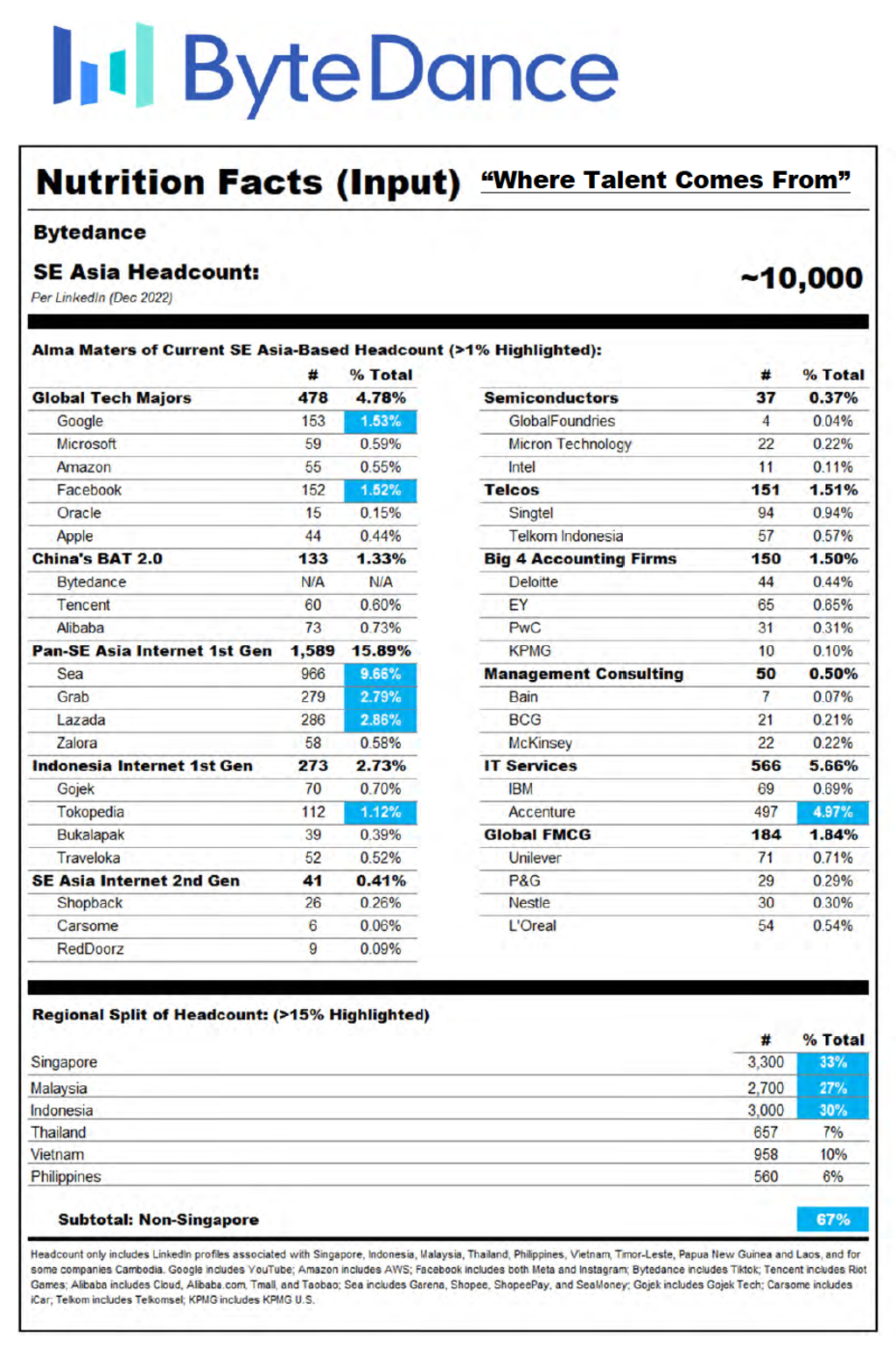
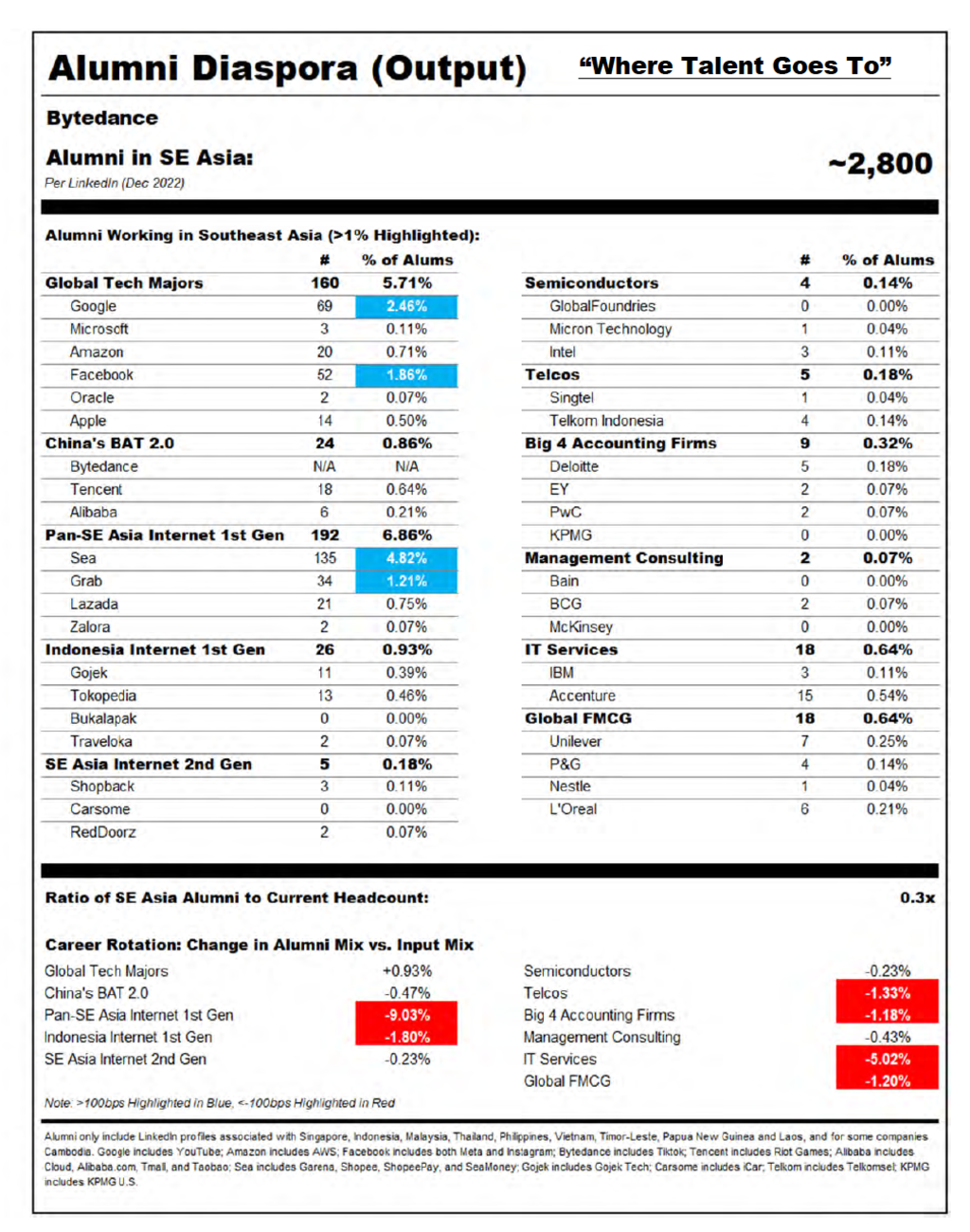
It’ll be worth watching what the ByteDance alumni will do next. The following “nutrition facts” of the company shows where its talents are coming from and where they’re going to.
Perhaps we might see new names emerge on the labels in the future.
A dream destination for tech listings?
The US equity markets will remain top of mind for Southeast Asian companies as a destination, although local exchanges are prepared for a fight.
Bolstering the case for local listings is the fact that returns of equity markets in Indonesia, Thailand, and the Philippines have outpaced the US over a 22-year period, Asia Partners finds.
The Philippines and Thailand are also seeing their stock markets grow in proportion to economic growth – a situation that Asia Partners sees as ideal.
The stock markets in the remaining major Southeast Asian countries, however, are not capturing as much value from their economic growth.
This is being addressed. Indonesia’s IDX has revamped its listing rules and GoTo raised US$1.1 billion by holding its IPO in its home country. That said, the collapse of GoTo’s stock price from close to 400 rupiah (US$0.026) to 96 rupiah (US$0.0063) in December of last year might give some companies pause.
Meanwhile, Singapore’s SGX is looking to bolster its attractiveness for tech IPOs through 65 Equity Partners, a Temasek investment fund that aims to help companies raise money in the city-state’s public markets. Two of its investees are Carsome and ShopBack, which also happen to be portfolio companies of Asia Partners.
On tech listings, perhaps it’s not just the questions of when and what that are the most interesting, but where as well.
You can download the full report and learn more about Asia Partners here. You can also check out a documentary based on this report here.
Stay updated on the go with our mobile app.
Get latest insights with smoother, more personalized experience through TIA mobile app.
Recommended reads
 SG fintech firm banks fresh capital for global expansion
 Baozun completes acquisition of Gap Greater China
 Sequoia India and SEA rebrands as Peak XV Partners
 Gobi-backed EWA firm Paywatch expands to Indonesia
 SEA’s IPO market fares relatively well amid global downturn: EY report
 Chinese fintech firm IceKredit gears up for SEA expansion
 Stars align for Astrotalk as it nets $20m fund for international expansion
 SG wireless startup to expand in SEA, US with $10m raise
 Fave co-founder and CEO Joel Neoh to step down
 Bukalapak JV to boost stock trading in Indonesia with new scheme





Editing by Lorenzo Kyle Subido
(And yes, we’re serious about ethics and transparency. More information here.)