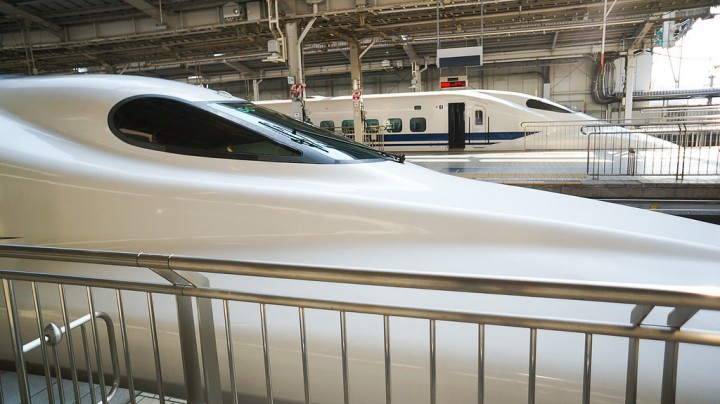
Japan’s Ministry of Land, Infrastructure, Transport, and Tourism today approved an application by Central Japan Railway Company to build what may become one of the world’s fastest commuter trains. The ultra high-speed magnetic levitation (maglev) train, slated for completion by 2027, will connect Tokyo and Nagoya and travel at speeds up to 500kph (311mph). It will cost and estimated 5.5 trillion yen (US$51 billion).
One of the country’s currently-operational bullet trains, known as shinkansen in Japanese, carries passengers between the two cities in about 100 minutes. The new maglev train will cut that commute down to only 40 minutes. According to The Japan Times, engineers will have their work cut out for them, as roughly 86 percent of the maglev track will require the construction of tunnels – some deeper than 40 meters below ground.
A proposed extension of the upcoming maglev track by train operator JR Tokai, tentatively set for 2045, would connect Tokyo and Osaka in just 67 minutes – down from an existing travel time of 153 minutes. That stretch is projected to cost 9 trillion yen (US$85 billion).
Japan’s new maglev train is blazing fast, but it may not be the fastest – especially by the time it opens to passengers in 2027. The Shanghai Maglev Train (SMT), in service since 2004 on a 30km route from the edge of the city to Pudong International Airport, already reaches a “top operational commercial speed” of 431kph (268mph) – and it only cost US$1.2 billion to build. In a 2003 test run, SMT reached 501kph – one kph faster than Japan’s maglev reached in tests last month.
See: High-speed trains in China to get wi-fi
Even 501kph pales in comparison to the top speed of a sci-fi inspired maglev train being designed by scientists at China’s Southwest Jiaotong University. They theorize that an ultra high-speed maglev train traveling in a vacuum – without that pesky thing called air resistance – could reach speeds of 2,900kph (1,800mph).
Source: The Japan Times
Editing by Paul Bischoff, image via Flickr user Antonio Tajuelo
(And yes, we’re serious about ethics and transparency. More information here.)





Stay updated on the go with our mobile app.
Get latest insights with smoother, more personalized experience through TIA mobile app.