Jack Ellis · · 3 min read
Singapore opens its skies to commercial and government drones
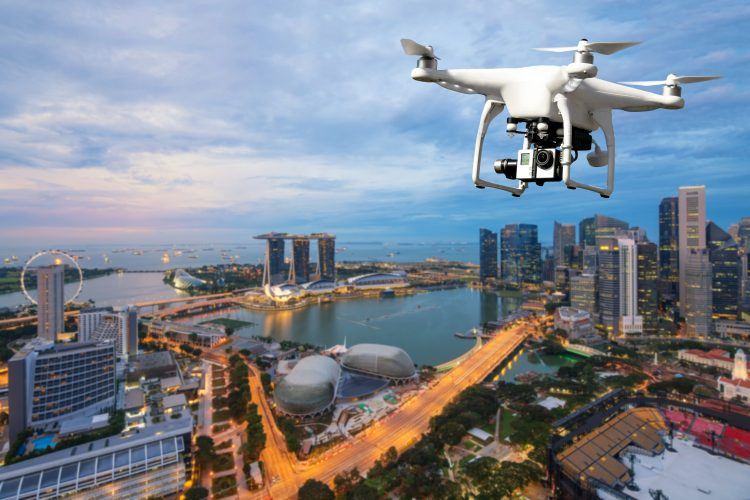
Photo credit: ake1150 / 123RF
A consortium led by startup Garuda Robotics has been selected to create an air traffic control system for drones in Singapore, as skies over the city-state are increasingly abuzz with unmanned aerial vehicles (UAVs).
The Garuda-led Future Flight Consortium submitted its proposal after Singapore’s Civil Aviation Authority (CAA) and Ministry of Transport called for the development of an unmanned aircraft systems traffic management (UTM) framework in November last year.
The ministry and the CAA recognized the need for a UTM as the existing regulatory framework isn’t up to scratch when it comes to accounting for a range of possible applications for drones, such as package delivery, buildings inspections, and security surveillance.
Future Flight Consortium said its proposed system will enable beyond-visual-line-of-sight (BVLOS) flight operations in Singapore’s urban environment. In other words, it will allow for remotely controlled flights, where pilots can be located in central operation bases and don’t need to be in eyesight of the drones they’re flying.
At the moment, such drone tests are limited to a “drone estate” in the city-state’s One North business district.
Over a two-year period, Future Flight Consortium’s members will collaborate to trial their technologies, piloting from a centralized Drone Operations Center in order to “demonstrate the reliability and safety of the system.”
“Our goal is to make it possible for any enterprise who needs to fly drones BVLOS in Singapore to easily do so in a safe and effective manner,” said Ong Jiin Joo, Garuda’s chief technology officer and Future Flight Consortium’s project director.
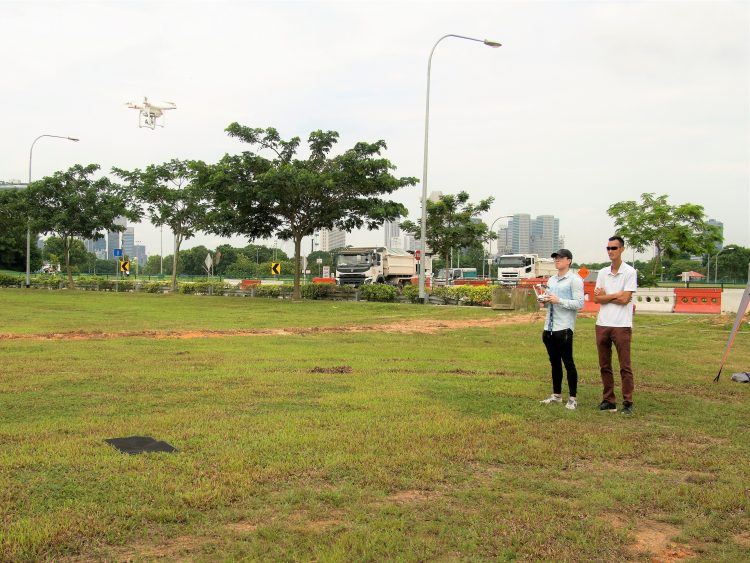
The proposed system will allow for remotely controlled flights, where pilots don’t need to be in eyesight of the drones they’re flying. / Photo credit: Garuda Robotics
Two other consortium members – Skyfront and the Singapore Civil Defence Authority – are exploring how BVLOS drones might be used to deliver supplies in emergency “first responder” situations.
Parkway Pantai – which runs four hospitals in Singapore – is also a member. It wants to trial the transfer of blood and other specimens by drone between its hospitals and its central lab.
Other members of the Future Flight Consortium include Singtel, Arete-M, AirMap, Gemalto, Flare Dynamics, Volans-i, University of Glasgow, Acorn International Network, and Security Industry Institute.
Ready for take-off
Research suggests that people in Asia Pacific are ready to embrace UAVs in their everyday lives. US payments firm Worldpay recently asked consumers in the region how comfortable they would be with deliveries and other services provided by drones.





Stay updated on the go with our mobile app.
Get latest insights with smoother, more personalized experience through TIA mobile app.