 Raja Jamalamadaka · · 7 min read
How to stay relevant in today’s rapidly-changing job market
As I celebrated my birthday last week, I reflected on the past year. Four unrelated episodes played on my mind:
- My close relative hasn’t had a full-time job in over a year. He’s well educated, has worked for Fortune 500 companies, and has 20 years of work experience. But despite these, he couldn’t find a suitable opportunity.
- My friend, the CEO of a mid-sized company, was going through a tough time. Poor market conditions outside his control had brought his company down to its knees.
- Several startup CEOs complained to me about reduced funding, leading to staff reduction. Their employees were frustrated that they had to face the brunt of this.
- A few of my acquaintances were in the job market for months. They felt helpless that a weak market, reduced funding, and other factors outside their control were responsible for their failed job search.
Helplessness is the common theme in all four scenarios.
I wondered, “How can these ‘helpless’ people help themselves?” Then I realized that all these episodes had a common thread: an inability to recognize, understand, and adapt to the tectonic shifts in the corporate world.
Factors that affect our employment, like disruptive innovations, government policies, and such, seem totally out of our control. But the truth is people and their actions (or inactions) have a major role to play in the outcomes of their professional lives.
A deeper understanding of how trends work and how we can ride the trend curve can help us adapt better to the business environment.
Looking at the organization trend curve
Let’s start with the movements of the market (what we’ll call trends).
A trend can be anything that changes the status quo. It can be in the form of a method, process, or technology. Every trend leads to an advancement.
Here are some examples:
- Financials were prepared manually for years (trend 1). They then graduated to spreadsheets (trend 2) and moved on to enterprise resource planning (ERP) (trend 3).
- Performance reviews used to be tracked manually (trend 1). They then moved to the bell curve system of appraisal (trend 2) and then to continuous feedback (trend 3).
- Lower-level languages used for application development (trend 1) are replaced with higher-level languages (trend 2). They’ll ultimately go obsolete with the rise of robotic programming and AI (trend 3).
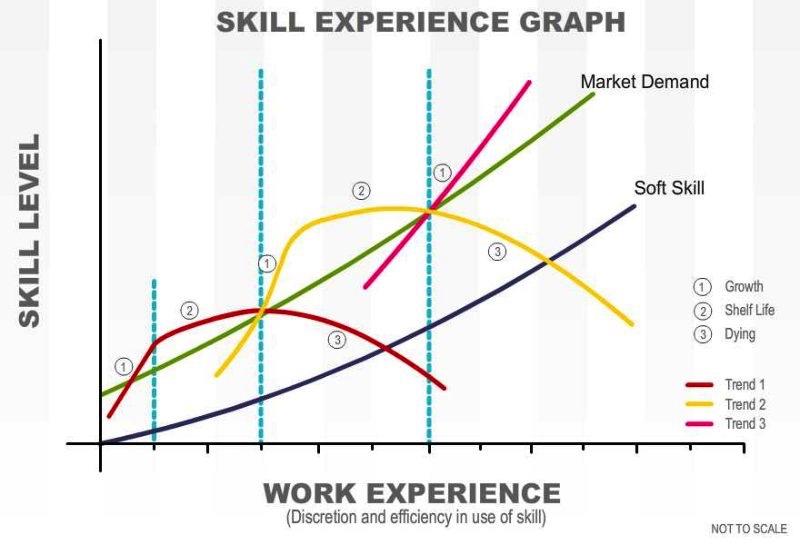
Trends in the industry follow set patterns that can be represented by a curve. Regardless of industry or geography, every individual is somewhere on this curve. The exact location has a large role to play in an individual’s career.
Let’s study the trend graph:
Phase 1
So why do people ignore this knowing the consequences?
Comfort zone
How do you escape the comfort zone?
Continuous learning
Soft skills





Stay updated on the go with our mobile app.
Get latest insights with smoother, more personalized experience through TIA mobile app.










📅 Upcoming Events
22 October 2026
Payoneer x CSPN Summit 2026