Josh Horwitz · · 6 min read
Hive.im hopes to turn unlimited cloud storage into something social, fun, and free

Is cloud storage a commodity? That’s a question that’s been on the minds of investors and industry specialists over the past six months. Giants like Google and Amazon continuously lower their monthly storage prices in what looks like a race to the bottom. Meanwhile, high-profile startups like Dropbox and Box have delayed their IPOs, indicating that the Apples and Microsofts of the world might be stunting their growth.
Other cloud storage companies have zeroed in on specific verticals or (sometimes minute) problems in hopes of differentiating themselves. SugarSync, Cubby, SpiderOak, Bitcasa, and a slew of other startups claim their storage service is better, cheaper, more secure, and more flexible than other high-profile competitors.
Perks aside, in the eyes of the consumer that’s only looking to store a few movies and some guitar tabs, one key ingredient is missing from most cloud services – fun. For better or for worse, most cloud storage services are the virtual equivalent of an actual urban storage space: no frills, visit only when needed, and bring your flashlight because it’s dark in there.
Hive.im, a Hong Kong-based startup with staff in Eastern Europe and California, is hoping to win over average consumers with some visual sheen and a social spin. Even though it’s built on a folders-and-files scheme, a cruise through the website and reveals how Hive stands out from its competitors. Files are laid out thumbnail style, and can be accessed inside Hive’s web app through a built-in media player. Individual storage collections are called hives, and users are encouraged to share their hives with friends they invite onto the service.
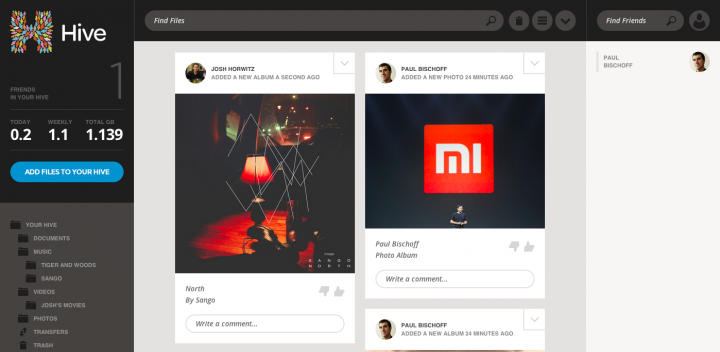
It’s still a storage service through and through, but in Hive’s case, a little branding and design go a long way. Individual Hives feel less like utilitarian warehouses and more like personal treasure chests you can show off to friends. Founder Thierry Lehartel tells Tech in Asia that this minor reinvention of the concept of storage – one that’s more about “collecting” than “storing” – addresses a genuine market void.

“We don’t want to be a utility, we want to be a destination,” says Lehartel. “When you think of media, you think of Facebook, because that’s where people go to share media. You don’t think of Dropbox, even though that’s where people store media. Dropbox still follows a very standard taxonomy – you have folders, you have files, you have links, and you can share a link. It’s damn simple and has a fairly lean UI, and they’ve done a fantastic job. But I don’t think they’ve created a UI that drives engagement.”
“There’s a social aspect to cloud storage that hasn’t been tackled,” he adds. “At the end of the day you want to use cloud storage to manage your data. But the question that hasn’t been answered is, “How can we have users share their data in a way that fits the cloud storage model?
With so many other storage options available, Hive has to fight hard to get users to sign up. Moreover, since Hive, in theory, is more fun when one’s friends are on it, the company looks set to face the same chicken-and-egg problem most social networks face: users won’t join unless other quality users are on it, but how can one attract those quality users in the first place?
Lehartel hopes to clear this hurdle by ditching the preferred business model of like-minded companies. Instead of charging for set storage amounts – free 20GB, 50GB for US$10 a month – Hive will offer unlimited storage, completely for free. Users who pay monthly subscription fees can access higher-quality media streaming. Premium pricing decreases as a user invites more and more friends onto Hive.
Hatching the honeypot





Stay updated on the go with our mobile app.
Get latest insights with smoother, more personalized experience through TIA mobile app.