Tim Romero · · 5 min read
How this founder moved to Japan, quit a lucrative job, and built a startup
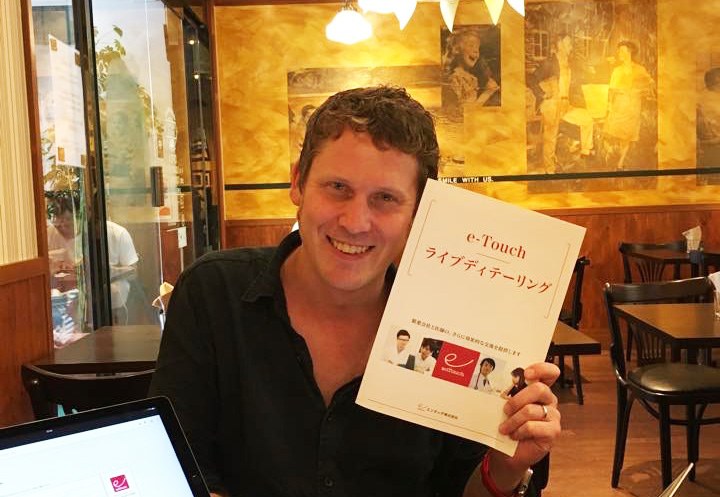
Marty Roberts, founder of enTouch.
This article is part of Tech in Asia’s partnership with Disrupting Japan where we publish the revised transcripts from the show’s podcast interviews with Japanese entrepreneurs. This is heavily revised from the original transcripts. For the full interview, go here.
Marty Roberts is the founder of enTouch, a platform where medical sales representatives can explain new drugs to doctors online rather than face to face. In this interview, he explains a little more about the company and how he moved from New York to Japan and jumped from a well-paying job to start his own startup. He also shares some advice for those thinking to do the same.
See more: Medtech startup offers a cheaper alternative to pharmaceutical sales ‘armies’
Can you explain what enTouch does?
EnTouch is focused on helping pharmaceutical companies communicate better with doctors so that doctors know about the newest medicines and trends in healthcare. Pharmaceutical companies spend huge amounts of money (US$20 billion a year) promoting drugs to doctors in Japan, and they do it with high-priced sales reps/medical reps.
These reps are always trying to catch doctors in hospital hallways to explain these new medicines to them. They spend a vast majority of their time waiting because doctors just don’t have the time. We try to flip this around by enabling doctors to request for more explanation online.
Can you tell us a little about yourself?
When I was finishing my doctorate, I started working at Forest Laboratories, a pharmaceutical company, in their market research division. But I was quickly headhunted by a French company called Cegedim to build their patient data business in the United States. It was a French company, so the boss was flying in from Paris. I lived in Brooklyn and he was staying in Manhattan. So, I would pick him up every morning when he was in the US, take him to the office, and drop him off.
We became really good friends, and at one point he asked me, “What do you want to do?” I said, “I don’t know. I want to move?” He asked me where, and I gave him a list of countries—France, Germany, India, Japan. Then he said, “I need someone in Japan. You’ll go.” So I sold everything, took two bags, and got on a plane to Japan.
In the Japan office, he wanted me to do similar things. We started running a patient data business, a market research company, and then they also asked me to run a publishing company. After a while, they asked me to also run their software company, which was focused on a Salesforce automation software for medical reps.
When I was overseeing both businesses, I saw the data coming in from the Salesforce automation software, where the medical reps inputted how many visits they had, what they discussed with the doctors, and how impactful they thought that sales call was. Then on the market research side, we had a panel of doctors who were reporting who actually visited them, what they remembered the person saying, and how impactful the sales call was for them. And when I started looking at how much pharmaceutical companies were investing in this, I thought that there’s got to be a better way.
I started looking at models throughout the world. We saw a few different things and quickly copied it in Japan. We actually acquired one of the companies I was looking at, localized their software, and started shopping it around. But I quickly realized that software itself wouldn’t be enough. If you look at what’s going on in the Japanese market, you can’t just say, “We bought this new software. Everyone use it from Thursday onward.”
Why didn’t it take off in Japan?
No one wanted to use it. If you are a medical rep, you probably took the job because you liked having freedom, having the doctor be your customer, driving to him/her, and being your own manager. If you start sitting behind the computer all day, it’s a different job that requires a different personality profile and skill set.
So, I realized that just selling software isn’t going to work. We had to enter the market as a service provider instead of focusing just on the IT.
What made you decide to start your own company?
It was a really great experience running Cegedim because I was exposed to a lot of business aspects that I otherwise wouldn’t have been. But to be honest with you, I was not particularly interested in all of them.
How did you navigate jumping ship at that point?
How did you go about starting a company?
What was the biggest surprise when you quit your job to start a startup?
What’s your advice for people leaving a well-paying job to start a startup?





Stay updated on the go with our mobile app.
Get latest insights with smoother, more personalized experience through TIA mobile app.