- Premium Content It takes our newsroom weeks - if not months - to investigate and produce stories for our premium content. You can’t find them anywhere else.
 Melissa Goh · · 7 min read
Rlwrld takes aim at US robotics giants with new foundation model
Asia may have gotten off on the wrong (late) foot on large language models, but with physical AI, the tables can still be turned.
That’s what Jung-hee Ryu, CEO of South Korea-based robotics firm Rlwrld (pronounced real world), firmly believes.
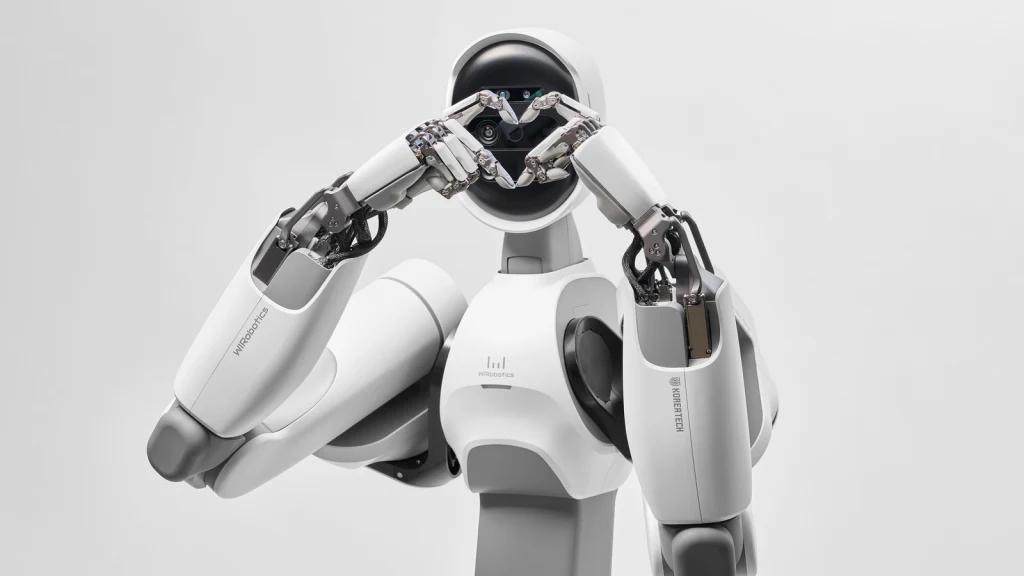
ALLEX, the humanoid robot Rlwrld co-developed with South Korean robotics company WiRobotics, has a robotic arm with 15 degrees of freedom / Photo credit: WiRobotics
His company is developing advanced hand movements for robotic arms as well as a foundational visual language action (VLA) model, RLDX, which determines how robots perceive the real world and translate natural language prompts into action.
Visual language models (VLMs) map the relationship between text and visual inputs like videos and images and can describe images or answer questions about what they see. VLAs extend this by converting this capability into physical actions.
East Asia may have lost its chance to enter the foundation model market against US firms like Google and OpenAI. But while Western players benefitted from the wealth of language data available on the web needed to train large language models, they don’t have the same advantage in real-world data needed to train robots, Ryu points out.
Rlwrld is going up against well-heeled rivals in the US like Physical Intelligence and Skild AI, which this month raised US$1.4 billion from a SoftBank-led round. Nvidia also offers its own open-source robot foundation model, Gr00t.
VLA models like “Nvidia’s Gr00t or Physical Intelligence’s π0 are widely used by research labs and some industries, but I believe that our model is in some viewpoints better than them,” Ryu says.
Rlwrld’s edge will likely be in its model’s dexterity and the company’s access to real-world data from some of its strategic investors.

Photo credit: Rlwrld
Among Rlwrld’s investors are large South Korean conglomerates like SK Telecom, LG Electronics, CJ Logistics, and Japan telecommunications firm KDDI.
The firm says it is already collaborating with some of its strategic backers on various initiatives, including “joint projects that involve data utilization.” The firm will also be combining this with synthetic data that’s generated based on real-world data points.
By collecting industrial data from partners like KDDI and major South Korean hotel chain Lotte Hotel & Resorts – which the firm will begin doing this quarter – data sets that Rlwrld’s model is trained on will reflect the complexity and variability of actual manufacturing and logistics sites.
More than “dancing, kicking, flipping”
It starts with data
It’s win-win
Stay ahead in Asia’s tech landscape
This is premium content. Subscribe to read the full story.
Asia may be late to large language models, but not in foundational models for robots. This South Korean firm claims its version can outbeat US ones.
We know this is not ideal. ⌛ Sign up in 20 seconds. Cancel anytime.
Our subscriber community includes professionals from these companies:





Stay updated on the go with our mobile app.
Get latest insights with smoother, more personalized experience through TIA mobile app.