Steven Millward · · 5 min read
This Is Why Vietnam Plans To Ban Social Media Sharing of News
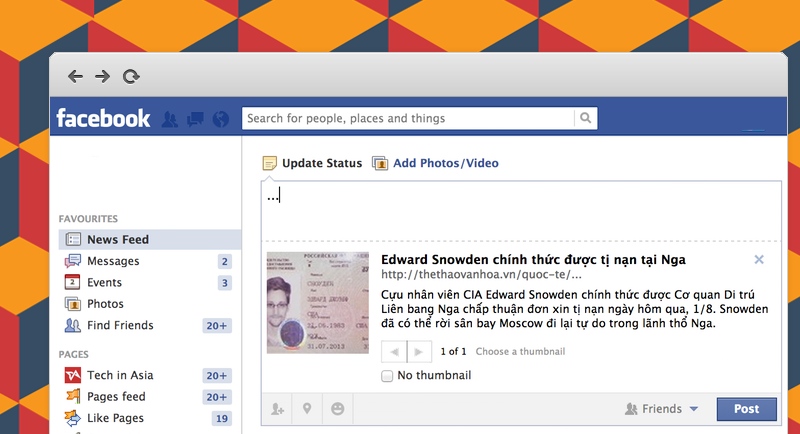
This is what Vietnam wants to stop people doing?
The Vietnamese government announced today a new law relating to the sharing of news online. It effectively bans social sharing of news links on sites like Facebook and other news aggregation platforms. The main idea is, according to Hoang Vinh Bao, director of the Broadcasting and Electronic Information Department at the Ministry of Information and Communications:
Personal electronic sites are only allowed to put news owned by that person, and are not allowed to ‘quote’, ‘gather’ or summarise information from press organisations or government websites.
The law also bans:
…information that is against Vietnam, undermining national security, social order, and national unity […] or information distorting, slandering, and defaming the prestige of organisations, honour and dignity of individuals.
Media outlets like ABC, the Bangkok Post, and Saigoneer have been crying foul on the new decree, hinting that it is closely related to human rights violations. But those in the industry know there are two sides to this story.
This decree is actually related to a case we covered earlier this year wherein Bao Moi, the local news aggregator, was sued by a local newspaper for copyright infringement. The decree is a follow-up on newspapers protecting their copyrights, and essentially their businesses. In other words, it’s a ban on copying and pasting news content into other platforms, namely social media.
One side of the coin: Vietnamese newspapers struggle to survive
Probably more than any other industry in Vietnam, journalism is severely under assault. Mainly because the practice of copying and pasting articles is rampant. For example, let’s look at a satirical article that we published on Apple in Vietnam last month. For the last two days, it has been circulating in Vietnamese under the title “Duc Nam from Infonet”. There’s no credit to the writer, and no link here to TechInAsia. But this doesn’t just happen from English into Vietnamese (although it does happen on a large scale), it also happens between Vietnamese news sites.
Even the most popular Vietnamese news sites are satisfied with copying and pasting content and just writing “From so-and-so” as a footnote at the bottom of an article. Most of the time, the articles aren’t linked at all. This is all extremely frustrating for real news organizations who put in all the money and work to find and build stories but then don’t get the hits and views – and meagre ad revenue – they deserve. In other words, some sites out there are copying and pasting content for free and profiting off of it.
For news organizations the world over, this is already a serious concern; their survival is being threatened by new types of online media and fast reblogging and copying of content. The latest decree signals one step in bringing litigation to this situation.
The other side: limiting people’s inclination to share news
On the flip side of the decree there’s the more obvious implications on individuals. After all, the decree does not exactly state how authorities plan to monitor online activity for individual infringers who post news on social sites, nor does it say how they will be punished for infringement. Social media is also a very vague term in this scenario that encapsulates a huge amount of activity on the internet today. In fact, as translated by Australia Network News, “Blogs or social media sites such as Facebook and Twitter should only be used ‘to provide and exchange personal information’” in Vietnam once this becomes law in November. That means there’s wherewithal in this decree to prosecute individuals for sharing news deemed inappropriate – or inconvenient – by authorities.
Certainly, this is some cause for concern since Vietnamese bloggers were prosecuted and arrested in the very recent past. But if this decree were to really take such an extreme turn, many questions arise.
The catch-22 of enforcement and punishment
What’s next?





Stay updated on the go with our mobile app.
Get latest insights with smoother, more personalized experience through TIA mobile app.