Sumit Chakraberty · · 4 min read
Silver lining: Infosys founders’ accelerator doubles startup intake
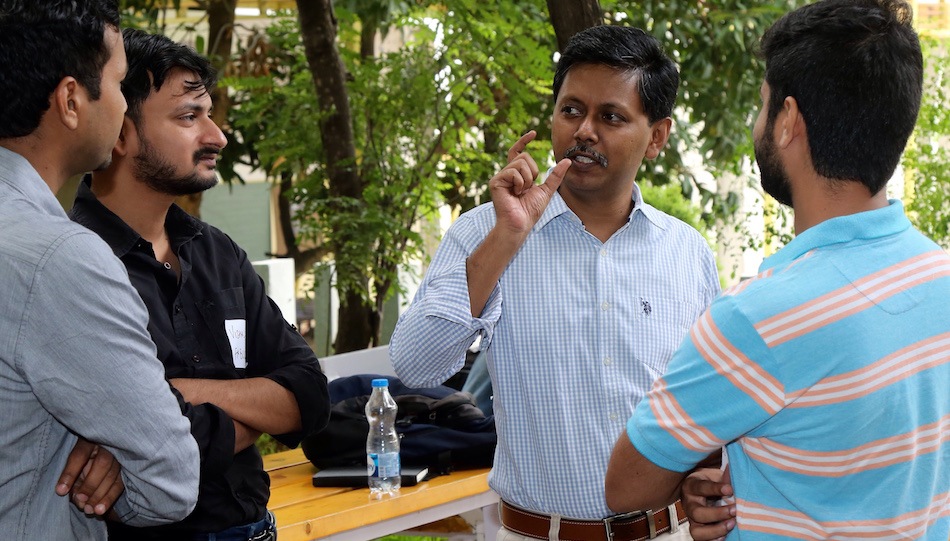
Axilor CEO and co-founder Ganapathy Venugopal chatting with founders. Photo cedit: Axilor.
Amidst the gloom in India’s startup ecosystem over a funding crunch, here’s a silver lining: Bangalore’s Axilor today announced a doubling of the intake of startups for its accelerator program.
Axilor was launched in November 2014 by Infosys founders Kris Gopalakrishnan and S D Shibulal along with Srinath Batni and Ganapathy Venugopal, who held senior positions at the Indian IT giant, and Harvard Business School professor Tarun Khanna. So far, 30 startups have gone through its accelerator program. Now, the fifth batch for which applications are open till February 23, doubles the size of the cohort to 20.
70 percent of the startups from our last batch have moved to their next stage – half of them have secured funding, one has been acquired, and the others are in pilots.
“A fast-growing base of online consumers, an enabling public digital infrastructure, growing pool of founders with prior startup experience, and increase in early-stage seed capital are creating conditions for the second wave of startups in India,” says Kris Gopalakrishnan, Axilor Ventures chairman. This is a vote of confidence in the startup ecosystem from the first generation of tech entrepreneurs in Bangalore, who created an IT services industry that accounts for a tenth of India’s GDP today.
It comes at a time when the ecosystem’s hype cycle has hit a trough of disillusionment after the inflated expectations and funding of 2014 and 2015. Over 1,000 startups shut down last year, half of which were founded in India’s takeoff period of 2013 and 2014. Mostly, they ran out of runway as follow-on funding became scarce. Several were acqui-hired in distress sales.
See: 25 failed startups in 2016 and what we can learn from them
The five-spice program

Infosys founder Kris Gopalakrishnan at a startup mentoring session at Axilor. Photo credit: Axilor.
Axilor, whose mentors try to bring system and process to startups without shackling their nimbleness and agility, appears to have mostly come out unscathed in these worst of times. “Seventy percent of the startups from the last batch have successfully moved to their next stage – half of them have already secured funding, one has been acquired, and the others are in advanced stages of pilots,” says Ganapathy Venugopal a.k.a VG, Axilor CEO and co-founder.
The new batch will have 20 early stage startups in five spaces: artificial intelligence, fintech, healthtech, enterprise SaaS (software-as-a-service), and consumer internet.
AI is the buzz everywhere this year, with impressive advances in the technology thanks to computing power. But what VG is looking for are founders grounded in the mundane world of business. “The use cases need to be understood well. A company that we recently invested in, for example, uses visual algorithms for diagnostics and is able to deliver a five-fold improvement in throughput for pathologists and three-fold reduction in costs for the tests,” he explains to Tech in Asia.
See: Why Microsoft is asking startups to dance with it into the new year
Likewise, fintech is also a natural choice this year, given the moves to digitize the economy after demonetization. But while the recent focus has been on payments, VG hopes to see a broader range of innovations in this space. “Some of the new opportunities around security, blockchain, robo-advisory [automated portfolio management] products can be interesting. Or, for that matter, businesses which leverage Aadhaar [unique number as citizen ID] and IndiaStack [digital infrastructure] to create solutions addressing India-specific solutions can be disruptive.”





Stay updated on the go with our mobile app.
Get latest insights with smoother, more personalized experience through TIA mobile app.