- Insights This article was written by a TIA community member. Insights pieces undergo the same rigorous editorial process that newsroom-produced articles have.
 Nick Brogden · · 4 min read
PayPal remains dominant in e-payments, but its business model may need updating
PayPal, a company that once innovated the world of digital payments, is facing certain challenges.
Despite the firm clocking in 17% growth in total active user accounts from 2018 to 2019, its main partner, eBay, has dropped it as a payments processor. The ecommerce giant will instead work with Amsterdam-based Adyen – a PayPal competitor.
As of 2014, eBay accounted for 30% of PayPal’s revenue while making up over 50% of its profits.
In light of this and other events, could the company be drawing further into obscurity?
Increased fees
One factor that might spell doom for PayPal is its ever-increasing merchant processing fees. One of the objectives that prompted eBay to end its partnership with the firm – apart from increasing its revenue – was to reduce such costs.
But since then, PayPal has announced an increase in merchant processing fees to a flat 2.9% plus US$0.30 on domestic transactions in the US. If you are a seller receiving funds that come from countries apart from the US, you will be charged a much higher transaction cost of up to 4.4% plus a fee that will vary depending on the country the funds originate from.
While this adds to PayPal’s annual revenue, it mostly affects the middle-class businesses that are neither the largest nor the smallest segment of the merchant account class. PayPal merchants are left with no alternative but to incur higher charges.
To put this in context, the average credit card processing cost for a brick-and-mortar retail business is roughly 1.95% to about 2% for Visa, Mastercard, and Discover transactions. This means that merchants will be expected to pay 0.25% plus US$0.10 per transaction. So, a US$100 transaction will cost the merchant about US$0.35.
Although this is a rough estimate, it illustrates just how high PayPal’s charges are in contrast with credit card companies. The following table shows a summary of PayPal’s current fee changes.
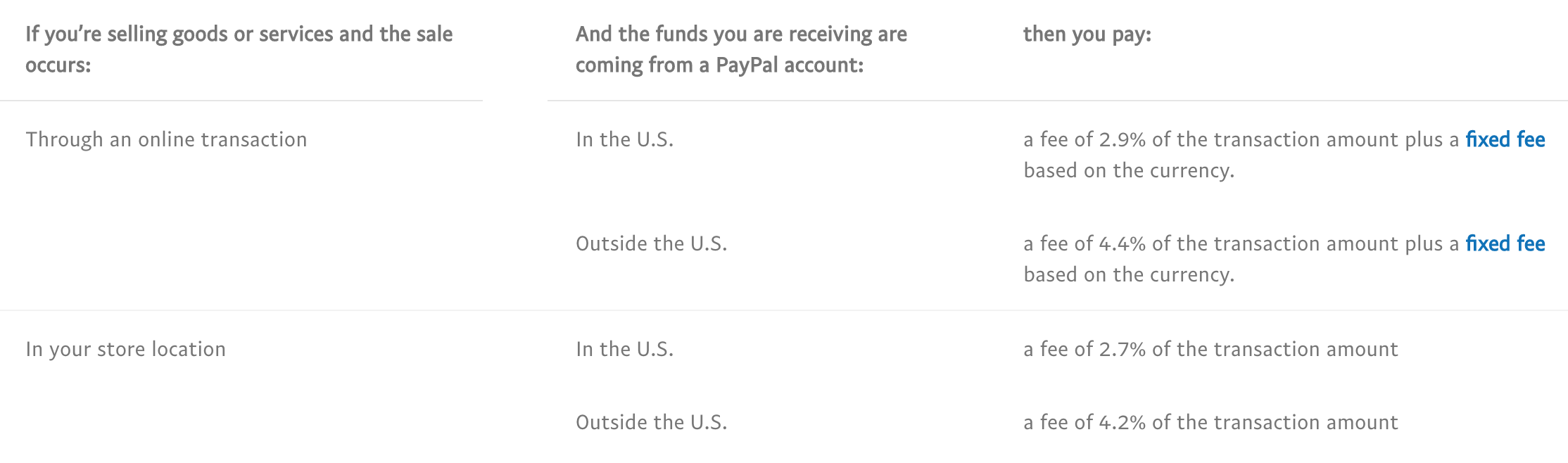
Screenshot from PayPal’s fees page
PayPal’s strength in mobile
A ray of hope for the firm is its mobile business.
While creeping operational costs and the release of PayPal’s Q2 2019 earnings report in July sparked a stock sell-off, a closer look at its operational success allayed investor fears. The report showed that the company added 9 million new active accounts in Q2, an increase of 17% year over year.
The firm’s One Touch service, which allows users to stay logged in to PayPal for easier and faster checkout, has been a success for the company on mobile, with greater than 10 million merchants using the service. The payment gateway is able to demonstrate increased conversion rates for merchants using One Touch on mobile, so there’s a strong incentive for internet retailers to use the service. As a result, mobile payment volume has increased by 45% for PayPal in Q3 2018.
The company has recently reported revenue of US$4.31 billion, up 12% year over year. It maintains that its growth areas will more than offset the loss of users coming from its break with eBay after 2020.
Targeting Asia
The rise of Bitcoin





Stay updated on the go with our mobile app.
Get latest insights with smoother, more personalized experience through TIA mobile app.












📅 Upcoming Events
22 October 2026
Payoneer x CSPN Summit 2026