Video gamers are always looking forward to what’s next. What new games are coming out next month? What new consoles are coming out next year? This week, we’re throwing the dial even further forward, and time-traveling into the (possible) future of video games.
The further out we get, the harder future developments become to predict. But here’s one you’ve probably been hoping to see for quite some time now: photorealistic graphics.
Videorealism…
By 2034 we’re going to be doing a lot in virtual worlds, and those worlds are going to look awesome. How awesome? Awesome enough that, at least visually, you probably will have a difficult time distinguishing them from reality.
If that sounds like science fiction, think about how far we’ve come in the past twenty years. The graphic below is a side-by-side screenshot of Final Fantasy VI (1994) and The Witcher 3 (screenshot taken in 2014). Look at how much the RPG genre has changed, visually speaking:
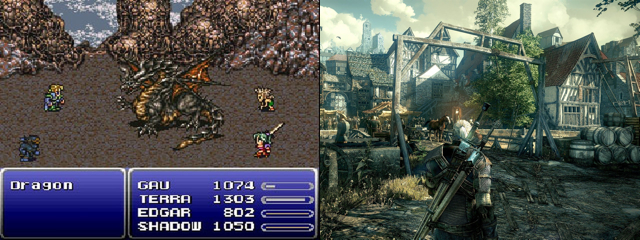
The contrast between graphics now and twenty years from now will likely be similarly stark. Computer graphics artists are already capable of creating 3D models that are virtually indistinguishable from the real thing—we see this all the time in the visual effects of blockbuster films—and in twenty years, graphics processing hardware will likely be fast enough to render real-life 3D worlds in real time.
In fact, the biggest problem with having ultra-realistic graphics in games isn’t so much the technology (which is inevitable) but the manpower that would be required to create such a game in the traditional way. Creating even a small virtual world with real-world graphical fidelity would take an enormous amount of time and money, because you’d need artists to design every single texture and block out every 3D model.
Thankfully, this problem has a number of potential solutions. With more advanced capture technologies, game developers might be able to essentially “scan” a real-world location and let sophisticated computer software do the work of turning the scan data into 3D models, textures, and animations automatically.
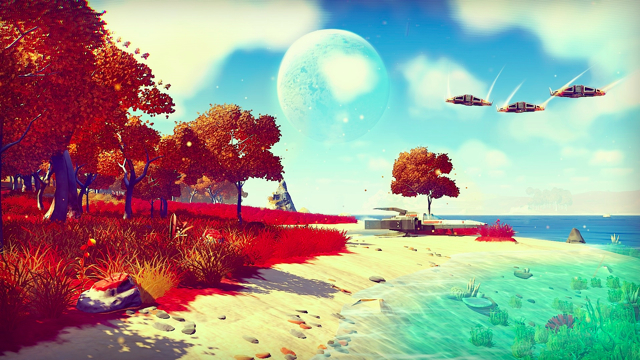
The world of No Man’s Sky is procedurally-generated.
Alternatively, developers can take an approach that’s already in place in some games today and use procedural generation to create the game world. Developers might, for example, be able to create art assets for one realistic-looking tree in the traditional manner, and then teach the computer to create new models and patterns for other trees in the game based on the original tree and the rules the developers have set out for tree generation. In this way, game developers could populate a massive virtual world with unique, high-fidelity assets without having to actually design all, or even most, of them by hand.
…but not too much





Stay updated on the go with our mobile app.
Get latest insights with smoother, more personalized experience through TIA mobile app.