- Premium Content It takes our newsroom weeks - if not months - to investigate and produce stories for our premium content. You can’t find them anywhere else.
 Thu Huong Le · · 6 min read
Is Singapore’s LLM project timely or too late?
Singapore has taken decisive steps to advance its AI goals.
Last week, the country hosted Nvidia boss Jensen Huang, revised its national AI strategy, and committed S$70 million (US$52 million) to build the region’s first large language model (LLM) for Southeast Asian languages.

Image credit: Timmy Loen
The Singapore government has made it a priority to create a regional LLM, which is scheduled for launch within the next two years. This model aims to capture the rich tapestry of languages and cultures found in the region.
But some AI practitioners question the practicality and timing of the LLM project in light of OpenAI and other tech giants’ rapid advancements. They also wonder if this model can propel Singapore toward its goal of becoming a global AI hub.
Does it have commercial value?
In justifying the project, Ong Chen Hui, assistant chief executive of the business technology group at the Infocomm Media Development Authority (IMDA), told Tech in Asia over email that most large generic models are “Western-centric by design and may not incorporate our region’s diverse culture and languages.”

Photo credit: Shutterstock
However, several non-Western LLMs have already embraced Southeast Asian languages and their cultural nuances. It’s also unclear why Western-centric models are at a disadvantage.
Earlier this week, Alibaba announced the release of open-source SeaLLMs, which the Chinese tech giant touted as “a technological leap forward in terms of inclusivity” due to its support for local languages in the region like Vietnamese, Lao, Burmese, and Tagalog.
Similarly, VinAI, a unit of Vietnamese conglomerate VinGroup, has launched an open-source model called PhoGPT specifically for Vietnamese. Singapore’s Wiz.ai also unveiled the first foundational model for Bahasa Indonesia in September.
Meanwhile, OpenAI’s GPT-4 has demonstrated proficiency in Singlish, a colloquial form of English spoken in Singapore. It can grasp the country’s cultural nuances too.
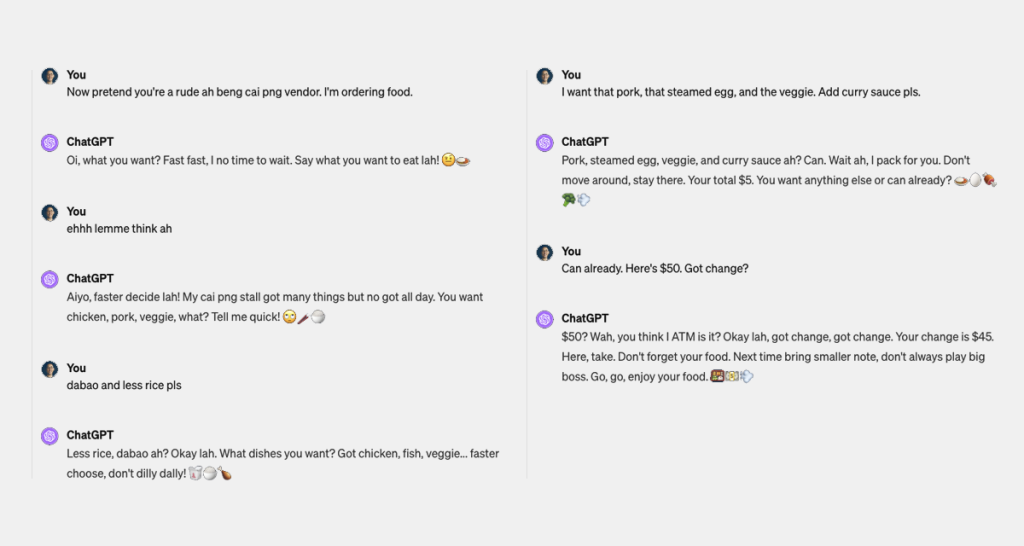
Tech in Asia editor-in-chief Terence Lee gets chatty and orders food in Singlish with ChatGPT-4. / Image credit: Tech in Asia
“Sovereign capabilities in LLMs”
S$70 million may not be enough
Stay ahead in Asia’s tech landscape
This is premium content. Subscribe to read the full story.
The city-state wants to launch a regional large language model within the next two years. But some experts question whether the move will pay off.
We know this is not ideal. ⌛ Sign up in 20 seconds. Cancel anytime.
Our subscriber community includes professionals from these companies:





Stay updated on the go with our mobile app.
Get latest insights with smoother, more personalized experience through TIA mobile app.