What are the ingredients for a successful fundraising round? Does it include a great story? Impressive numbers? Having the right connections? Or just good old-fashioned luck?
The answer differs depending on who you ask, but one key element is the pitch deck. This presentation summarizes the essential details about your company – its mission, where it sits in the competitive landscape, and its projections – in a concise and persuasive pitch for investors.
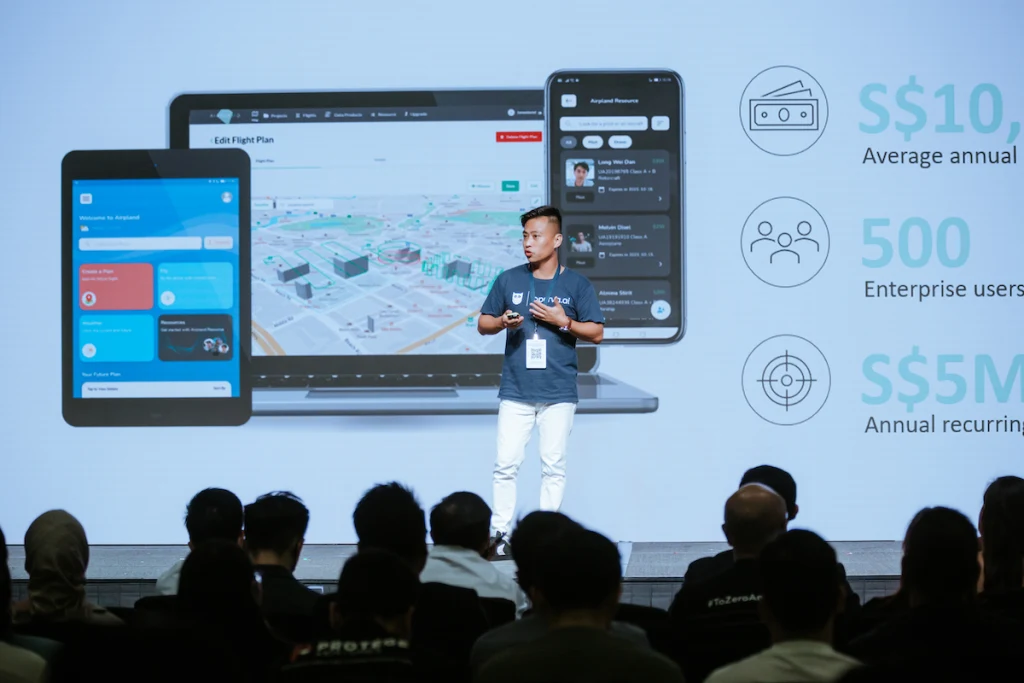
Photo credit: Tech in Asia
Often, a potential backer will see your pitch deck before they see you. Given that the average partner at a VC firm sees some 5,000 pitches a year, your deck plays a critical role in forming that first impression.
If you’re not sure about how to get started with your pitch deck or how to craft one that really makes you shine, Tech in Asia School’s got your back, as we’re peeling back the layers to understand the anatomy of this crucial presentation.
There are no hard and fast rules about what it should include, but there are some commonly accepted principles. Let’s dive into the six essential components of a pitch deck.
1. Problem
The startup life is all about problem solving, so one of the first things your pitch deck needs to do is outline the problem you’re trying to solve.
At Tech in Asia School, we often think about it like this: “If someone were on fire, you could sell them a pitcher of water for any price.” Founders need to think about what this fire is for their customers and how to best describe and drive home the urgency of this problem.
There are several ways to do this: You can take it from the user perspective, discussing the user experience and why it needs to be improved, or you can address it at an industry level, highlighting why the industry needs to change. You can also take a more personal approach, especially if you’re tackling an issue that’s near and dear to your heart.
Ultimately, you want your investors to feel empathy for your users and understand why this problem matters so much.
2. Solution
After highlighting the problem, you need to talk about how you’re addressing it.
Demonstrate how your product would work and highlight the key benefits it offers to users. This is where a startup should talk about its value proposition – what is it bringing to the table that’s different from others out there? What need is it meeting? Why is now the right time for a product like this to come up? Why is it the best?
If you have customer testimonials, this is the place to put them. After all, having real, happy customers who love your product is a great sign that you’re on the right track.
3. Business model
If you’ve done a good job selling the problem and solution, this is where most investors will prick up their ears. How do you intend to make money?
For early-stage companies, there’s no need to go into too much detail about how everything works. Outline your revenue model and pricing and talk about your margins. If you have traction – whether it’s gross merchandise value, returning customers, or revenue – highlight these numbers. Financials can be useful, but all the details may not be relevant, especially at an early stage.
This is also the part where you talk about your path to profitability – something lots of investors are interested in right now – as well as the opportunities that lie ahead for your business. Things like market size and total addressable market will provide investors with a sense of just how big things can get – and, if presented correctly, could help cultivate a sense of FOMO.
4. Competition
Fun fact: Having no competitors is not necessarily a good thing because it can sometimes mean that there’s no market for what you’re doing. Talking about your potential rivals adds to the discussion of the market opportunity at hand. Where are the gaps? Where can you seize a slice of the pie?
Be candid and honest about your competitors. Don’t talk smack about them, but take the opportunity to highlight what they’re doing and where you’re different.
Investors are likely to ask why Competitor X can’t do what you’re doing or how you intend to differentiate yourself from Competitor Y. You’ve got to make the case for why you stand out from the pack.
5. Founding team
In the early stage, a large part of an investor’s decision to invest is based on the team. Who are you? Why are you the best person for the job? What skills, credentials, or insights are you bringing to the table that will enable your startup to rise above the rest?
They’ll also take a close look at your founding team and early employees, asking a similar set of questions about their experiences and skills. It’s critical, then, to drill down and highlight your unfair advantage and what sets you and your team apart.
Depending on the strength and background of your founding team, you may actually want to move this section up in the deck. After all, a startup launched by ex-Google executives or by someone with a Ph.D. in a relevant field is more likely to catch investor attention than one founded by someone who doesn’t have such experience or expertise on their resume.
6. Fundraising ask
As you wind down your pitch deck, you shouldn’t lose steam. One of the biggest mistakes a startup can make is to go into a pitch without knowing what it wants out of the experience.
This is the point where you lay out how much money you want from an investor and what you intend to do with it. While it’s not crucial to have a super detailed vision for what the future holds, you definitely need to highlight where this money is going, whether it’s hiring more staff, expanding into a new market, or fueling research and development efforts.
Having this in place gives you direction in your fundraising and a point at which to start negotiations. It also helps an investor assess the feasibility of your goals and understand where they can help you if they do end up coming on board.
Let’s get that bag
There’s no one right way to go about your pitch deck. What’s important is communicating your startup’s story and value proposition and making sure that it efficiently tells an investor why you’re worth their time and money.
If you need some help crafting one, Tech in Asia has a database of pitch decks from businesses all over the world at every stage of the startup journey. We also publish a video series titled Pitch Deck Breakdown, where investors look at startup pitch decks and unpack what the company did well and what could have been improved.
However, pitch decks are just one part of the larger fundraising process. Whether it’s getting introductions to VCs, actually making a pitch, or negotiating term sheets, fundraising is one heck of a challenging game.
That’s where Tech in Asia School comes into the picture. Having been around in the Southeast Asian tech and startup ecosystem for over 10 years, we’ve had the opportunity to connect with the region’s most successful tech leaders, and we’re bringing together all the resources we have to create content, community, and mentorship opportunities tailored to the most critical stages of the startup journey in order to help founders see success.
Sign up for our newsletter to get founder tips, event invites, and exclusive resources from Tech in Asia School emailed to you monthly:
Stay updated on the go with our mobile app.
Get latest insights with smoother, more personalized experience through TIA mobile app.
Recommended reads
 4 things to keep in mind when building MVPs
 3 pieces of advice for the aspiring founder from Unravel Carbon’s Grace Sai
 Runway? Check. Users? Check. I still killed my startup
 Don’t play nice: guerrilla marketing for SaaS startups
 3 tips from Monk’s Hill Ventures’ Susli Lie on finding the right co-founder
 YC on why founders get bad advice (and the fix)
 How founders can prepare for 2023 even as markets fall apart
 A VC asked me not to use the ‘N-word.’ He meant nipple
 How to tell hype chasers and thesis-driven investors apart
 How to break into a career as a venture builder





Editing by Dhania Putri Sarahtika, Jaclyn Tiu, and Eileen C. Ang
(And yes, we’re serious about ethics and transparency. More information here.)







📅 Upcoming Events
22 October 2026
Payoneer x CSPN Summit 2026