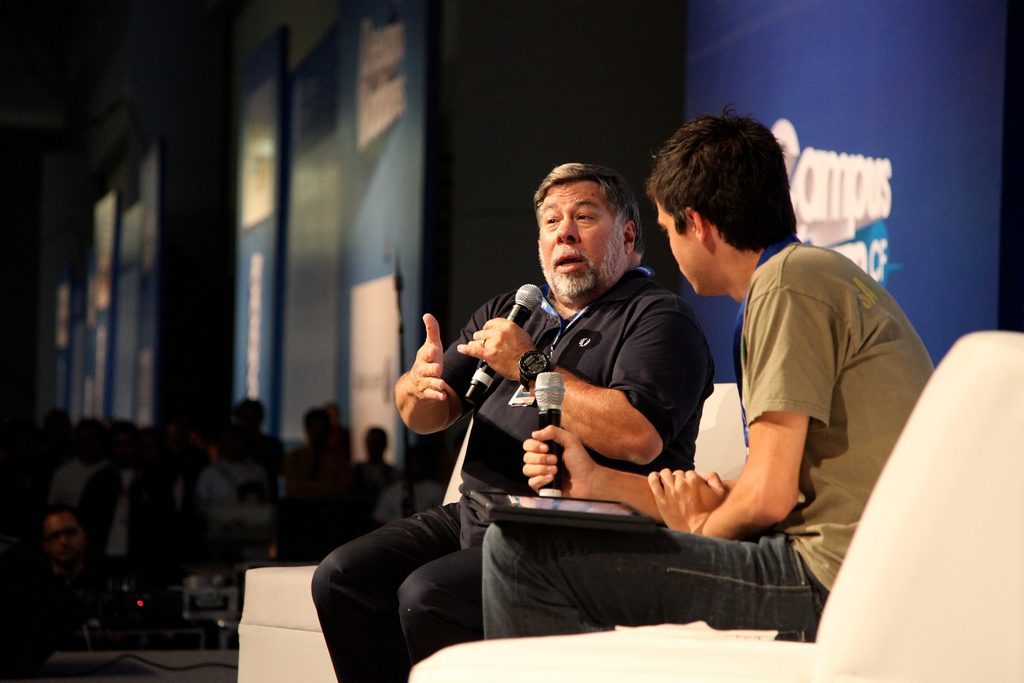
Image credit: Oscar Yasser Noriega
I first saw Steve Wozniak speak in person during a small press meeting at Xiaomi headquarters in Beijing. Wozniak rolled up in a shiny new Tesla before the electric car brand had officially started selling vehicles in China. He sat on a couch next to Lei Jun, the founder of China’s biggest smartphone brand, opposite a couple dozen members of domestic and international press.
Unable to communicate with each other due to the language barrier, Lei and Woz awkwardly took turns speaking about a handful of assorted Xiaomi gadgets. In retrospect, it was clear that Wozniak probably only had a brief introduction to the router and phones he subsequently posed with for photographers.
He talked a lot, but didn’t say much of substance, only, “I’m playing with mine. I like it so far. I’ll tell you if I have problems,” and, “Xiaomi has excellent products. They’re good enough to break the American market.”
That second quote became the headline that I wrote later that day for Tech in Asia. Like most media, I was eager to fawn over this grandfather of modern technology. The article performed above average as far as the number of hits it received and attention on social media, showing the power of the Apple co-founder’s endorsement.
Woz went on to to speak at Geekpark 2014 in Beijing, where he was chauffeured to in the Tesla. He and his agency receive $50,000 to $100,000 per speaking engagement, according to Speaker Booking Agency’s website.
Parody of himself
What was most apparent to me — and what I didn’t write in my article — is just how much of a sellout Steve Wozniak has become. He’s a serial endorser of products he knows almost nothing about, and he sells tickets to conferences that many attendants might not otherwise pay for.
And yet, he’s a god of Silicon Valley. People take his word as scripture without questioning the Holy Father of Apple. He makes headlines.
Many view him as some sort of victim. In promotional clips for the latest Steve Jobs biopic, he’s the geeky brains behind the Apple 2 personal computer and the target of much of Steve Jobs’ ire.
Wozniak hasn’t contributed in a meaningful way to any technological advancement in modern-day computers. In 2003, he started a hardware company for keeping track of lost items using GPS-enabled keychains. It shut down operations in 2006. In 2009, he took a post as Chief Scientist at Fusion-IO, a company that builds flash storage for large servers. The Register in 2012 reported that Wozniak’s actual contribution to Fusion IO’s tech was suspect:
“Fusion-IO Director of Communications Shannon McPhee told us Wozniak has offices in the company’s California and Utah offices, does not keep regular hours and is valued for the ‘vision’ he brings to the company.”
In other words, he was there to get investor and press attention. In 2013, the company’s stock went into freefall when it simply ran out of customers. It was rescued in a $1.1 billion acquisition by SanDisk in 2014.
So why do we take this guy so seriously, again?
Cruise control





Stay updated on the go with our mobile app.
Get latest insights with smoother, more personalized experience through TIA mobile app.