This article is brought to you by Studios, Tech in Asia’s new advertising arm which provides integrated media, marketing, events, and design solutions to help brands expand their reach in the tech ecosystem. Get in touch with us at studios[at]techinasia[dot]com for your tailored business solutions.
You can also sign up for our Studios bi-weekly newsletter to get the scoop on the latest trends in marketing, sales, tech and more.
The evolution of consumer behaviour in the digital age means that businesses need to adapt swiftly in their marketing strategies or risk losing out.
Last year saw certain key trends such as customer-based and community marketing, as well as video advertising. With the start of a new year, it’s time to look forward to what’s next.
Below, we bring you four marketing trends to keep an eye out for this year.
1. Revolution of the search game
Text-only searches are slowly giving way to visual and voice searches. This may come as no surprise ⎯ a report by Slyce revealed that 74 percent of shoppers found text-only searches to be insufficient when searching for products.
Visual search, where images can be uploaded online to filter for more accurate results, has been adopted by companies like Pinterest and Google with notable success. In February 2018, there were twice as many users compared to six months earlier who used Pinterest Lens, an app that allows one to use images to search for related items.

Pinterest Lens / Source: Pinterest
As for voice search, consumers input verbal commands to a virtual assistant ⎯ think Alexa and Siri ⎯ and expect relevant information in return. Predictions about its future usage have been positive, with ComScore predicting that half of all searches will be voice searches by 2020.
Why the rise?
One factor driving these changes is the surge in Asia’s mobile phone penetration. People are getting online more, and doing so via smartphones instead of desktops. This has simplified the search process – pictures are taken and uploaded directly from a mobile device within seconds, instead of having to transfer them to a desktop first.
Consumers are now faced with more options, thanks to the digitization of online retail. Visual and voice searches offer a more efficient alternative, particularly with the latter’s ability to search on the go.
How businesses can keep up
Structured data is crucial in leveraging the potential of visual and voice searches. Businesses should provide information such as price and availability of products to search engines in order to optimize their online pick-up rate. This is particularly important in voice search, where only top results are presented.
It is also advisable to implement long tail keywords (targeted phrases that contain three to five words and often contain key terms) as competition is lower, leading to better conversion and click-through rates. Voice searches tend to be more casual and detailed than text searches, since people talk to voice assistants the same way they converse with friends.
As for tackling visual searches, the crux is description. Namings and alt-texts of websites and images should be as descriptive as possible. In addition, images should be accompanied by alt-tags and captions to provide context.
Schema markup, a form of semantic microdata added to a website’s HTML, will be the point of difference. With minimal text usage in visual searches, it may eventually become the only source of textual information for search engines to parse through.
2. Understanding micro-moments
The battle to capture consumers’ attention today is increasingly fought in micro-moments. A concept introduced by Google in 2015, micro-moments refer to when people turn to a digital device to learn, do, watch, buy or discover something.
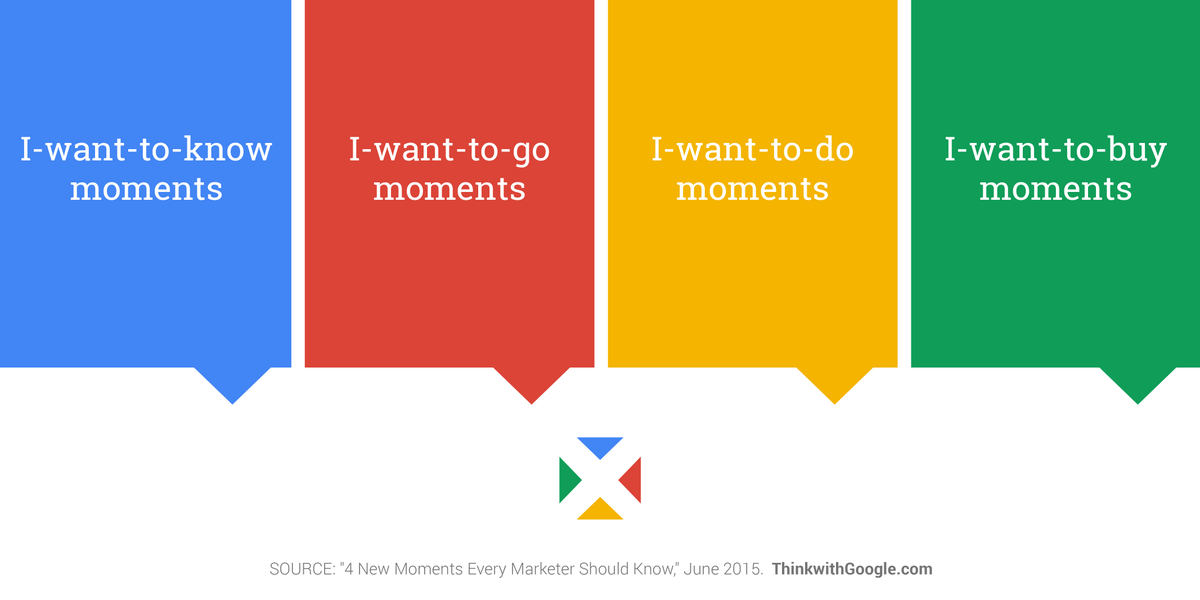
Consumer decisions are shaped in micro-moments / Source: Think with Google
In 2018, over 61 percent of web page views in Asia were generated via mobile. Nowadays, consumers demand results to be fast and relevant. They hold high expectations for personalized digital experiences, and if unfulfilled, they move onto the next search.
Why the rise?
People are more dependent on their mobiles than ever before. Its ubiquity has increased convenience, efficiency and speed, cultivating an on-demand consumer behaviour.
Customers today want to know beyond basic product details. Instead, they seek critiques and evaluations from those who have already experienced the product and brand, before deciding for themselves.
This reduces the risk of bad purchase, and helps avoid potential dissatisfaction. According to Local Consumer Review Survey 2018, 95 percent of those aged between 18 and 34 search and read online reviews for local businesses. On average, they read 10 online reviews before they feel a business is trustworthy.
How businesses can keep up
57 percent of consumers revealed they will frequent a business only if it has four or more stars, showing the heavy reliance on online reviews. Companies should invest in review marketing and incentivize customers to leave reviews as well as respond to negative feedback.
This growing trend of people having much shorter bursts of online activity also means that businesses need to embrace bite-sized advertising. Think short and ephemeral content by the likes of Snapchat, Instagram and Facebook Stories – where content disappear after 24 hours. These are just some examples of how companies can use platforms to “storytell in micro-moments”, as Gary Vaynerchuk puts it.
In addition, a seamless purchasing experience must be ensured to increase consumers’ willingness to buy. Essentially, businesses should ask themselves what they can do to make this exercise quick, accurate, and simple for their customers.
3. Rise of native advertising
Native advertising is a paid media strategy that fits the look and form on a website. It often contains a headline and description to entice users to click-through, which leads them to some form of sponsored content.
Some examples of native advertisements include in-feed ads, promoted listings and paid search ads.
Why the rise?
According to a 2017 report, 54 percent of companies are using native advertisements, while 38 percent are likely to do so in the future.
Consumers also seem rather welcoming to its presence. While often skeptical about the authenticity of sponsored content, consumers don’t feel the same about advertisements that blend in well with the rest of the website’s editorials.
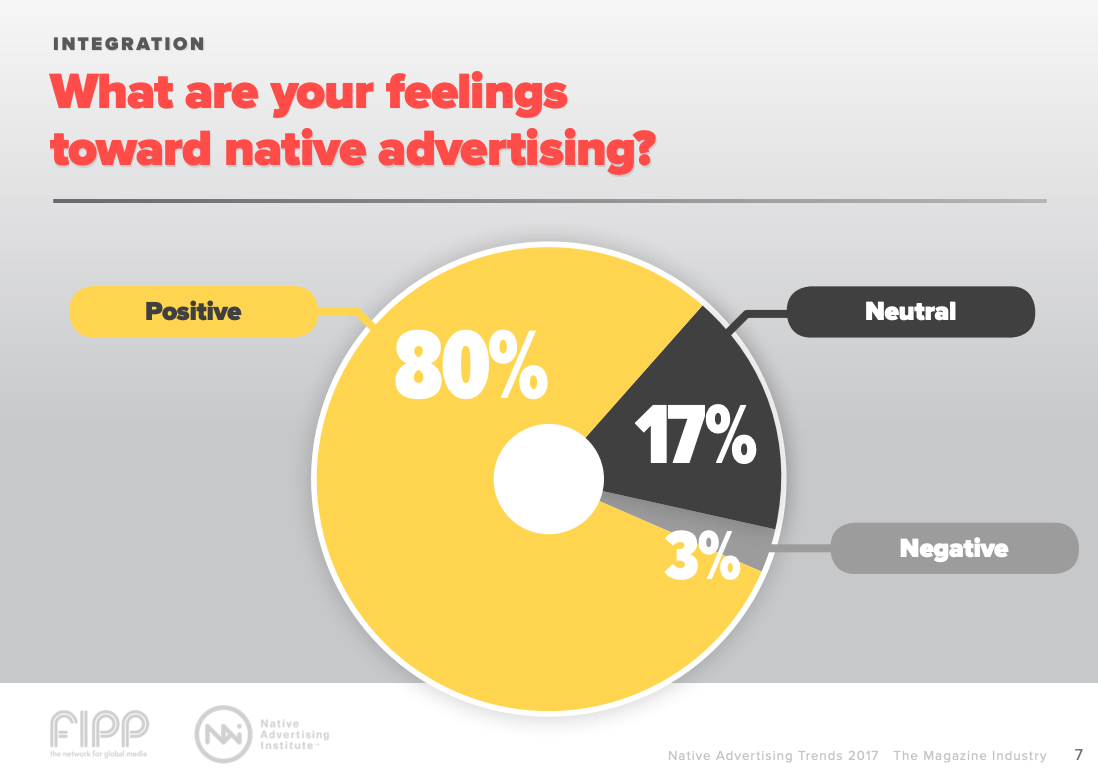
Source: Native Advertising Institute
Further, native advertising can reach a wider audience by circumventing ad blockers, which is employed by 615 million devices. Native advertising is, however, undetectable by them.
How businesses can keep up
Educating customers about products so they can better understand your brand is an important aspect of marketing, but companies need to also ensure that they carry this out in a genuine and engaging manner.
To do so, strike a chord with your audience and build credibility. This can be achieved through interactive content such as personal interviews and or videos. More importantly, it must feel authentic.
One great example of how native advertising was done is Under Armour’s collaboration with Complex.com, featuring Michael Phelps in The Water Diviner.
4. Influencer marketing
In 2016, brands spent a total of US$81 billion on influencer marketing, and that figure is projected to reach US$101 billion by 2020.
Influencer marketing will continue to be a driving force for brands looking to expand their market ground, especially on social media. The three-way engagement between brands, influencers, and consumers is nothing new, but its use is burgeoning.
Why the rise?
Thanks to the popularity of social media, consumers are now more exposed to influencers, who often cater to a niche market – for instance, fitness, food, beauty, just to name a few.
One in three millennials and Gen Z revealed that they trust what an influencer says about a brand more than what the brand says about itself. The returns seem promising – businesses are getting an ROI of more than 600 percent, generating US$6.50 on average for every US$1 spent on influencer marketing.
How businesses can keep up
For all its profitability, the degree of efficacy depends largely on the fit between brand and influencer. It is integral that businesses work with individuals who are knowledgeable in the product field and have an interactive relationship with their followers. Otherwise, influencer marketing could backfire.
With the prevalence of fake followers in recent times, businesses must do their due diligence or risk undermining their own authenticity. A low engagement rate despite a high following, and irrelevant or spam comments, are some indicators to look out for.
Staying ahead in the marketing race
In this digital age, simply being aware of these upcoming trends is not enough. Timing is key, so businesses must learn to be an early adopter to distinguish themselves in an already saturated market.
More importantly, companies must now find a way to relate to their customers, building trust and authenticity in the process, leading ultimately to customer loyalty.
To gain insights into the latest happenings across tech, marketing, sales and more, sign up for our Studios’ bi-weekly newsletter.
Stay updated on the go with our mobile app.
Get latest insights with smoother, more personalized experience through TIA mobile app.
Recommended reads
 Shein’s playbook to supply chain domination
 Grab is leveling the playing field for MSMEs with its merchant super app
 Don’t play nice: guerrilla marketing for SaaS startups
 Vietnamese B2B platform bags $1m in Touchstone-led seed round
 SEA food delivery spending tops $16.3b in 2022: report
 CapCut could be ByteDance’s next cash cow
 Why ‘too expensive’ is just a decoy for leaving customers
 5 key takeaways from Meta’s report for D2C startups
 Our AI outbound efforts were a black box. Here’s the real cost.
 How ecommerce firms can get the most bang for their buck with digital advertising





Editing by Cheong Hui Min and Lim Jia Xin
(And yes, we’re serious about ethics and transparency. More information here.)