While you’re sitting smug as your parents and grandparents stare in awe of smartphones and the internet, take a second to think about what your own offspring will be doing 10 to 20 years from now that you won’t be able to wrap your head around. To give you an idea, we’ve compiled a list of eight consumer-facing emerging technologies that kids born today will take for granted by the time they’re adults.
Modular phones
Modular phones, meaning smartphones where you can easily swap out parts to upgrade and add new functions, are slowly becoming a reality. Google is leading the way in this regard with Project Ara, the company’s prototype that’s already inviting developers to create their own modules. Night vision cameras, car key fobs, and extra displays, inputs, and buttons are just the beginning of the possibilities. Depending on who you ask, modular phones could be either the biggest threat or the biggest opportunity for today’s smartphone manufacturers. Gone will be the days of buying pre-fabricated phones that you’re stuck with until you run it into the ground and buy the newest model. If a component burns out, just swap it with a new one at a much lower cost. Want to switch to a different carrier? Just switch the SIM card slot to your preferred telco.

Image source: Wikipedia
Wireless power
Wifi is everywhere these days, and so will wireless charging eventually. You’ve probably seen wireless charging pads for homes and cars, but most of those still require a very close (touching or nearly touching) proximity. Companies like uBeam and MediaTek, however, are working on longer-range prototypes that will charge a smartphone or other device from anywhere in the room. Electricity is transmitted by ultrasound waves, so you may never have to worry about batteries going dead again. Taiwan-based MediaTek has even developed a prototype that charges multiple devices through walls and other solid matter. And it’s not just handheld devices, the technology could even be used to charge electric vehicles.

Image source: Wikipedia
Autonomous cars
Autonomous, or driverless, vehicles are here to stay, and they’ll only get more popular from here on out. The applications both for consumers and logistics companies are boundless. No need to hire a team of delivery drivers. No need to worry about falling asleep at the wheel. Even send a car to pick up kids from soccer practice. Google obviously got a jump start in this emerging tech sector, but Asia has its own fair share of competitors. Singapore’s National University of Singapore (NUS) and the Singapore-MIT Alliance for Research and Technology are working on a budget-minded model. Japan has a whole host of auto makers getting in on the driverless game. And even China’s Baidu confirmed earlier this year it’s working on an autonomous car. Combined with the onset of electric vehicles, the automotive industry will look very different by the time kids born today apply for a driver’s license.
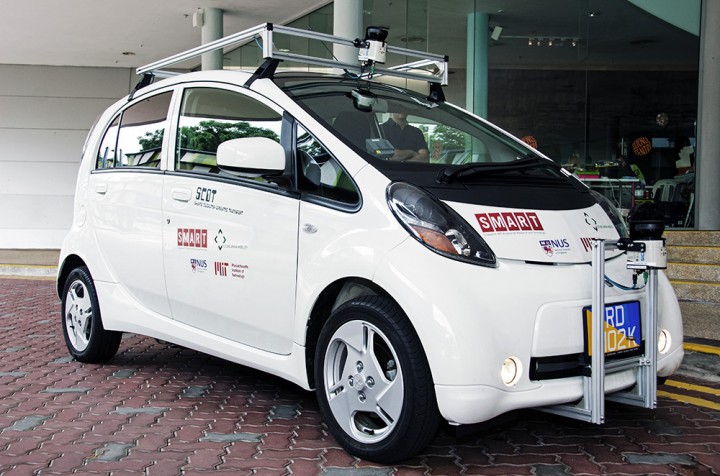
Singapore’s prototype self-driving car, made by NUS and MIT.
MOOCs
And by the time they apply to college, online education will probably be the norm rather than the exception. As the need for higher education grows, so does the demand for classes. This is one of the reasons why tuition in countries like the US, the UK, and China have skyrocketed in recent years. The answer to this is massive open online courses, or MOOCs. MOOCs allow hundreds or even thousands of students to participate in a single online course led by top professors. Coursera, Xuetangx, and Kaikeba are all picking up steam in China, and some can even be used toward actual college credit. As the system is perfected and demand continues to rise, the traditional college experience of living in a dorm on campus will seem profoundly old school.

Image source: CreativeCommons.org
Hydroponic farms
As the Earth’s population increases, the amount of arable land decreases and the climate warms. Agriculture will have to undergo some major overhauls if we plan to keep feeding ourselves in the future. One solution to this is hydroponic farming, which is much more water and nutrient efficient and requires no soil. Hydroponic farms can be built in any contained area, including areas unsuitable for traditional farming like deserts and urban environments. The types of crops that can be grown are somewhat limited though, and the process has a much lower margin of error than traditional farms. Hydroponics isn’t exactly a new emerging technology – it’s actually been around for hundreds of years – but the growing necessity has led to more sophisticated techniques.
See: This startup buys old shipping containers and turns them into urban hydroponic farms
Genetic screening
Private drones
Face recognition





Stay updated on the go with our mobile app.
Get latest insights with smoother, more personalized experience through TIA mobile app.









📅 Upcoming Events
22 October 2026
Payoneer x CSPN Summit 2026