Michael Tegos · · 4 min read
The numbers behind Luxola’s acquisition, and what they mean
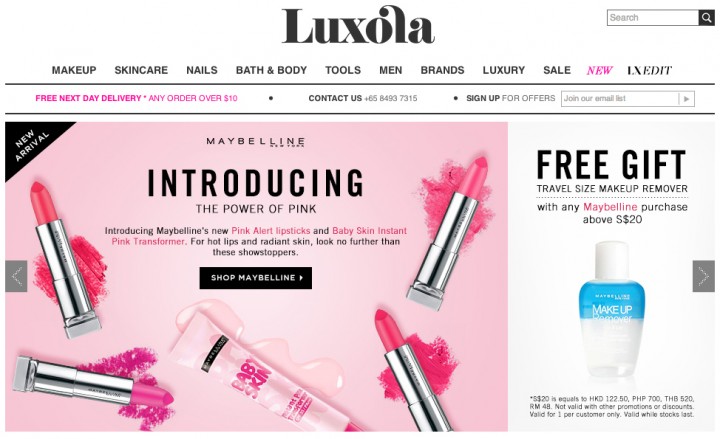
Easily the top news recently in Singapore’s startup scene is the acquisition of Luxola, the cosmetics ecommerce startup that launched four years ago. It was snapped up by Sephora and parent company Moët Hennessy Louis Vuitton (LVMH), a massive luxury goods company.
So, what has LVMH bought? How well was Luxola really doing? And what does this mean for the startup ecosystem in Singapore?
First, let’s remember how Luxola started.
As Luxola founder and CEO Alexis Horowitz-Burdick recounted in a video interview, Luxola had a rough start back in 2011. There were months when the startup estore would bring in only S$10,000 (US$7,400). Persistence, a fighting spirit, and prior experience (Luxola is the third startup Horowitz-Burdick has been a part of, and the second one she founded) drove her and the company forward. After receiving seed investment from venture capital firm Wavemaker Pacific, Luxola went on to raise a total of over US$15 million in funding.
Official data that Tech in Asia obtained shows that Luxola’s revenue for the 2013 to 2014 financial period was in the area of S$2.6 million (US$2 million). Certainly not bad, but not exactly cause for celebration either, since that’s less than what online fashion retailer Zalora made in any of its local operations.
The startup held about S$11.8 million (US$8.75 million) in current assets, which could be a mixture of cash reserves and unsold inventory. Finally, the same data places Luxola’s valuation at the time of its series C investment in May 2014 at US$28 million or more.
Horowitz-Burdick and the Luxola team declined to comment for this story.
How big of a win?
Sources speaking to Singapore daily The Straits Times said that this is an eight-figure deal, and “one of the largest startup acquisition deals in the last three years.” The newspaper places the deal “on a similar scale to the 2013 reported US$60 million purchase of Asian Food Channel by American television network Scripps Interactive Network.”
If so, this is in line with Luxola’s series C valuation and speculation we’ve heard that the final valuation could be as high as S$50 million (US$37 million). While leaving out the actual acquisition sum can be interpreted as a sign that the valuation was underwhelming – perhaps Luxola failed to meet performance targets – a source who declined to be named says the deal was definitely a win for the company.
Nonetheless, the numbers would still compare favorably with other high profile startup acquisitions in Singapore. Live chat for businesses startup Zopim was acquired by Silicon Valley’s customer support company Zendesk last year, in a deal believed to be worth around US$30 million. Digital advertiser Gushcloud was recently purchased by mobile advertising network Yello Mobile for a sum exceeding US$10 million – by how much remains uncertain.
Video streaming startup Viki’s acquisition by Rakuten in 2013 remains a mammoth deal in comparison, reportedly worth US$200 million. While Luxola isn’t exactly breaking new valuation grounds, it’s nonetheless another multi-million dollar exit from a Singapore startup.
For early investors in the company, this is likely good news. To illustrate, Wavemaker was the first to invest in Luxola, with a seed investment of US$590,000. According to official information, Wavemaker held 354,819 shares in the company at the end of financial year 2014. Based on the investment amount, the shares’ purchase price at the time of the seed funding round, in 2012, would have been about US$1.66 per share. A US$37 million valuation would now put the price of those shares at US$7.34 per share. That means, if the reported figures stand, Wavemaker was rewarded for its early trust in Luxola with an almost 5-fold return on its investment.
There are still many unknowns. For example, we don’t know how much of the deal amount is in cash or shares, or whether Horowitz-Burdick has previously cashed out or given away her shares to employees or co-founders. Official data confirms that Horowitz-Burdick herself held a tiny stake in Luxola as of 2014 – valued at around S$161,000 (US$119,000). The CEO declined to comment on that as well.
The French connection





Stay updated on the go with our mobile app.
Get latest insights with smoother, more personalized experience through TIA mobile app.