 Ainun Nadhifah · · 5 min read
LinkAja’s strategies to get Indonesia closer to financial inclusion

In a study conducted in Indonesia by fintech app LinkAja and online news platform DealStreetAsia, 97% of respondents said that they use at least one e-wallet service. A survey by Populix found that respondents use e-wallets for reasons such as practicality, integration with ecommerce platforms, and cashback promos.
LinkAja, one of the country’s major digital wallet providers, has its own strategies to enter this space. Its main approach is by collaborating with strategic partners such as telco company Telkomsel, energy firm Pertamina, and other state-owned enterprises (SOEs). It’s an obvious move, considering LinkAja itself was formed through a national synergy of 10 SOEs.
New business direction
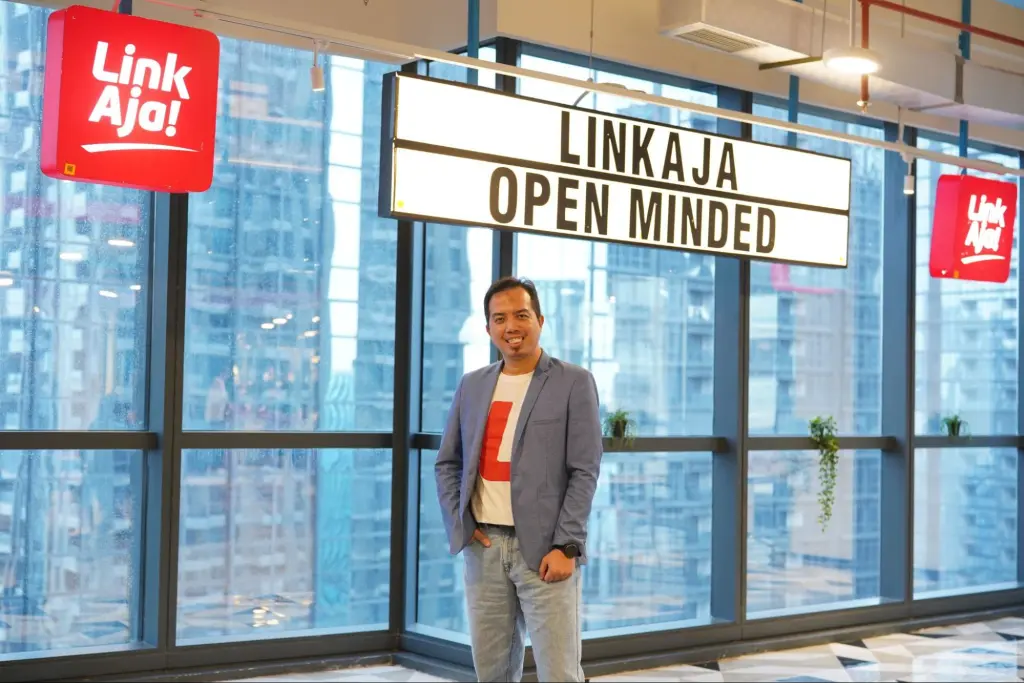
Yogi Rizkian Bahar, CEO of LinkAja / Photo credit: LinkAja
In 2022, LinkAja changed its B2C-centric strategy to B2B2C – or a two-sided business model, in other words. The purpose of the shift was not only to ease digital payments for end users, but also to offer end-to-end financial solutions for digital and traditional supply chains, especially those within the SOE ecosystem.
For B2C, LinkAja makes a serious effort on low acquisition cost and profitable users, while on the B2B side, the firm concentrates on digitizing traditional end-to-end value chains for SOEs.
All this is done with one aim: to become a fintech company that can improve national financial and economic inclusion.
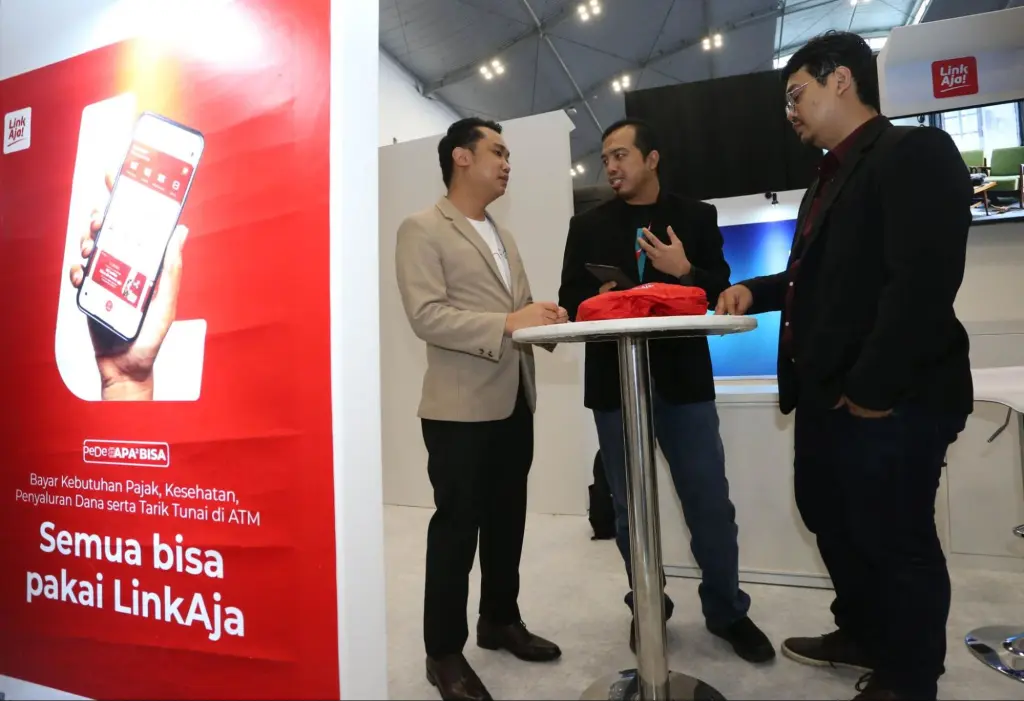
(From left) EdenFarm founder and CEO David Setyadi Gunawan, LinkAja CEO Yogi Rizkian Bahar, and Feedloop CEO and co-founder Ahmad Rizqi Meydiarso signing a strategic collaboration agreement at BUMN Startup Day 2022 / Photo credit: LinkAja
LinkAja also appointed Yogi Rizkian Bahar as its new CEO to reinforce its business strategies. Yogi, who has 19 years of experience in the tech and telecommunications industries, lays out his vision for the company.
With a “new, more focused business direction,” he believes LinkAja is on the right track to “faster and more optimal growth” and to make “a positive contribution in accelerating Indonesia’s financial inclusion.”
Through the company’s commitment to “linking” the nation’s infinite potentials – as expressed in its #SatukanPotensiIndonesia slogan – LinkAja hopes to help create an integrated digital ecosystem.
Digitizing the supply chain ecosystem
Every SOE has its own supply chain ecosystem that involves various parties – retailers, distributors (agents), and principals – at each stage. Many of these players are MSMEs, which are arguably the backbone of Indonesia’s economy.
These MSMEs produce a number of unique data points that LinkAja can access. With these data points, LinkAja gets insights into the transaction behaviors of partners and agents, enabling it to offer loans and digital payment methods.
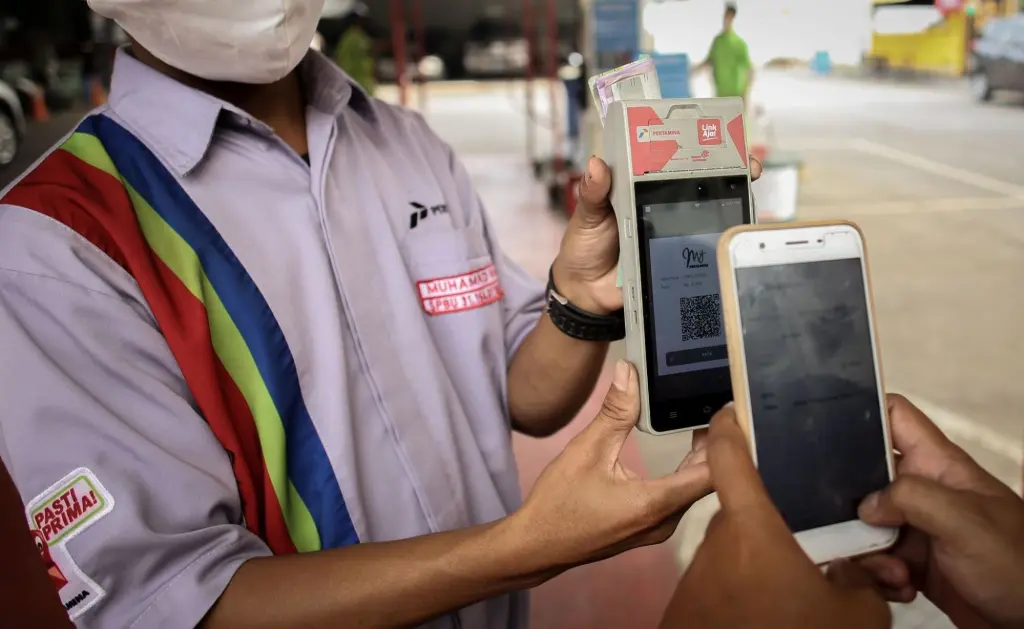
Customers use the LinkAja application to make payments for fuel / Photo credit: LinkAja
One of the companies whose supply chain has been digitalized by LinkAja is Telkomsel, which has over 300,000 partner MSMEs selling phone credits. For its upcoming pipeline, LinkAja plans to tap into and digitalize other SOEs’ traditional value chain ecosystems. The company has also provided an allowance disbursement solution for SOE employees.
Another strategic development is LinkAja’s foray into digital loans. After acquiring a peer-to-peer lender at the end of April 2021, the company launched LinkAja Modalin. Through its lending arm, LinkAja extends its end-to-end financial offerings to the underserved – specifically MSMEs.
By optimizing the potential of SOEs and MSMEs, LinkAja is optimistic that it can fill the gaps left unaddressed by other players, thus further accelerating Indonesia’s financial and economic inclusion.
Other than that, LinkAja holds both an e-wallet license issued by Bank Indonesia, the country’s central bank, and an e-retailer license from the Indonesia Investment Coordinating Board (BKPM). This indicates that the company has earned the trust of the regulators to develop more financial services and expand its business. As a result, LinkAja continues to strengthen its position as a digital goods provider for the SOE ecosystem and others.
Promising Shariah-based services
LinkAja’s competitive edge comes not just from partnerships with the government and state-owned institutions, but also from LinkAja Syariah, which runs in tandem with its conventional services.
LinkAja Syariah is the first digital wallet to obtain licenses from the National Shariah Council of the Indonesian Ulema Council (DSN-MUI), as well as KNEKS, or the National Committee for Shariah Economy and Finance.
The Islamic digital payments platform guarantees that all transactions and the money stored on it are managed according to Shariah principles. LinkAja also works closely with Muslimat NU, one of the biggest Muslim women’s groups within the Nahdlatul Ulama organization, to strengthen its Shariah line.
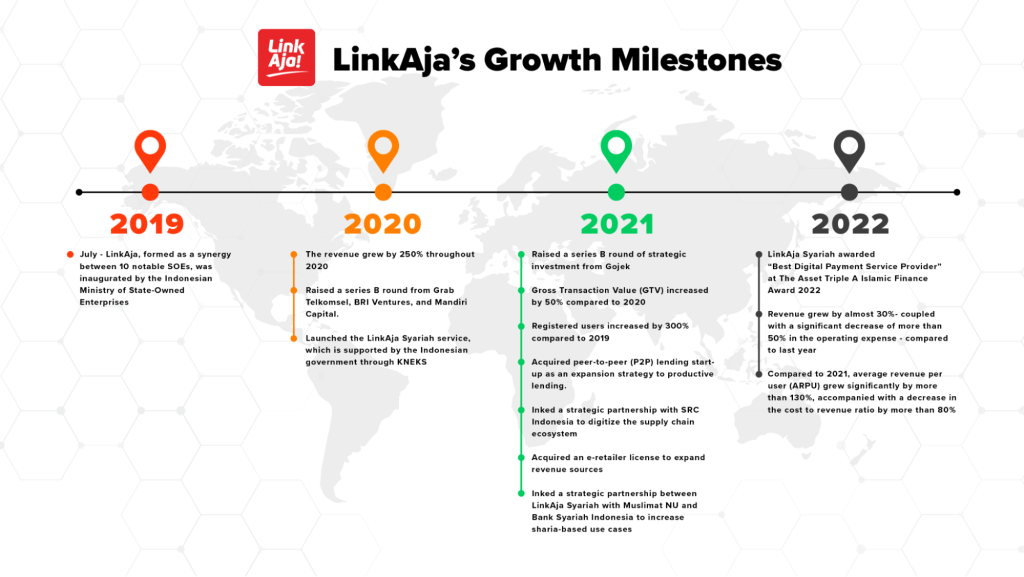
Image credit: Tech in Asia / Data credit: LinkAja
Other notable partners include Bank Syariah Indonesia – the country’s largest Islamic bank – and the largest Shariah cooperative in Indonesia, the Baitul Maal wa Tamwil Cooperative (BMT) Nusantara Integrated Joint Venture (UGT).
In addition, LinkAja has partnered with the national Baznas, Indonesia’s Islamic alms-giving governing body, to cater to users’ religious needs such as making payments for zakat (mandatory alms), infaq (charity), and qurban (animal-sacrificing ritual). Shariah investment products are also offered.
To further support Indonesian Muslims in achieving their spiritual goals, LinkAja Syariah has collaborated with a third party for the Hajj feature. Not only can users easily sign up for their Hajj pilgrimage on their smartphone, they can also enjoy benefits such as obtaining financing for the down payment of the registration.
According to Yogi, LinkAja Syariah users tend to be more loyal than users of the regular app.
“LinkAja Syariah users focus on the ‘inner peace’ they get from Shariah-based financial management. That can’t be measured by typical user-satisfaction metrics,” the CEO says.
LinkAja, a synergy of 10 SOEs (e.g., Telkomsel, Himbara Bank, and Pertamina), is one of the largest e-wallet companies in Indonesia and biggest decacorns in Southeast Asia.LinkAja launched its Shariah-compliant wallet in 2020 that is now the largest in the region. With a mission to accelerate economic and financial inclusion in Indonesia. LinkAja also acquired a digital lending entity in 2021 to tap into the MSMEs, especially those within the SOE ecosystem.
Currently, LinkAja has 89 million registered users and 2.8 million registered merchants. After pivoting to a two-sided business model, the firm has successfully increased its revenue and cut down operating expenses.
This article was originally published on Tech in Asia Indonesia and has been updated according the latest developments at LinkAja.
This content is produced by Tech in Asia Studios, which connects companies with the tech community in Asia. Find out more about partnering with Tech in Asia Studios.
Stay updated on the go with our mobile app.
Get latest insights with smoother, more personalized experience through TIA mobile app.
Recommended reads
 Tracking AI hiring in Singapore: OpenAI, Anthropic, and more
 Last to board: why travel may be AI’s final frontier
 Why ‘cheaper’ no longer wins dev deals for Vietnam
 Alibaba’s capex isn’t the full story
 Forget startups. Buy the business running on Excel
 Life’s a game, and AI agents are Animoca’s new play
 Indonesian AI startup goes global
 Forrest Li on scaling Sea, building smarter bots, and founder grit
 An AI assistant that joins sales calls and scores team skills
 Beyond the check: Why VCs need more than capital





Editing by Putra Muskita, Dhania Sarahtika, and Eileen C.Ang
(And yes, we’re serious about ethics and transparency. More information here.)





📅 Upcoming Events
22 October 2026
Payoneer x CSPN Summit 2026