 J.T. Quigley · · 4 min read
These 5 Korean startups are trying to make their mark in Japan

Korean Startup Demoday 2015 kicked off in Tokyo last night, featuring 10 up-and-coming startups from Seoul and beyond that hope to scale their product or service to Japan. Each team was given an opportunity to pitch in front of an audience of Japanese investors, businesspeople, and domestic media.
Here are our top five, in no particular order, including the pitch contest winners.
BeeCanvas
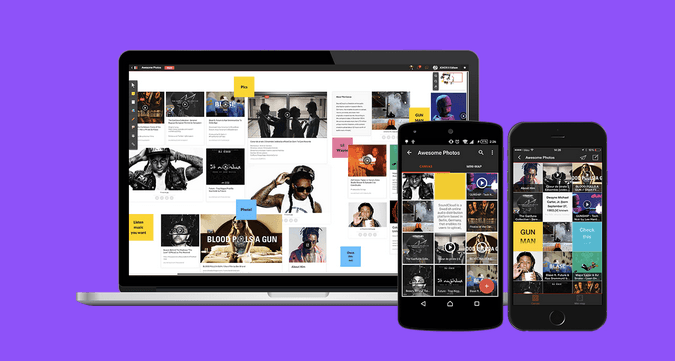
The startup that won the award for being most ready to enter the Japanese market was JokerPack, with its virtual canvas for all things visual, dubbed BeeCanvas. Users can drag and drop various files, links, photos, and videos onto their canvases and add sticky note-like text annotations. They can then share the collages as-is – or open them up for collaboration with colleagues.
Think of BeeCanvas as a visual answer to Slack. Instead of dropping image files into a text chat, teammates can use the software (available for desktop and mobile) to share their sketches, storyboards, and other visual inspiration in real time. It could become a hit with people in creative industries, from web and fashion designers to illustrators and film directors. The visual, intuitive nature of BeeCanvas also adds to its international scalability.
Azar
Combine Tinder and Chatroulette and you get Hyperconnect’s Azar app – random live video and text chats that can be swiped away to start a new one. I know what you’re thinking – it must be full of crazy naked people, right? Well, if user reviews are any indication, it’s not as bad as you think. Azar rewards users who report such users with in-app “gems” which can be used to unlock premium features.
The app has amassed over 25 million downloads and nearly 2.5 billion “matches” since launch. Available in 18 languages, Hyperconnect earns more than half of its revenue from users in Europe and the Middle East.
Musio
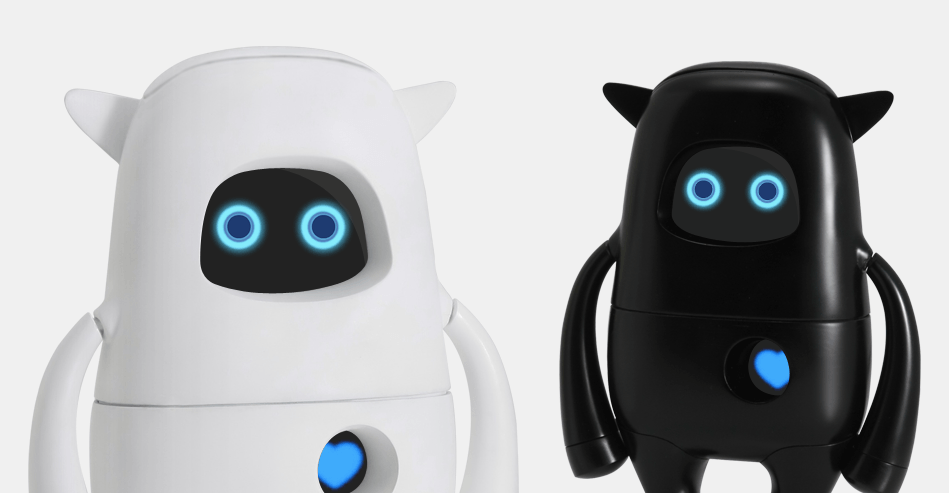
Musio is a cute robot that helps kids learn how to speak English. Designed by AKA Intelligence, Musio raised over US$100,000 on Indiegogo last July. It’s powered by machine learning and natural language processing, enabling it to have life-like conversations with users. The startup claims Musio becomes a better conversationalist the more you talk to it.
The AKA Intelligence team includes engineers from Harvard, Yale, UC Berkeley, and South Korea’s prestigious GATE school. Musio robots can be pre-ordered for US$599 and are expected to ship in June 2016.
Keukey
The judges crowned Keukey the overall pitch winner, and it’s an absolutely brilliant idea. Don’t you hate when you’re about to tap send on a text message and realize there’s a typo in the middle of your sentence? Maybe you meant to type “food” and ended up with “good.” Zeroing in on the typo with the little magnifying glass can be a pain in the ass, and some people opt to just erase everything from the typo on forward. There has to be a better way, right?
Keukey allows users to fix the mistake from any point in the message. Once you notice the typo, simply type the correct spelling and swipe down on the keyboard. The service uses pattern matching algorithms, not a dictionary, so it even allows users to fix contextual errors. If you typed “Let’s get lunch” but you really meant “Let’s get dinner,” typing dinner and swiping down will replace it. You can even add a missing word by typing it and swiping left or right until it’s in the correct position.
The startup says that Keukey works in multiple languages and across multiple platforms. It is currently seeking partners (I’m looking at you, Apple) to use its tech to enhance their stock keyboards or third-party keyboard apps.
Idecca

Idecca wants to become Google Maps for the great indoors. Instead of relying on beacons or GPS, it uses naturally-occurring magnetic fields and your smartphone’s existing magnetometer to gather location data. The startup wants to use its technology to map museums and shopping centers. Retailers could use the app to send nearby shoppers a coupon, similar to iBeacon. It could also be used for the security industry when CCTV monitoring is unavailable.
The startup has a well-funded rival in IndoorAtlas, a European startup with its eye on Asia, but it’s nice to see a local player entering the fold. Naver-born messenger Line also offers an indoor mapping app.
The event was sponsored by Startup Alliance Korea – a collaboration between the private and public sector founded in 2013 – is supported by Line parent company Naver, the South Korean Ministry of Science, ICT, and Future Planning, and others. It also oversees events, manages startup coworking spaces, and facilitates foreign market entry.
Stay updated on the go with our mobile app.
Get latest insights with smoother, more personalized experience through TIA mobile app.
Recommended reads
 Indonesian AI startup goes global
 Forrest Li on scaling Sea, building smarter bots, and founder grit
 An AI assistant that joins sales calls and scores team skills
 SGX’s CEO says it doesn’t need a unicorn to win
 SMEs want AI too, but not the kind Big Tech is selling
 Oatside’s alt-milk rise hits a profitable gear
 Alibaba’s financial health in 12 charts
 Asia’s telcos bundle AI into mobile plans. Will it pay off?
 M-Daq chases bigger clients as revenue falls, losses grow
 VC tracker: Accel raises US$3.5b, including US$550m for India





Editing by Terence Lee and David Corbin
(And yes, we’re serious about ethics and transparency. More information here.)




