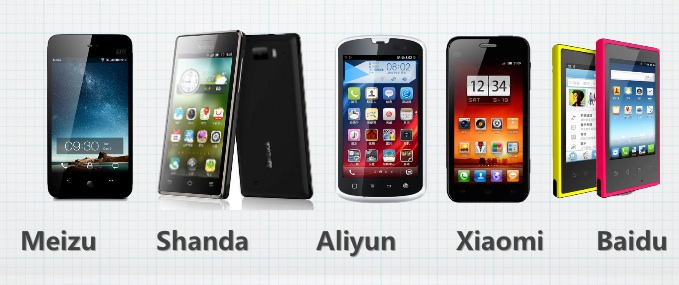
China’s web companies want to go mobile. And to that end, many are creating their own phones that carry their own mobile platforms, serving as a vehicle and a showcase for their own apps and services. The likes of Xiaomi, Baidu, Alibaba (with its Aliyun OS), and Shanda are pioneering this, and many more will follow.
So let’s take a look – see our colorful graphic below – at five homegrown mobile platforms from China that are packaged in their own hardware. The afore-mentioned four web companies are on the list, and I’ve thrown in Meizu as well, since it has transformed itself so well in the past couple of years, and is building an ecosystem of its own too. Scroll down below the table for a summary of why they’re significant, and why both local and global handset makers – from ZTE to HTC, Huawei to Motorola – should be very, very worried about the consumer familiarity and brand pulling power of these affordable smartphones.
After all, telcos and old-skool handset makers have a tendency to fill their smartphones with bloatware and other crap. But these new devices from the more savvy web companies come brimful of apps that look great and which you’d actually want to use for, say, music-streaming, group messaging, or cloud notes syncing.
Here’s our table, comparing the five hot phones spec-by-spec:

Meizu MX (dual-core)
Looking at the cheaper dual-core model, not the newer 4-core version, the Meizu MX was launched with Android 2.3 and Meizu’s attractive Android UI skin, which will soon by updated to the more evolved Flyme OS that Meizu is building as its ecosystem. As such, it has the Flyme cloud backup service and its own app store. Here’s a review of the MX dual-core from Engadget.
Shanda Bambook phone
Launched on June 6, the Bambook smartphone is the first ever phone from Shanda (NASDAQ:SNDA; FRA:RZP), makers of the Bambook e-reader. It’s also based on Android – though the older 2.3 – and comes with neat cloud apps and supports Shanda’s Yuncheng e-book market.
Aliyun OS – represented by the Haier Zing
Aliyun OS is the big play for mobile and mobile commerce from Alibaba, the country’s e-commerce giant. Launched last summer, it is not based on Android, places an emphasis on web apps, and is also loaded with useful – and mostly cloud-oriented – apps. It’s a tough sell, though, up against so much competition. Earlier this month, Haier (SHA:600690; HKG:1169) stepped in as a new hardware partner with the cheap Haier Zing.
Xiaomi M1





Stay updated on the go with our mobile app.
Get latest insights with smoother, more personalized experience through TIA mobile app.