We’re entering an interesting time in the Asian startup ecosystem. And it’s an increasingly tough time. It’s characterized by movements that are unique to now and may never come to pass again. Just to name a few:
- Regional funding is increasing steadily and stabilizing as Asian and non-Asian investors are wiser and more keen on the continent.
- Various startup ecosystems across the region are maturing at different speeds (especially seen in steady government support of local startup ecosystems and the rising number of investments per country).
- We’re seeing large active regional tech companies reaching across multiple countries for new markets (threatening local competitors…more on this later).
- We’re seeing gargantuan Silicon Valley unicorns investing heavily into taking various local markets (effectively preventing any local startups from playing for these markets altogether). After all, who can resist the exotic and burgeoning open markets of Asia?
- At the same time, at the bottom, startup ecosystems are still largely undeveloped. Funding isn’t as aggressive as the Valley, mentorship is still scarce, talent still immature.
If you talked to me five years ago, I would have told you that Asia is full of low-hanging fruit with lots of opportunities and young startups to tackle them. There were a few giants on a warpath, but the market seemed open season. Now the continent is much more complicated. And it leads me to one resounding conclusion: if you don’t go big, you’re doomed to fail.
Don’t be a flashlight app
It’s not an Asian story, and it might be a stretch, but I’m sure many of you iPhone users remember the Flashlight apps that Apple ended up killing with the advent of iOS7. Indeed, if you thought deeply about Apple’s need to create sticky features that users need, it makes sense that Apple will come along and kill the little apps and startups that add value to their operating system. It’s not the first time Apple has done this either.
It’s true for every major tech company in its respective industry. Either acquire or build your way to a win by increasing your offerings and market share. If you’re too small, you end up just being a mere feature in a larger platform.
This climate is a warning sign for tech startups across Asia, especially since the regional threats loom much larger with Chinese and American companies aggressively targeting the region. The sign says, “don’t build too small because eventually platforms and unicorns will eat you up.” Don’t be a flashlight app.
3 types of big guys
Given the signs, this is especially scary for younger startups that are building niche products hoping to grow. This is true in everything from food delivery to ecommerce. If I am building a new logistics company, how can I be sure that a larger company like Uber won’t step into my space and take me out?
In Vietnam, when Uber and GrabTaxi set foot in the country, both Aloxeom and Pingtaxi have since evaporated. Translation: the days of cloning are over because the pioneers of the models you want to clone are going global faster than you can successfully clone and implement. Does this mean that acquisition opportunities are more scarce? Are the days when Groupon would acquire every local player it could find over? Let’s dig into the different types of players in the market first.
- Regional players: Let’s come back to GrabTaxi, the surprising juggernaut out of Malaysia. The mantra of Southeast Asia has been “go regional” for the last few years and GrabTaxi is probably the biggest posterchild for this school of thought. Going regional allowed GrabTaxi to raise money, hire a strong international grassroots team and effectively squash all local taxi apps. They come from a local mindset and understanding of the region. It’s an asset that even global competitors don’t have.
-
Global players: Despite the advantages of being regionally-minded (and quasi-local), global players like Facebook and Uber have the product, technology, and investment to dominate even the bigger players (thought experiment: imagine what would happen to WeChat and Sina Weibo the minute Facebook was allowed to step into China).
Valley and American investment is simply willing to write much larger tickets for what they believe to be much bigger opportunities (yes, it is very inflated at the moment). In the case of Vietnam, it’s especially scary for the advertising world where Facebook and Google are dominating. Simply put, a local startup with less resources, fresher talent, and less investment cannot compete against foreign companies who are becoming wiser to local strategies along with their longer run-rates and marketing budgets.
- Chinese players: I intentionally don’t put Chinese players in global nor regional because the Chinese players (namely Baidu, Alibaba, Tencent, Didi Kuadi, and especially Xiaomi) operate with strategies unique to themselves. Where GrabTaxi had to go regional in order to really grow, Chinese companies can afford to sit on their local market for extended periods of time before even considering Southeast Asia, India, or other outside markets. Xiaomi is thus unique in that it is attacking India (and now Brazil) early in its growth. And then Tencent is unique in that it is investing in multiple companies across the region, thereby extending its influence, while at the same time fortifying WeChat against all the other chat apps. Chinese companies are both threats and friendlies.
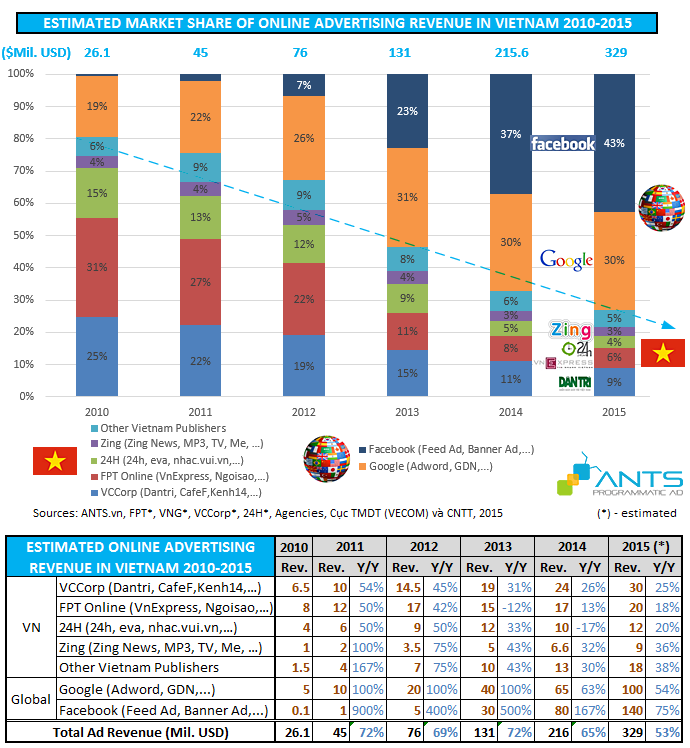
This is the online advertising revenue in Vietnam from 2010 to 2015. It’s quite clear that, in terms of marketshare, Facebook and Google are dominating the market.
Dinosaurs vs mammals (vs unicorns)
The mechanics of how these three types of players throw their weight around the continental ecosystem is troubling for smaller companies. In the case of news organizations in Vietnam, they got sidelined. In Asia, this will be ever-present due to incumbent companies unable to adapt. The result is this:
The silver lining: Asian investment is hot





Stay updated on the go with our mobile app.
Get latest insights with smoother, more personalized experience through TIA mobile app.












📅 Upcoming Events
22 October 2026
Payoneer x CSPN Summit 2026