Leighton Cosseboom · · 6 min read
GrabBike and Go-Jek prepare for a street fight in Indonesia

Ride tech is one of the few sectors where street traffic is just as valuable as web traffic. Jakarta has the world’s worst traffic conditions. For most, it’s a plague to be avoided. But for a select few firms, it represents an opportunity ripe for the picking.
At the end of May, Southeast Asian unicorn GrabTaxi opened up its motorcycle service GrabBike in Jakarta. GrabTaxi has US$340 million to play with and the launch made waves. As a courtesy from co-founder and CEO Anthony Tan, local commuters were able to enjoy free rides for nearly two weeks. GrabBike recorded 8,000 free rides during its first week in Jakarta.
However, as Indonesia’s transportation market represents one of the largest opportunities in Southeast Asia, GrabBike won’t be able to easily champion the scene without facing resistance. In Jakarta’s case, that resistance comes in the form of local competitor Go-Jek, the archipelago’s homegrown “Uber for motorcycles.” Go-Jek has been operating in the local market since 2011, and Jakarta residents can’t leave their apartments without spotting Go-Jek’s signature green jackets zipping through traffic.
But at such an early stage, it’s still anyone’s game. Neither Go-Jek nor GrabBike have the Indonesian market sewn up by any means. A boxing match is set to ensue between these two firms, so in no particular order of importance, here are a few comparison points on how the two contenders stack up.
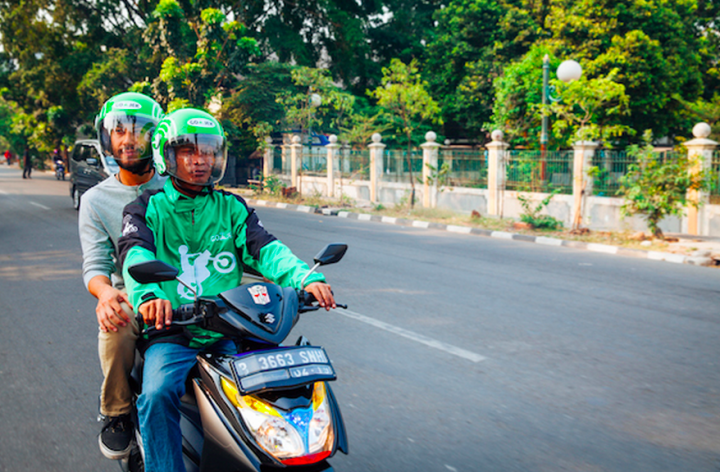
See: GrabTaxi’s motorcycle service rides into its third city, offers free rides in Jakarta
Entrepreneurial pedigrees
GrabTaxi was co-founded in Malaysia by Harvard Business School MBA graduate Anthony Tan. Prior to starting the company in 2012, Tan briefly worked as head of marketing at his family’s business Tan Chong & Sons Motor Company. The firm is known for its Nissan and Subaru franchises, and for holding the rights to represent Changan Automobile in Singapore, Indonesia, Thailand, Vietnam, and the Philippines. It is a subsidiary of the Hong-Kong based publicly traded investments holding company Tan Chong International. Tan Chong & Sons Motor deals in car distribution, but not motorcycles and scooters. It also does vehicle repairs and servicing. Critics could make the argument that Tan was born with a silver spoon, as Tan Chong International is a multibillion-dollar firm. However, it’s worth noting that Tan built GrabTaxi outside the capacity of his family’s enterprise, armed only with an angel investment from his mother.
In the case of Indonesia’s motorcycle fight, Tan’s strength is GrabTaxi’s resources and infrastructure. His weakness is likely his unfamiliarity with the market.

Anthony Tan, co-founder and CEO of GrabTaxi
Nadiem Makarim, founder and CEO of Go-Jek, looks to be a bit more of a hustler. While he too went to Harvard Business School (and in fact was there during the exact years as Tan), Makarim took the route of a McKinsey associate after getting his MBA. Nearly three years later, he was recruited by Rocket Internet to become the Indonesia-based managing director of fashion ecommerce giant Zalora. Makarim took the ride on Rocket for almost a year, then opted for a managerial position at Indonesian payments firm Kartuku. All the while, Makarim had been running Go-Jek on the side since March 2011, even before his days at Zalora. Today he serves as the full-time CEO.





Stay updated on the go with our mobile app.
Get latest insights with smoother, more personalized experience through TIA mobile app.