Grace Priscilla Teo · · 4 min read
Google’s chief scientist reveals the hidden economics of AI
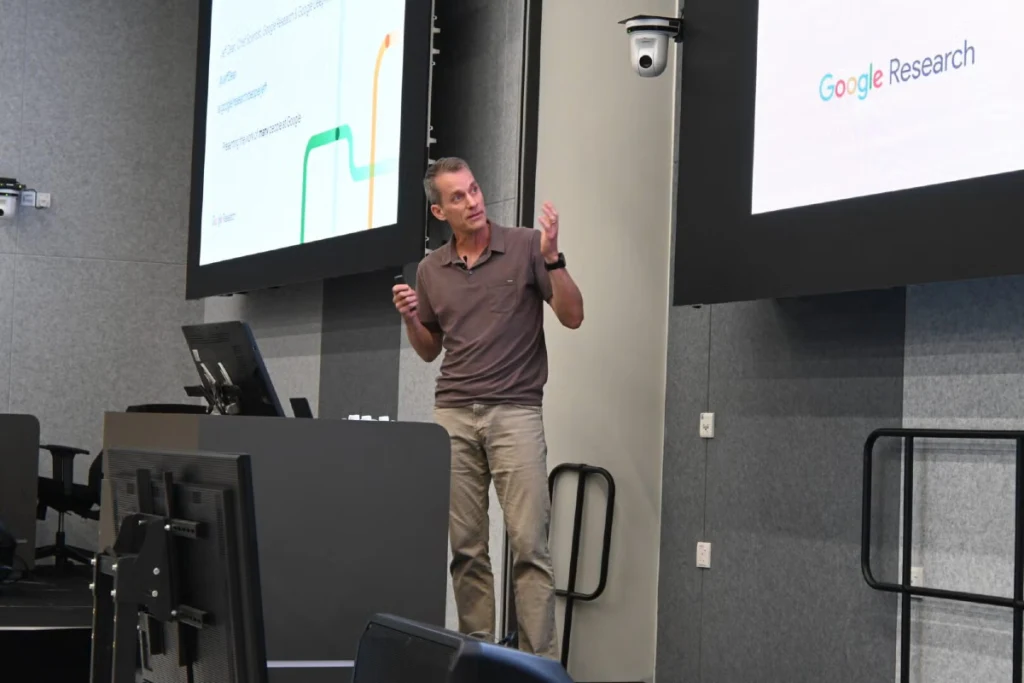
Google chief scientist Jeff Dean / Image credit: NUS
Contrary to fears of mass job displacement, AI will likely expand creative industries. Google DeepMind and Google Research chief scientist Jeff Dean detailed this perspective at the Gemini Singapore Symposium. He outlined a future where AI’s impact is determined by a field’s economic elasticity.
This framework suggests a shift in how we approach AI integration. Dean’s analysis moves beyond technical capabilities to focus on economic and scientific impact. He presents a vision where AI acts as a research partner and a tool for human augmentation.
Industry elasticity will determine AI’s impact on jobs
Dean frames AI’s employment impact through economic elasticity. He argues that in fields with inelastic demand, automation reduces jobs. However, in sectors with elastic demand, productivity gains will fuel industry expansion.
Automation shrinks inelastic markets.
Dean illustrates, “If you think about the agricultural development of like, much more mechanized agriculture… as we got much more mechanized farming, that number plummeted, because demand for food is not very lasting, right? Once you’ve grown enough food, you don’t need 10 times or 50 times as much in that market.”
Elastic markets grow with technological advancement.
He offers, “The observation is that in industries where demand is very elastic, you will actually have, you know, a substantially larger number of people employed in that area and able to make more use of it.”
In software, AI will amplify demand and expand the field
Applying this framework to software, Dean predicts growth. Rather than replacing developers, he believes AI tools will enable the creation of more software. The industry’s capacity will increase to meet a demand for new applications.
Productivity gains will be reinvested into creation.
Jeff Dean argues, “If we create AI coding tools that can make people three times as productive, we’ll mostly take that three times productivity and put it to writing three times as much software for different things than we will to making 1/3 as many people spend their time on software.”
AI is nearing autonomous scientific exploration
The same powerful capabilities expanding the software industry are now enabling AI to conduct independent research. He envisions a near future where humans provide high-level direction to models. The AI will then independently explore vast idea spaces, conduct experiments, and deliver human-readable results.
AI will function like a research assistant with high-level direction.
Dean states, “I think we’re already starting to see in our internal use of Gemini, you can kind of prompt the model to say, ‘hey, I have this vague idea space I’d like you to explore. Please go off and do a bunch of experiments, and run the experiments and then give present the results to me in some interesting human consumable form.’ And [the model is] actually able to do that in some cases.”
This dynamic mirrors a PhD advisor guiding a student.
He explains, “I think the first direction will be humans giving extremely high level direction, like, say, a PhD advisor to a model to go off and then explore, you know, an area in much more depth… I don’t think that’s that far away.”
This research capability extends to physical engineering
This autonomous research paradigm will directly apply to hardware design. Dean believes AI will compress the chip design lifecycle from years to weeks. This will lower the barrier to entry and could trigger an explosion of specialized, custom hardware.
AI can make specialized chip design accessible and rapid.
Dean notes, “If you could shrink the barrier to entry for designing a new chip from, you need a team of 50 to 100 people and 18 months to something that was more like three people and three weeks and 1/10 the amount of other resources could get you a specialized chip. All of a sudden we’d have this explosion of specialized hardware.”
Faster design cycles reduce the need for long-range prediction.
He continues, “That also means you then don’t have to look out as far. Like right now, when you’re designing new AI accelerators, you’re trying to predict what are the models we want to run two years to five years from now, right? And that’s a pretty hard problem… because you’re only trying to look out three months or six months out… that’s a much easier problem.”
AI’s purpose is human augmentation
This augmentation will make specialized expertise widely available





Stay updated on the go with our mobile app.
Get latest insights with smoother, more personalized experience through TIA mobile app.