David Corbin · · 2 min read
Crowdsourced translation service Gengo takes in $5.4M series C
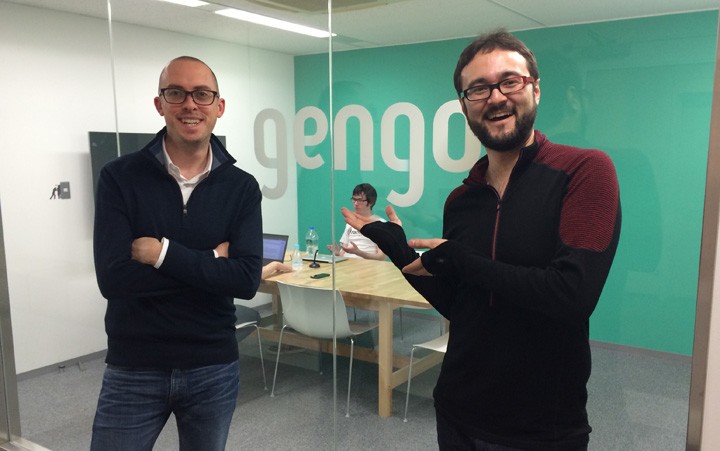
Co-founder and advisor Robert Laing (Left), co-founder and CEO Matthew Romaine (Right)
Gengo, the Silicon Valley-Tokyo hybrid that solves translation woes for firms large and small around the world has just raised US$5.4 million in its series C. Investors were led by Recruit Holdings and included SBI Investments, Mitsubishi UFJ Capital, CrowdWorks, Allied Architects, and Libertad, along with returning investors Intel Capital, Iris Capital Management, STC Ventures Fund Company, and Infocomm Investments. The startup previously raised US$12 million back in 2013.
Gengo connects clients to 15,000 translators. It works in a crowded space with local competitors like Conyac and Wovn, but its dedication to transparency is one way the company keeps bringing in customers. Last November, Gengo debuted its open data program as a way for anyone to check the speed, capacity, customer support, and quality ratings of the translations.
Since the program’s start, Gengo has reduced the average “first action time” – the time it takes for a translator to start working on a project – by 70 percent and the overall turnaround time has fallen by 62 percent. Now, the typical user will submit a project for translation and will see the project begin within seven minutes and finished within 37 minutes. 87 percent of requests are for 500 words or less.
The funding news also comes with the announcement that Robert Laing, co-founder and CEO, will pass control of the company to Matthew Romaine, co-founder and CTO. Laing will stay on as an advisor.
Romaine will be leading the company during a time when machine translations are gaining prominence. Despite recent advancements, he remains confident in Gengo’s importance to the industry. “We see machine translation less as a threat and more as a tool. As everyone has experienced, language is a “living thing,” which continues to grown and change. Every day there seems to be some new catch phrase or hot terminology. Machine translation (MT) by definition is fed by human translation, so will always be a few steps behind. So I believe MT will serve a similar purpose – as a tool in assisting human translation, which will always continue to be a necessary element in helping with global communication,” he tells Tech in Asia.
In the meantime he will be focusing on taking advantage of new cross-border opportunities. “We have an incredibly stable technical platform that has processed over 300M words to date […] our focus is to help businesses – both in Japan and in US and EU – expand globally and prepare for the growing wave of cross-border commerce and travel. For example, we’ve been noticing increasing interest from food and beverage-related companies in Japan preparing their international branding with an eye towards the 2020 Tokyo Olympics,” he says.
Editing by Terence Lee and Steven Millward
(And yes, we’re serious about ethics and transparency. More information here.)





Stay updated on the go with our mobile app.
Get latest insights with smoother, more personalized experience through TIA mobile app.