 C. Custer · · 3 min read
Study shows China’s online propaganda is more ‘Brave New World’ than ‘1984’

Photo of Aldous Huxley: public domain.
China’s strict systems of internet control are often (and with good reason) compared to George Orwell’s dystopian novel 1984. But when it comes to online propaganda efforts, a recent study has shown that China’s approach actually borrows more from that other famous piece of mid-century dystopian fiction, Brave New World. When it comes to pushing its message on social media, China’s aim apparently isn’t to argue with or defeat its critics. Rather, it’s working to overwhelm them with distractions.
The study, which was conducted by American scholars Gary King, Jennifer Pan, and Margaret E. Roberts, claims to be the first emperical look at what’s commonly known as the 50 cent party: China’s vast army of government-sponsored internet commenters. This group, the authors say, is responsible for a whopping 488 million social media posts each year.
The common perception of the 50 cent party is that it’s used to argue with critics. Post something negative about the Chinese government online, and you’ll be swarmed with pro-government commenters trying to poke holes in your story – that is the understood narrative of how the 50 cent party works. But King, Pan, and Roberts’s study suggests nothing could be further from the truth.
Analyzing a database of posts leaked by a local government source in 2014, the scholars found that around 80 percent of 50 cent posts were focused on what they call “cheerleading” – praising government efforts or programs. Another 13 percent were “non-argumentative praise or suggestions.” The study looked at 50 cent posts from a variety of sources and found that without exception, critical or argumentative posts were rare:
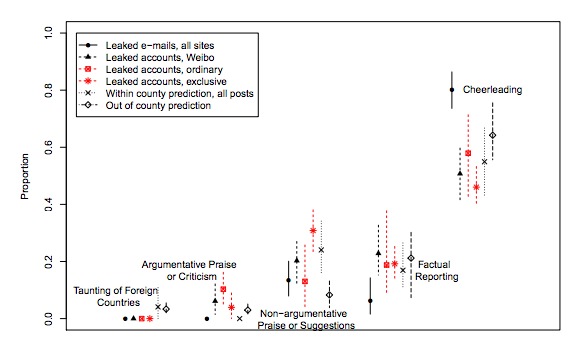
Another interesting finding was that pro-government posts, as one might expect, appear in large bursts when something negative like a riot has happened. Popular belief would have suggested that 50 cent commenters swoop in to attempt to control the narrative, but again, the results of the study suggest otherwise.
In the wake of the Shanshan riots, for example, there was a large spike of pro-government posts, but most of them didn’t address the riots at all. Instead, they were designed to distract, focusing on topics like Xi Jinping’s recent “China Dream” speech or economic growth. In fact, the scholars found “no connection other than timing” between the negative news event and the burst of pro-government posts that followed it.
One of every 178 social media posts on commercial sites are fabricated by the government.
China’s government adopting a theory of distraction rather than engagement on controversial issues makes sense, the study’s authors say. “An argument in almost any human discussion is rarely an effective way to put an end to an opposing argument,” they write.
Plus, censorship tends to make people angry. China certainly censors plenty of social media comments too but, the authors write, “[this distraction-based approach to propaganda] has the additional advantage of enabling the government to actively control opinion without having to censor as much as they might otherwise.”
The study also looked at the size and makeup of the 50 cent party through a series of surveys, with some interesting results. Most 50 cent comments (52.7 percent) are posted on government sites. The rest are posted on commercial social media sites, and the authors estimate that “about one of every 178 social media posts on commercial sites are fabricated by the government.”
And interestingly, the 50 cent party isn’t really paid outside commenters. According to the study, “the [50 cent] party is mostly composed of government employees contributing part time outside their regular jobs.” In fact, there’s no evidence they’re even paid extra for their commenting work.





Stay updated on the go with our mobile app.
Get latest insights with smoother, more personalized experience through TIA mobile app.












📅 Upcoming Events
22 October 2026
Payoneer x CSPN Summit 2026