Michael Tegos · · 5 min read
Australian accelerator Muru-D just launched in Singapore, and it’s looking for startups

Australian startup accelerator Muru-D announced today it’s launching in Singapore. The accelerator is backed by Australian telco Telstra, and has already produced one successful batch of nine startups in Australia that have attracted more than US$2.4 million in follow-on funding. A second batch of 11 startups is approaching its demo day next week. The program will bring startups from across Southeast Asia to Singapore, in brand new premises located near Singapore’s Central Business District (CBD).
Muru is an aboriginal word of the Eora Nation meaning “path” (with “D” standing for “Digital”), and the accelerator’s logo is a path connecting dots. Appropriately, this is exactly what Muru-D hopes to do in Southeast Asia, according to co-founder Annie Parker. “The opportunity here in Singapore is extraordinary,” she says. “We can use it as a jumping on point for the rest of Southeast Asia, and that is hugely exciting to me. There are very few other places in the world where you have that really exciting opportunity on your doorstep. So for us this is about helping to connect dots across the region, finding the very best entrepreneurs, and giving them the chance to grow.”
Open season
Startups can already begin applying to participate in Muru-D’s Singapore accelerator program, and will be able to do so until June 15. Judging will take place on August 6, with a goal of beginning the program in late August or early September. The program itself will last for six months, during which participating startups will receive US$30,300 in seed funding each, workspace in Muru-D’s Singapore premises, and access to mentors, coaches, and investors. Muru-D will obtain a 6 percent stake in each of the startups in return.
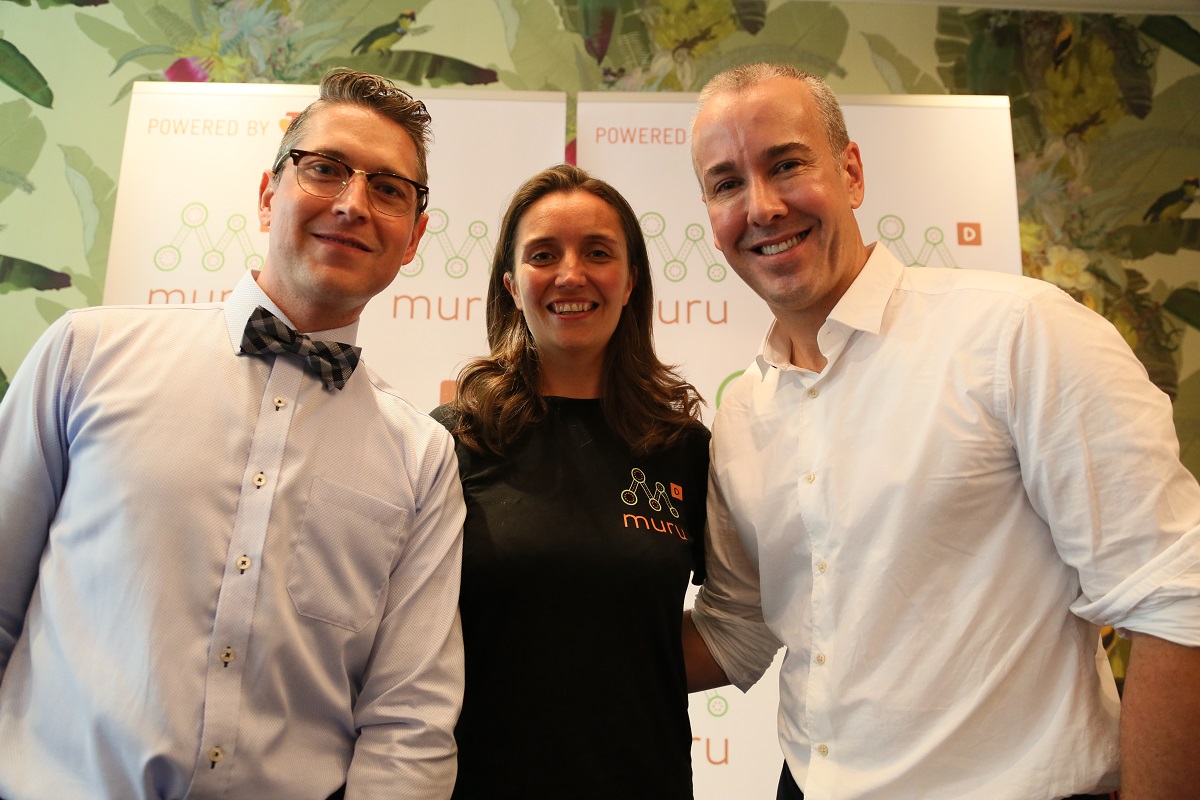
(From L to R:) Joseph Ziegler, Annie Parker, and Jamie Camidge at the Muru-D launch event.
Muru-D will be boosting awareness of the program until the application deadline runs out in June, including exhibiting at Tech in Asia Singapore on May 6 and 7. The team will also be taking its show on the road around Southeast Asia, visiting the region’s capital cities in order to scout for startups that have a shot of being a part of its program.
The accelerator’s CBD location has been strategically chosen to facilitate access to corporate partners. This kind of access is one of Muru-D’s main selling points, made possible through the accelerator’s connection to Telstra. “We really believe that introductions in the right stage of a startup’s growth to corporate partners, channel partners, marketing partners, productization partners, offer incredible potential,” says Jamie Camidge, Muru-D’s head of strategic partnerships and alliances for Singapore. He will be in charge of cultivating these partnerships and working with participating startups to identify the most appropriate relationships for each of them.
“Telstra’s support extends beyond just funding,” he tells Tech in Asia. “One of the things that worked really well in Sydney, and we expect to work really well here, is the introduction of skills in areas like pricing, marketing, and channel management. There’s a whole range of things that young startups struggle with, and we are borrowing the best talent from both Telstra and our partner group to offer [our startups] exposure to thinking that is not always common in the startup ecosystem.”
Come one, come all
In terms of what kind of startups Muru-D is looking for, the team claims it is open to ideas. Joseph Ziegler, Muru-D’s entrepreneur-in-residence for Singapore, has been working with startups one way or another for almost 20 years, both in Silicon Valley and Australia. What he wants to see are strong mobile-first, software-based ideas.
“If we do things on the software side with commodity technology, we’ve got a lot of talent to be able to pull from [in the region],” he told Tech in Asia in an earlier interview. Ziegler defines commodity technology as open source, low cost cloud solutions, which help startups to approach problems from new angles. He also believes that startups participating in the program must be allowed to develop their ideas without having to worry about setting up the basics, such as tools and online services. “I don’t want to see technologists solving technology problems; they should be busy building,” he said.
This is where Telstra’s support and connection will prove critical in order to secure partnerships that offer not just mentorship and guidance to startups, but also resources. All so the startups can spend their time working on their ideas instead of worrying about things like software licenses and cloud storage space.





Stay updated on the go with our mobile app.
Get latest insights with smoother, more personalized experience through TIA mobile app.