Steven Millward · · 3 min read
They just got $18m to escalate the storage wars
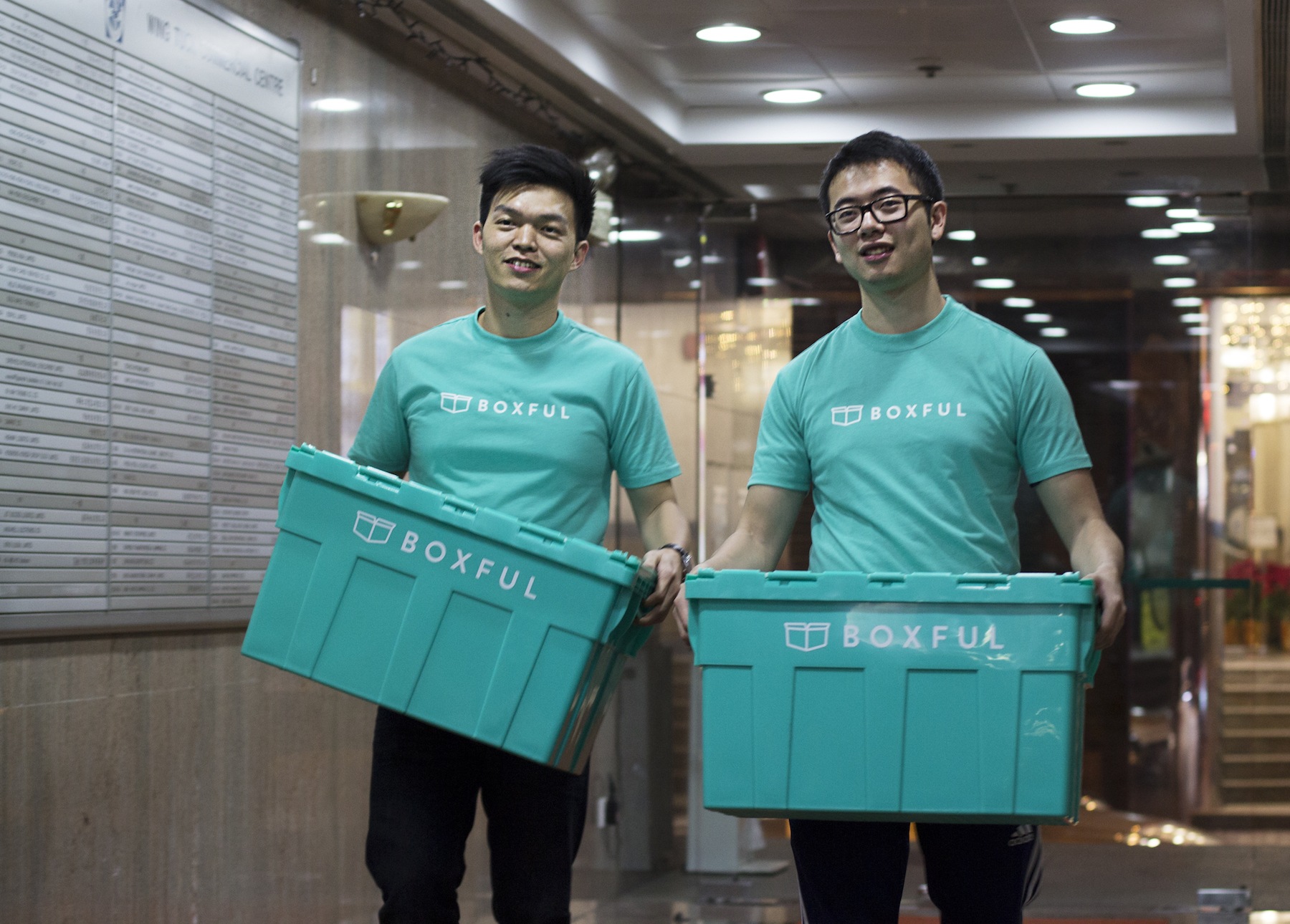
Carl Wu and Norman Cheung. Photo credit: Boxful.
Hong Kong’s housing is the most expensive on the planet – a title it’s held for seven straight years. But all that cash doesn’t get you much space, with people now paying as much as US$600,000 for an apartment the size of a parking space.
That’s playing into the hands of Carl Wu and Norman Cheung, whose startup injects some Uber-esque tech into the decades-old storage industry.
They set up Boxful in 2014 in their native Hong Kong, later expanding to Taipei after getting US$6.6 million in funding mid-2015. This week the duo has a further US$18 million, which they’ll use to expand again.
“First city will be Shenzhen, but we will likely expand to other mainland Chinese cities as well as the rest of Asia fairly soon,” Wu tells Tech in Asia.
Second time lucky
Although the startup has grown its Hong Kong business 30-fold since its previous funding, the storage startup hasn’t found expansion easy, with 2015’s mooted plans for Chinese and pan-Asian expansion grinding to a crawl.
“We postponed our China expansion until now because we were waiting for the market to mature – we have now seen enough data points to give us the confidence,” says Wu. “We also wanted to make sure that we have a scalable profitability model in our main markets, which we do now.”
Its revenue and user figures are not disclosed.

Crowded Hong Kong. Photo credit: ser ge.
It’s up against a number of similar startups that offer a lot more options than traditional self-storage firms – such as providing free boxes, pickups, and drop-offs. Rather than people having to rent a self-storage space by the month, these startups charge either by the item or the surface area. And they work entirely through an app. Spacebox, Redbox, and Klosit are among Boxful’s closest, Hong Kong-born rivals.
Wu says that he and Cheng have been “business partners and friends for a long time” – indeed, this is the pair’s second startup. Their first was a Chinese ecommerce site dedicated to women’s clothing.
“We did achieve some sort of scale, at least in Eastern China, but ultimately could not compete on repeat and unit economics versus Taobao and others,” he explains, name-checking the Alibaba marketplace that now has close to half a billion shoppers.
At least in the storage business they won’t run into any Chinese tech titans. Not yet, anyway.
See more Hong Kong action:





Stay updated on the go with our mobile app.
Get latest insights with smoother, more personalized experience through TIA mobile app.