Josh Horwitz · · 5 min read
Ambi Climate is a smart remote that controls the air conditioner for you
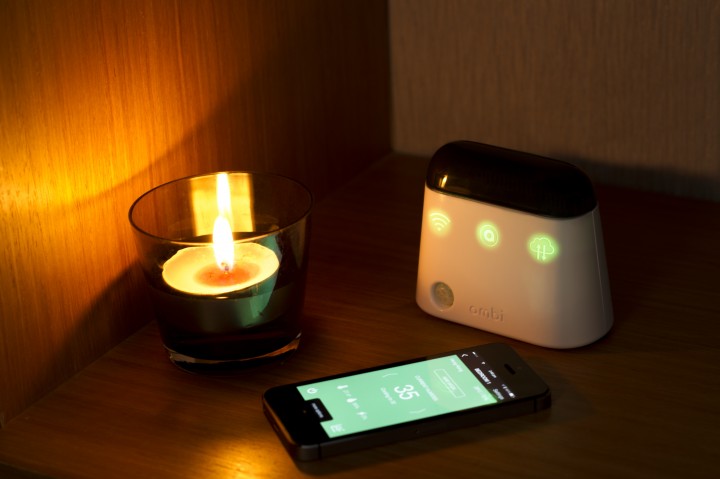
As smart home devices slowly makes its way into ordinary households, Kickstarter is quickly becoming center stage where Internet of Things startups fly or die. Right now, in the fly category, there’s Ambi Labs, a Hong Kong-based company that has designed a wedge-shaped device to control one’s home air conditioner.
Using an in-house algorithm that detects temperature, humidity, sunlight, and machine-specific quirks, and other factors, Ambi Climate controls household A/C’s through infrared rays. It effectively replaces the not-smart remotes that come bundled with most A/C’s in Asia. Ambi Climate owners can open the accompanying app on their smartphone to manually change the temperature via wifi, after which it will learn users’ temperature preferences and adjust its settings accordingly.
Ambi Labs founder Julian Lee tells Tech in Asia he started the company as a means to get back into entrepreneurship and technology, after years working in private equity.
“In my career in private equity, especially following the financial crisis, I saw a lot of money flowing into the region. For someone like me who’s a bit more of of a generalist, I wanted to look for a niche to anchor myself. And as someone with an engineering background who has always been interested in tech startups, I wanted to get back into that sort of thing. I feel a lot of times that enjoying concrete success with a startup is critical to helping other entrepreneurs understand how they can succeed with their own startups. So I started getting involved at a hacker space and saw the internet of things trend was taking off, so I knew I wanted to do something in that broad space.”
According to Lee, Ambi Climate began as a simple wifi-controlled remote for one’s air conditioner. It had none of the predictive functions it contains now. But after receiving lukewarm feedback from users, Lee and his team decided that they would have to double down on machine learning and artificial intelligence in order to make a product people would find useful. Wifi remote controls are cool, but what about a device that automatically turns up the AC temperature in the mornings, making it easier to get out from under the covers?
Of course, building a sunlight-detecting, habit-tracking machine requires a more computing muscle than a glorified remote control. Lee hired a machine learning specialist to help build the algorithms that Ambi Climate uses now. Collecting the data required was one of most challenging parts of the project, Lee says.
We had to take a different approach to some of the other big data-type products that you have out there. In Hong Kong we see a lot of fintech startups. There are teams that pull data from Twitter and Facebook to determine what your credit risk might be, for example. They’re pulling from existing data and making sense of that data. But for us, we really had to start off by collecting the data. what does the temperature look like in this room? How do people use their air conditioners? We’ll ask, “under these outdoor temperatures, and these sunlight patterns, if the air conditioner in this room is set to 25 degrees, what will happen?” Different air conditioners act differently and different rooms have different layouts.
After Ambi Labs collected enough data, it spent another six months testing out prototype models in friends’ apartments. Once the team felt confident enough, they began their first crowdfunding campaign.
Ambi Labs’ crowdfunding experience might make a good case study for startups mulling their own crowdfunding options. The team originally listed Ambi Climate on Crowdtivate, a newly-launched, Asia-facing crowdfunding platform created by Singapore telco Starhub. The campaign bombed, however, raising just under SG$17,000 (about US$15,000) of its projected SG$35,000 after 30 days. On Kickstarter, meanwhile, the team has already tripled its initial target of US$25,000 in less than a week. That story might not bode well for the slew of Kickstarter alternatives that have popped up all over the world. Lee tells Tech in Asia that he believes in Crowdtivate’s mission to bridge the continent’s startup hubs, but attributes the flop to the platform’s newness.
See: The cat facial recognition startup is real, and they’re totally serious about reading cat faces
“For everyone who is interested in crowdfunding in Asia, if they’ve heard of a global site, it’s going to be Kickstarter. When we spoke to people in Japan, they had all heard of the local sites, and then they had heard of Kickstarter. We went to a number of conferences around the region and pitched the crowdivate campaign, a lot of people were interested in the product, but [accepting] the new platform was a challenge for them. There were probably a lot of people that would have backed it if it were on Kickstarter, just because they know what Kickstarter is.” says Lee. “I definitely hope they succeed in their vision, but for us, being one of the first projects out the door, getting the word out was difficult.”





Stay updated on the go with our mobile app.
Get latest insights with smoother, more personalized experience through TIA mobile app.