 Jonathan Chew · · 6 min read
A battered sector is making a comeback. What should you expect?

Guess what has been making a comeback in recent months? That’s right, it’s cryptocurrency and – to a larger extent – the Web3 industry.
The sector went quiet a few years ago because of a few bad actors, and while it’s still around, it is no longer the investor darling that it was in 2020 and 2021.
But thanks to a confluence of factors – some business-related, some not – Web3 is back on the investor menu, with potentially huge shifts coming.
“The landscape has really changed drastically,” says Alec Goh, head of HTX Ventures, the strategic investment arm of crypto exchange HTX.
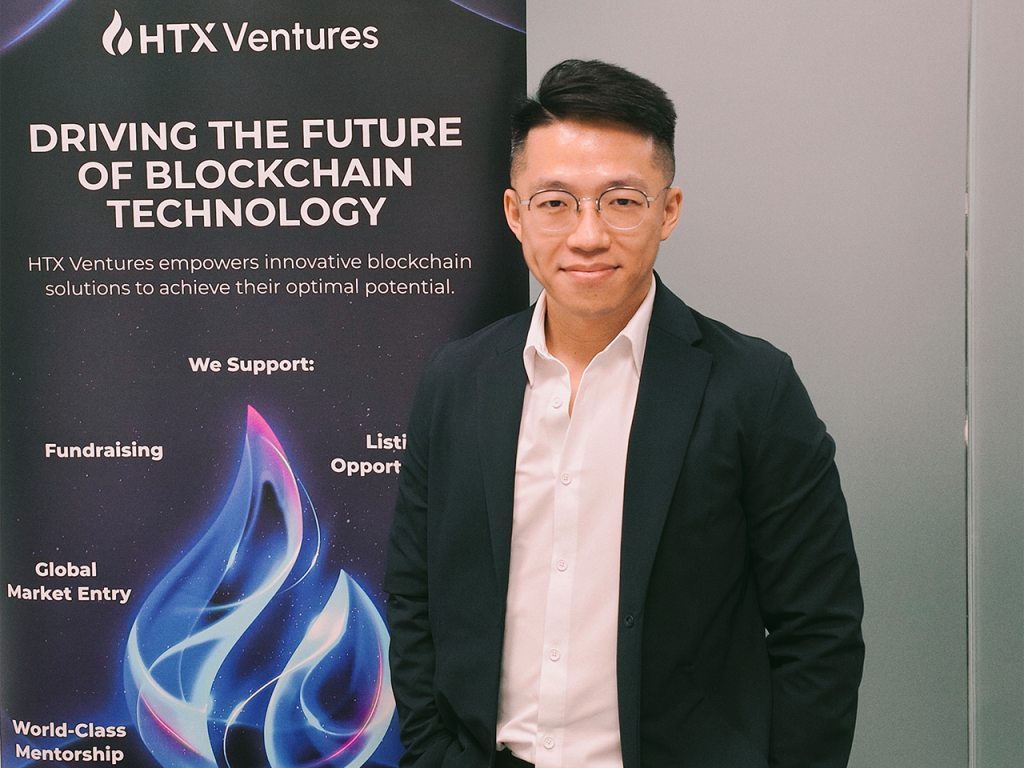
Alec Goh, head of HTX Ventures / Photo credit: HTX Ventures
Prior to joining the company, Goh held M&A and investment roles at Goldman Sachs and Deutsche Bank. This traditional finance background has shaped his views on how institutional-grade frameworks can be adapted for use in the Web3 space.
To learn more about what this means, Tech in Asia speaks with Goh, asking him to complete three fill-in-the-blank statements on Web3’s return in 2025.
Statement 1: This year, the Web3 market is going to mature and gain legitimacy
Goh says one of the biggest votes of confidence in Web3 in recent months has been Donald Trump winning a second term as the US president.
“In the previous administration, there were lots of regulations and enforcement set up,” Goh explains. “The current administration is a lot more supportive and constructive of Web3, which gives investors the confidence to build it as an asset class.”
For instance, Trump recently signed an executive order to establish a strategic bitcoin reserve, which would formally recognize bitcoin as a reserve asset of the US government, according to a report by Reuters.
The US isn’t the only country taking a shine to Web3. Bhutan has been quietly accumulating bitcoin and using it for public sector purposes, such as funding civil servant salaries and healthcare, Goh points out.

The parliament building of Bhutan / Photo credit: Shutterstock
With governments leading the way, Web3 has become a safer space for institutional investors. Banks like Standard Chartered are expecting more bitcoin investments from sovereign wealth funds, with pension funds and even central banks potentially following suit. New types of bitcoin investments, such as spot exchange-traded funds, are already cropping up to meet this new demand.
HTX Ventures foresaw some of these developments roughly a year ago, which gave it the confidence to invest in several high potential projects.
For instance, in June 2024 it made a strategic investment in Babylon, a bitcoin staking platform.
Babylon lets users earn a yield from multiple sources. Platforms like these create an organic demand for bitcoin beyond simply holding the tokens, says Goh.
Since the platform’s launch in August 2024, users have staked around US$4.5 billion worth of bitcoin on it.
“Still, investors need to ensure that we navigate these changes carefully,” Goh adds. “Just because previous investments have done well, it doesn’t mean that a more mature ecosystem will ensure they continue to do well.”
Statement 2: The key to building a sustainable ecosystem in 2025 is focusing on real-world utility
As more institutional investors get involved in the Web3 space this year, the additional capital flows will drive more businesses to build Web3 solutions or services, according to Goh.
Amid this growth, it’s important that investors look out for projects or businesses that provide users with a good solution, have a clear business model, and hold a sustainable competitive advantage.
“Focusing on real-world utility is a good way of driving the Web3 industry’s story,” Goh explains. “With this, we can reduce the more speculative, ‘gambling’ aspect of the sector.”
Examples of this include projects that provide payment rails – underlying networks and infrastructures to move funds without physically transferring money – for stablecoin transactions. These benefit users by offering a channel for faster, cheaper cross-border transactions than traditional banking systems.

Photo credit: Shutterstock
Another example is projects that tokenize real-world assets, offering users – in this case, retail investors – access to assets that were previously too large or sophisticated for them.
For instance, the Watford Football Club in England previously carved out 10% of the club as tokens, allowing fans to own a part of their favorite team.
However, investors will have to be prudent and thorough, ensuring that these projects have the right fundamentals.
“That means validating the investment thesis to see if there’s a sustainable business model, one that can properly generate revenue, before putting in any capital,” Goh says.
Statement 3: This year, the most important TradFi concept to keep in mind for Web3 is risk management
Goh believes that risk management will need to take center stage as funds flow into the Web3 industry this year and beyond.
“In traditional finance, robust risk management has always been built off the blood of previous generations,” he says. “We need to adapt this to the Web3 space so we can avoid repeating those mistakes.”
Goh also notes that in recent years, many Web3 projects haven’t always prioritized risk management, focusing on rolling out their products instead. As such, they might skip implementing important safeguards, leading to disasters – such as getting hacked or rug-pulled by rogue individuals – down the line.

Photo credit: Shutterstock
“For smaller incidents, the industry will survive, but larger ones could set us back even further,” he says. “We need to change this if we want institutional capital to flow in at scale.”
Having regular smart contract audits, for example, can minimize the chances that project founders miss something out and get hacked later on.
Additionally, when creating new tokens, project creators need to ensure that tokens are launched to benefit the overall ecosystem and not just to enrich insiders and early investors. This could mean implementing a lock-in period so insiders can sell only after the project hits certain key performance indicators or milestones, similar to employee stock option plans.
“It’s all about having strong security infrastructure and proper compliance policies to keep things in check,” Goh says.
To the rest of the year, and beyond
As these trends firm up this year, Goh believes that many countries might start to see bitcoin as a form of digital gold or even follow in the footsteps of the US in establishing their own strategic reserve.
Subsequently, we could start to see some movement toward regulatory harmonization.
“The US has been a leader in the space and it’s become a lot more constructive,” Goh points out. “We could see a convergence of different regulatory jurisdictions toward the US one, which will lead to less overall friction and lower costs for businesses.”
That said, he shares that it will take some time for the Web3 industry to shake off old labels.
“The speculative aspect will always be there – it’s human nature and it’ll always exist,” Goh says. “But as an industry, if we want to be taken seriously, we have to address the right issues and grow beyond that.”
HTX Ventures is the strategic investment arm of HTX. It focuses on integrating investment and research to identify and discover the best and most innovative projects in the market. To learn more about what it does, click here
This content was produced by Tech in Asia Studios, which connects brands with Asia’s tech community. Learn more about partnering with Tech in Asia Studios.
Stay updated on the go with our mobile app.
Get latest insights with smoother, more personalized experience through TIA mobile app.
Recommended reads
 Tracking AI hiring in Singapore: OpenAI, Anthropic, and more
 Last to board: why travel may be AI’s final frontier
 Why ‘cheaper’ no longer wins dev deals for Vietnam
 Alibaba’s capex isn’t the full story
 Forget startups. Buy the business running on Excel
 Life’s a game, and AI agents are Animoca’s new play
 Indonesian AI startup goes global
 Forrest Li on scaling Sea, building smarter bots, and founder grit
 An AI assistant that joins sales calls and scores team skills
 Beyond the check: Why VCs need more than capital





Editing by Winston Zhang, Stefanie Yeo, and Mina Deocareza
(And yes, we’re serious about ethics and transparency. More information here.)





📅 Upcoming Events
22 October 2026
Payoneer x CSPN Summit 2026