For this Lunar New Year, Tiffany Chen is trying something unconventional and ordering in a meal for her family get-together.
In the past, Chen, who works in Beijing, would return to her hometown of Hefei – the capital of Anhui province in east China. Her family celebrated the holiday the traditional way by cooking a large meal from scratch on Lunar New Year’s Eve.
But in recent years, attitudes have changed. Her mother felt cooking a big meal was a chore, and she became fed up with oil and smoke. This year, Chen’s mother decided to visit her daughter in Beijing instead.
To keep the celebrations going, Chen started looking at restaurants, trying to make a reservation for a holiday dinner, but found they were packed and her family did not want to go out on a cold night. Then she logged onto Ele.me, a food-delivery service app, and searched “new year’s meal.”
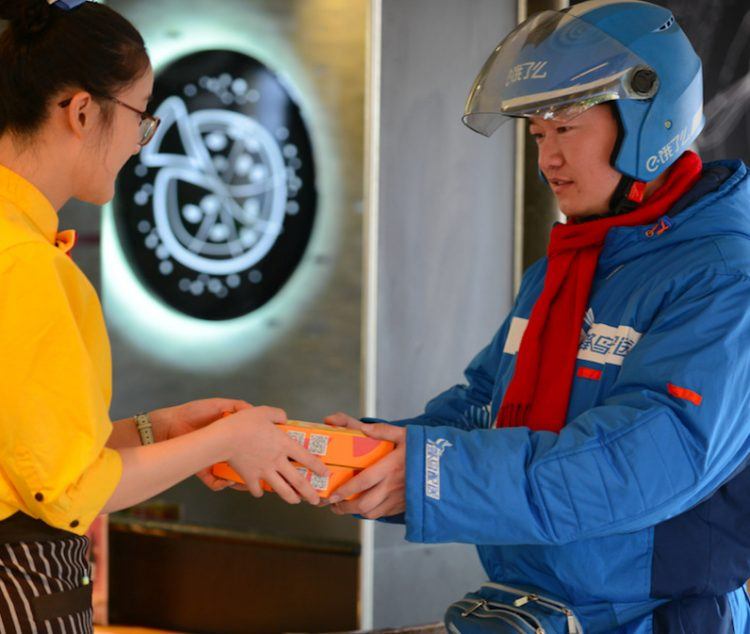
An Ele.me deliveryman picks up a pizza from a restaurant. / Photo credit: Ele.me
“I actually found quite a few results; this apparently is a real thing now,” Chen said.
The ease of ordering takeaway food is one of many ways that technology is changing how Chinese people celebrate Lunar New Year. And this change has been embraced by all generations, not just those raised with gadgetry that has become ubiquitous over the past 25 years.
Dining-out hopefuls using a service like Ele.me find restaurants offer a variety of meals – from Peking roast duck to hotpot and common stir fry – for Spring Festival parties. A hotpot meal from restaurant chain Haidilao, for example, is marked “for five to seven people” at 499 yuan (US$71). For the culinary-minded, Haidilao lists the ingredients of its meals in detail.
Ordering takeaways with a swipe of the finger on a mobile phone has become a trend in China, supplanting the tradition of a home-cooked meal in some households.
Retailers looked to tap into this market as demand grew. Advertisements began flooding social media in the days and weeks before the holiday. One ad on super app WeChat read: “Do not want your parents to be tired cooking at home? Cannot get a restaurant reservation and do not want to clean up afterwards? How about getting your Lunar New Year’s meal delivered? None of these problems will matter.”
In bustling Shenzhen North Railway Station a week before New Year, a father hurries to catch a train, luggage in one hand, a packaged bluetooth speaker box in the other.
Yan Jianlong is from Changsha, the capital of Hunan province. He works as a designer in tech-focused Shenzhen, a city in China’s Guangdong province, to provide for his family back home.
This year, instead of getting local food or other specialities as gifts, he wanted to buy something high-tech for his 10-year-old son.
“I heard he likes these kinds of presents now,” Yan said. “He’s into singing, and the speaker can be hooked up to his phone.”





Stay updated on the go with our mobile app.
Get latest insights with smoother, more personalized experience through TIA mobile app.