Celia Chen · · 5 min read
How DJI went from university dorm project to world’s biggest drone company
In a modern, spacious showroom in Shenzhen, a dozen visitors spend one Wednesday afternoon checking out the sleek-looking products from the world’s biggest drone maker.
The showroom, located in the Weixin Software Science and Technology Park, stands in contrast to the drab, blue-gray high-rise buildings around it – typical of Chinese science parks built in the early 2000s.
That will soon change, though. SZ DJI Technology, whose products are sold in more than 100 countries, has commissioned world-renowned British architectural studio Foster and Partners to design a new headquarters.
This main office will not be ready for another four years, but it is fitting that the Chinese company known as “the Apple of the drone industry” is using the same outfit responsible for designing Apple Park – the US technology giant’s new corporate headquarters in Cupertino, California.
Founded in 2006, DJI has grown from a cramped room in a university dorm to a global enterprise with 14,000 employees and 17 offices internationally. It controls more than 70 percent of the global commercial and consumer drone market and generated sales of 18 billion yuan (US$2.7 billion) in 2017, an 80 percent jump from the previous year.
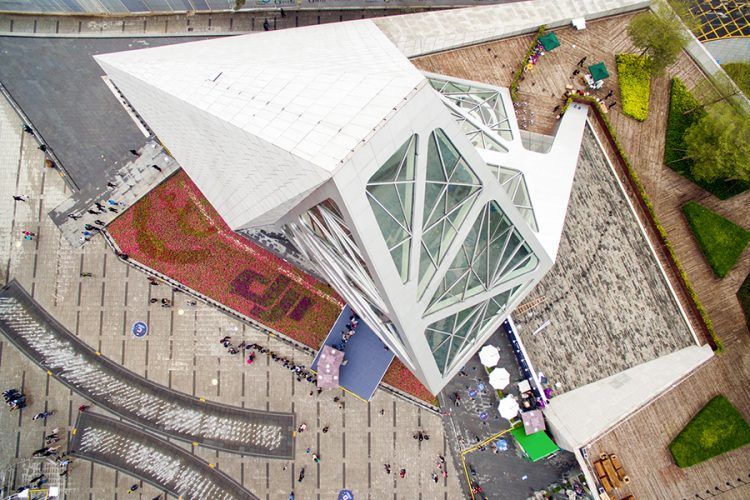
Aerial shot of DJI’s flagship store in Shenzhen, China / Photo credit: DJI
Founder and CEO Frank Wang Tao – the man behind DJI’s growth – seldom speaks in public or gives media interviews. The company said he was not available to be interviewed for this article.
“Frank was passionate about helicopters when he was a child […] He is very private and prefers the spotlight [to be on the products],” said DJI spokeswoman Natasha Gray.
Born in 1980, Wang grew up in Hangzhou, the home base of China’s biggest ecommerce company Alibaba Group Holding, and has been passionate about aircraft since childhood. (New York-listed Alibaba owns the South China Morning Post.)
“I felt very lucky reading a helicopter-themed cartoon when I was a child and have been obsessed with sky exploration ever since,” Wang said in rare public remarks he gave at Shenzhen University in 2015.
“My parents gave me a hobby helicopter as a reward for good marks in a high school exam, but I was very disappointed when it crashed due to limited stability during flight,” he said. “Later, I gradually got a better idea of what a perfect aircraft was and made the decision to build one.”
Wang did not achieve top marks in school, which he partly blames on spending too much time reading about aircraft, and was subsequently rejected by his top choices of Massachusetts Institute of Technology and Stanford University. Instead, he was accepted in 2003 by the Hong Kong University of Science and Technology to study electronics engineering.
In 2005, Wang built a helicopter flight-control system for his graduation thesis, but it failed the night before the class presentation, according to Chinese-language book DJI Drone. Wang’s efforts, however, eventually paid off, and he built flight controllers out of his dorm room until 2006 when he moved to Shenzhen with two classmates to establish DJI, with encouragement from his university professor Li Zexiang.
“In the very beginning, we had different competitors, but they were small,” said Wang in a 2015 interview with Chinese-language news site of Guangzhou-based NetEase. “We made a lot of the right decisions to stand out in the industry […] I think it is DJI’s success that made the drone industry attractive to investors and users.”





Stay updated on the go with our mobile app.
Get latest insights with smoother, more personalized experience through TIA mobile app.