 Jay Ng · · 5 min read
Daily Deals: Controversial, But Important to E-Commerce in Asia
Jay Ng was most recently the general manager for Dealised, a Singapore based e-commerce start-up funded by SingTel Innov8. Prior to Dealised, he was part of the product management team at Sprint Nextel and managed a $100 million+ mobile messaging and data services business. Jay holds an MBA from the Stephen M. Ross School of Business at the University of Michigan.
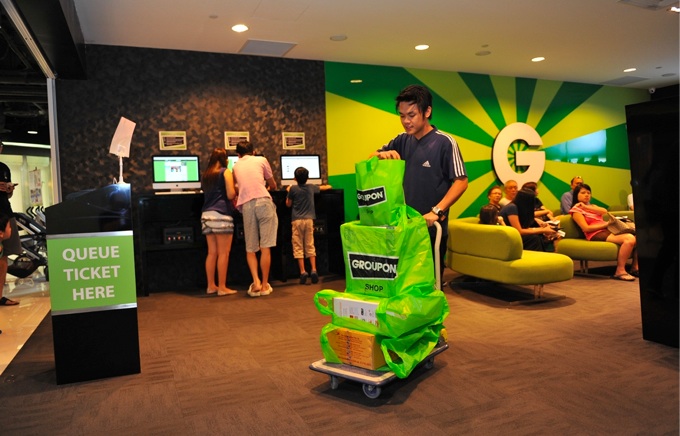
Daily Deals site Groupon, with a shop in Singapore
It’s funny the reactions I’ve gotten when I’ve told people in the tech community that I’m in the ‘daily deals’ (a.k.a. group buying) industry. Generally I get a disinterested reply of “oh, I see” or sometimes even a very blunt “why?” Sure, Groupon’s stock price is flailing at around US$5 and the tech press is now seemingly “over” daily deals since it has stopped publishing stories bashing it.
It’s true that daily deal sites are the epitome of the copy catting gone wild which has plagued the Asian start up scene, however I think the tech community will look back at 2012 as a watershed year for e-commerce in Asia. So where have global e-commerce stalwarts like Amazon, eBay and others fallen short in Asia and how has daily deals filled this void?
1. Daily deals has changed consumer’s attitudes towards shopping by giving them a reason to go online.
Many consumers in regions like Hong Kong, Singapore, and even Thailand look at brick and mortar shopping and mall walking as “shoppertainment.” Hong Kong has always been a head scratcher for e-commerce having a high smartphone penetration (third highest globally per capita), a large consumer segment with available spending income and a high broadband penetration. However it greatly lags China in e-commerce growth with a paltry projection of 7 percent annual growth rate [1].
Daily deals sites have brought Asian consumers online simply because of the great discounts. Consumers go through the “inconvenience” of going online and have gotten over their distrust of buying a virtual good in the form of a deals voucher. What’s more they’re taking the risk of pre-paying for a product or service from mostly unknown merchants without even seeing it! Daily deals is only two years old and already the Hong Kong and Singapore daily deals markets are estimated to be worth between $60 to $70 million annually while Thailand, Malaysia, and the Philippines are in the $25 to $40 million range [2].
2. Daily deals sites instituted “no questions asked” risk free shopping.

Hong Kong's BeeCrazy
One of the obvious challenges of curating deals from merchants and brands is quality control. It’s the hazard of acting as a channel for sometimes unknown merchants to peddle their wares to your customers. As painful as it sometimes was, deal sites provided refunds to customers who complained about anything from a restaurant running out of a lunch set deal the day they patronized the establishment to the merchant themselves going bankrupt and skipping town.
This was the case for Groupon Hong Kong and BeeCrazy who were left holding the bag when Macao Dragon Ferry went under (over 150,000 vouchers sold). Deal sites quickly recognized the power of word of mouth and the importance of preventing churn of a customer to a competitor with a seemingly identical smorgasbord of deals.
3. A pathway for e-commerce to reach the masses.
Daily deals democratized e-commerce by making a multitude of payment options available so that the non-credit card demographics could shop online. For example, in the Philippines there are only roughly seven million credit cards and three or so million credit card holders. The numbers are even less for Thailand and Indonesia. In fact only 5 percent of online Indonesians engaged in e-commerce or online banking, with credit cards being one of the main roadblocks [3]. Over-the-counter payment, ATMs, and online bank transfers are much more the norm for Southeast Asia. Deal sites also offer Cash on Delivery for the most cautious of consumers.
4. A new direct marketing channel for SMBs: the introduction of hyperlocal commerce.
So far I’ve focused on the consumer side of the equation. Daily deals has given local merchants a relatively risk free, pay for performance marketing channel. I say “relatively” because in the early days some merchants were not coached properly on how to manage capacity for deals and were swamped by a flood of redemptions for loss leader deals. Since then, they (and the deal sites) have become much more savvy at pricing and structuring deals so that there is an opportunity for up-selling for a profitable customer acquisition as well as converting a new customer to a returning one.
So where does the industry go next? Lack of congruent payment infrastructures and economical delivery and fulfillment solutions will continue to be a challenge for e-commerce in the near term. Mobile is the obvious next step but it’s one that requires getting a few very important things right.
- Utilizing the context of mobile (location, phone type, time of day, etc.) to drive discovery of deals and effective re-marketing.
- Utilizing the phone as the vehicle for payment. Much has been prophesized about this (think PayPal, Square, carrier billing, NFC, mobile wallets) but the key is to get the app and mobile site experiences right first. This means a super convenient and secure process involving single sign on, mobile optimized payment page flows that are UX tested and then re-tested. Shopping cart abandonment recognition and re-marketing tactics will be key because 3G is not yet reliable in SEA and consumers’ attention spans on mobile vary depending on where they are.
- Utilizing the phone as the tool for redemption. The first step is getting consumers and merchants to adopt a simple system to scan and validate a voucher that’s brought into the store on a phone.





Stay updated on the go with our mobile app.
Get latest insights with smoother, more personalized experience through TIA mobile app.











📅 Upcoming Events
22 October 2026
Payoneer x CSPN Summit 2026