Dr. Serkan Toto · · 4 min read
Nameko Saibai: How “Japan’s Angry Birds” Racked Up 30 Million Downloads
Dr. Serkan Toto is a gaming expert and independent consultant based in Tokyo. You can follow him on Twitter and his blog. This article is republished with his permission.
Puzzle/RPG hybrid Puzzle & Dragons and messenger app Line aren’t the only hypes in Japan’s smartphone world right now.
The third big name that must be mentioned in this context is Nameko Saibai, a series of super-quirky smartphone games that center on cute mushroom characters (nameko is a special mushroom, while saibai means cultivation).
Tokyo-based Beeworks probably didn’t know they were to produce the country’s first really big smartphone game when they launched the first Nameko title, namely Nameko Saibai Kit (English version: “Mushroom Garden” or “Funghi Gardening Kit”) in June 2011 on iOS – eight months before Puzzle & Dragons.
Today, if there is one company that can be labeled as a Japanese counterpart of the makers of Angry Birds, Rovio, it’s Beeworks – albeit on a small scale.
The first game in the franchise
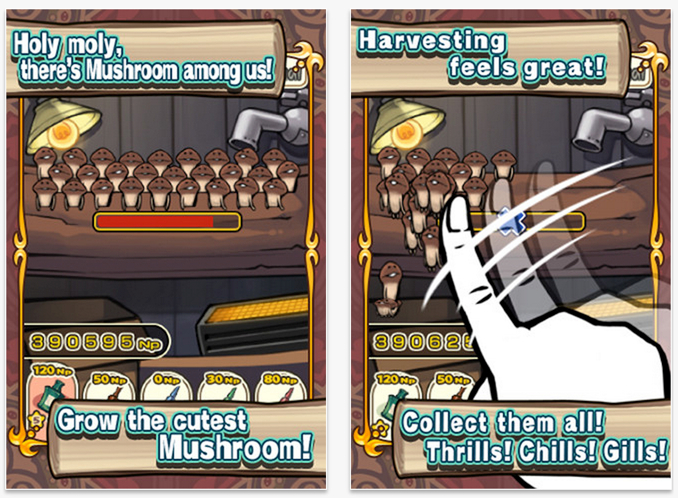
As the title suggests, players need to grow mushrooms on a piece of wood, and wait a while for them to grow before harvesting them by swiping over the screen. There are varieties of Nameko, some of which are harder to get than others. The goal of the game is to “collect them all”. There is basically no real game play, no high-quality graphics or music (quite the contrary), and no social hooks.
Reasons I heard from Japanese players why they like the game so much include “I like the feeling of swiping over the screen to harvest the mushrooms”, “The Namekos are so cute”, and “I love how they say NNFF NNFF when I harvest them”.
This first Nameko game took Japan by storm (without any marketing at the start) and currently boasts 11 million downloads across iOS and Android, putting it in Puzzle & Dragons territory.
Variations on a theme
Much like Rovio with its numerous editions of Angry Birds, Beeworks was very clever in creating variations of essentially the same game and making use of its existing user base for distribution. There are two different versions in addition to the original, namely Nameko Saibai Kit Seasons (users can harvest different mushrooms, depending on the season) and Nameko Saibai Kit Deluxe (which has some improvements, i.e. BGM).
Beeworks has been seeing considerable success with this strategy, in Japan and some Asian countries. The company is offering English versions of Nameko (on iOS and Android), but success outside Asia has been limited so far. As of April 7 this year, all Nameko Saibai Kit games have been downloaded 30,192,789 million times worldwide.
Parallels to Rovio
The Japanese developer can’t think in billions like Rovio does, but the numbers above are pretty impressive, and there are a few parallels between the two companies. For instance, much like Rovio, Beeworks was a small company that was around for a long time but largely unknown before landing its first real big hit (Beeworks was established in 1998, Rovio in 2003).
Both companies rolled out variations of their hits in quick succession and cross-promoted them inside the existing user base: the “Seasons” versions even share the exact same name and idea. Both franchises are specifically made for touch screens, feature “character-focused” design, come with a low learning curve and with extra-cute graphics and sound.
But the biggest parallel can actually be found somewhere else.





Stay updated on the go with our mobile app.
Get latest insights with smoother, more personalized experience through TIA mobile app.