
As Southeast Asia continues to develop into one of the world’s largest economies, cities in the region will have to reckon with the byproducts of rapid urbanization and digitalization.
Jakarta, for example, is infamous for its traffic gridlocks. It also deals with other challenges such as flooding and waste management. In a bid to solve these issues, the city has turned to artificial intelligence.
To this end, the Indonesian government launched the Jakarta Smart City (JSC) initiative. Built on six pillars, the program uses AI to tackle the city’s governance, people, living, mobility, economy, and environmental issues. It actively encourages public collaboration as well, allowing citizens to submit complaints and suggestions in several ways. In turn, this promotes transparency and the data-driven nature of the local government’s work to provide better public services.
The success of such programs is heavily reliant on efficient and effective data management. That’s why JSC partnered with Indonesian AI firm Nodeflux. Aside from data management, the company provides solutions such as computer vision and real-time video analysis, which help in the development of government policies in areas such as smart governance and smart mobility. It has collaborated with the Indonesian National Police to provide surveillance at high-profile international events, including the 2018 Asian Games and the 2018 International Monetary Fund and World Bank meeting.
“Facial recognition helped with security, and also with tracking crowd estimation and behavior,” says Meidy Fitranto, CEO and co-founder of Nodeflux. He believes that when this technology is used in conjunction with police and government efforts, it can help cultivate a safer society.
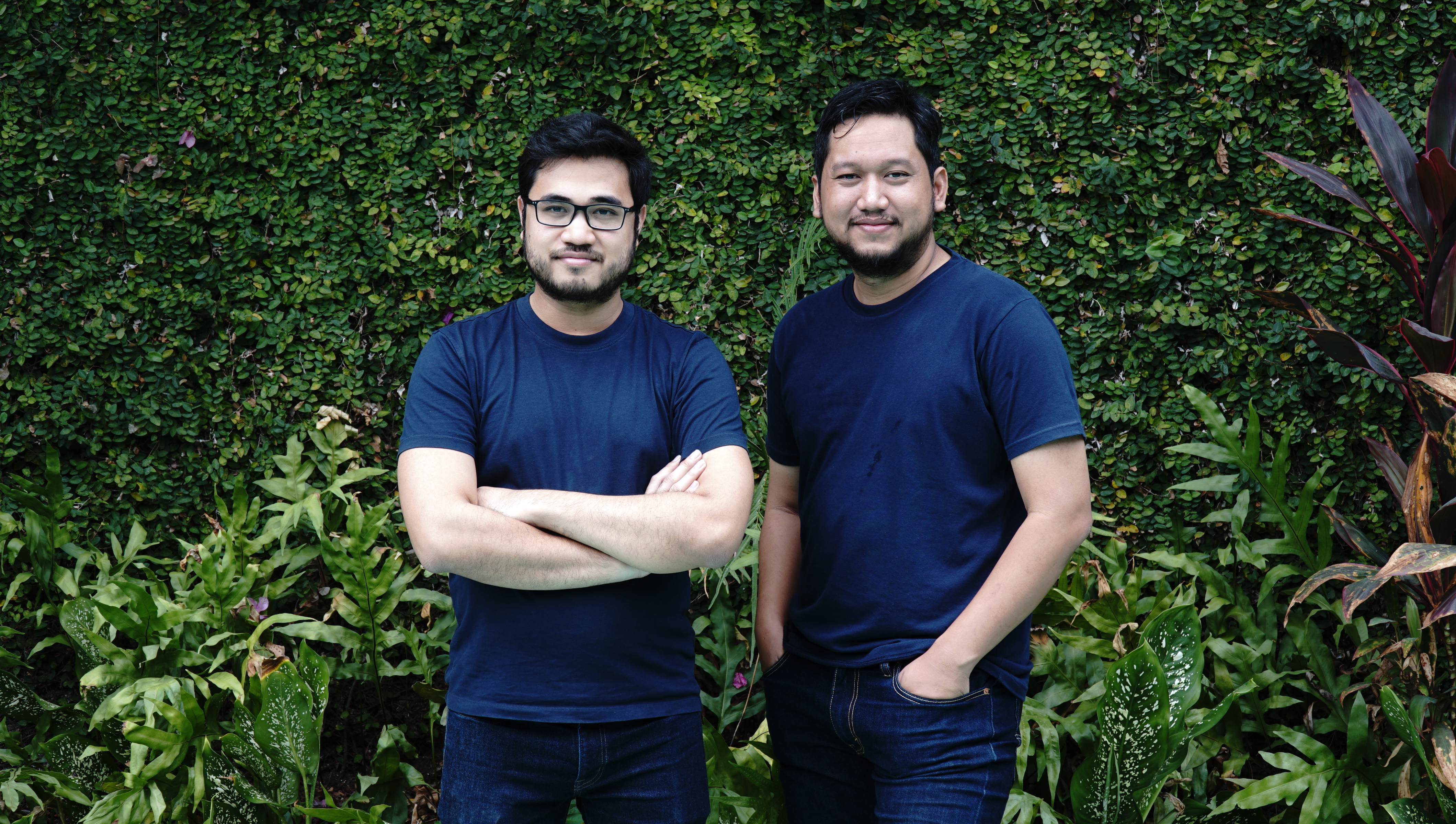
Nodeflux founders (From L to R): Faris Rahman and Meidy Fitranto / Photo credit: Nodeflux
Fitranto points out that AI adoption in Indonesia is “highly ranked in the ASEAN.” The country leads Southeast Asia in AI adoption, with 24.6% of organizations integrating the technology into their operations. Thailand is second at 17.1%.
This lead is driven by a digital-first mindset and the influence of internet giants such as Gojek and Tokopedia.
The CEO describes Indonesia’s tech industry as a self-sustaining ecosystem with trickle-down effects. “We gain knowledge and inspiration from those who’ve come before,” he says.
More talent needed
While this paints a rosy picture of the AI landscape in the archipelago, challenges to the growth of the industry still exist. Three main components drive effective AI use – algorithms, computing power, and data – and these are areas that Indonesia could stand to improve greatly.
The problem largely stems from a lack of expert talent. And as Indonesia’s digital economy is forecasted to grow to US$100 billion in 2025, the demand for such talent is only expected to go up.
“It’s very difficult to find AI talent in Indonesia,” says Fitranto, who also points out the need to reverse the brain-drain trend. “We have to attract Indonesians who have moved to places like South Korea, Germany, and the UK to come back to continue the development of technology in the country.”
To foster more local talent, Fitranto says the administration can do more to educate and engage the populace. “The government should provide more awareness on the future direction of the industry, about how this technology, Industry 4.0, and so on will progress significantly in the next few decades, and how we should prepare, as a country, to be ready for these changes,” he suggests.
The CEO adds that the administration also plays a key role in educating the public on AI and what it can do, as well as how it can improve the nation.
Awareness and education
Nodeflux actively engages the community in an effort to share knowledge and spread awareness. For example, it organized the Indonesia AI Forum together with chatbot developer Kata.ai. Nodeflux also works closely with the government and universities to develop curricula to train the next generation of AI and data professionals.
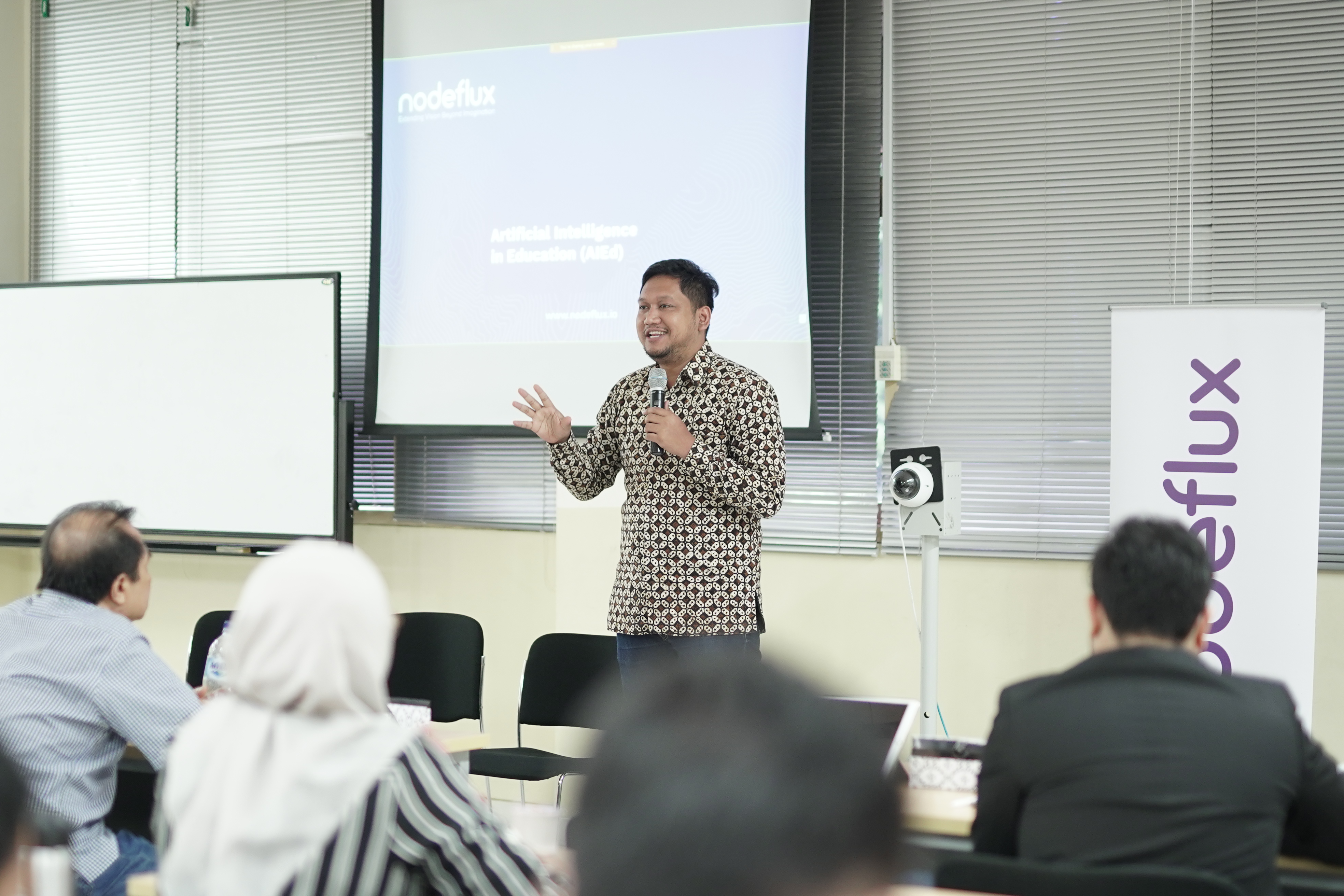
Fitranto speaking at a university event / Photo credit: Nodeflux
Still, the issue is not something that the startup can fix on its own, and Fitranto is under no illusions that it can.
“The government, the private sector, academia, and communities – to speed up and enhance the process of innovation of the tech development, we have to work together,” he insists. “No one part can work on its own.”
The market potential for AI in Indonesia is sizable. A large economy and population brings with it big challenges, but also many opportunities for AI solutions.
The bigger-picture concern is to ensure that Indonesia can harness this potential.
“In terms of long-term sustainability, Indonesia can’t just be a consumer of foreign technologies,” Fitranto stresses. “We should also develop our own solutions. We should be independent and have our capabilities, and not be just a passive consumer. We have the capacity to build our own solutions.”
Set up in 2016, Nodeflux is a leading AI company in Indonesia that focused on big data when it was starting out. Eventually, it developed deep-learning computer vision to provide intelligent video analytics solutions that help to solve complex issues faced by multi-sectoral industries and modern society.
It is the only Indonesian vision AI company to be a part of Nvidia’s Metropolis Software Platform Program, as well as the first Indonesian vision AI firm listed on the National Institute of Standards and Technology leaderboard.
Find out more and get in touch at their website.
Stay updated on the go with our mobile app.
Get latest insights with smoother, more personalized experience through TIA mobile app.
Recommended reads
 ASEAN gets a tailored risk tracking tool
 The 99% AI traffic threat (and how business survives)
 Southeast Asia’s data center boom has a water problem
 A middleman model makes free patient tracking possible
 Singapore to establish National AI Council, AI missions
 Inside OpenAI’s public-first bet on medical AI
 ‘Not how humans act’: how agentic AI is changing cyberattacks
 Has Southeast Asia reached its AI inflection point or stalled at pilots?
 Amartha banks on grassroots strategy to drive financial inclusion
 Southeast Asia pulls ahead of global average on AI adoption





Editing by Jaclyn Teng and Eileen C. Ang
(And yes, we’re serious about ethics and transparency. More information here.)





