Leighton Cosseboom · · 6 min read
Sidestepping the tax axe: Should foreign startups in Indonesia be taking cues from Uber?

Last week, international ride-hailing app Uber announced it was ready to cooperate with the Indonesian government by getting itself registered through the appropriate legal business channels in Jakarta.
“We are committed to working and growing our business in Indonesia,” Uber spokesperson Karun Arya tells Tech in Asia. “The response has been tremendous and we feel that there is so much more to do. We have listened to the authorities’ request and are now looking forward to a new dialogue towards fully regulating our business.”
The announcement came just a couple of weeks after five Uber drivers were arrested in a sting operation and detained for operating without the proper business permits in the capital. The arrests were likely the result of local taxi companies lining up against Uber which cuts into their market shares by using private vehicles instead of taxi cabs.
“We’re currently in the process of sending the application to create an investment company in Indonesia,” Alan Jiang, acting head of Uber Indonesia, told the media. He added that the company’s course of action in Jakarta will lead to a local entity that’s fully owned by Uber. Through the entity, Uber will be named as a tech firm, not a public transport company, as previously suggested by the Organization of Land Transportation Owners (Organda) chairman Shafruhan Sinungan.
See: Why Uber will fail in Jakarta, and why it won’t
Ponying up the cash
Earlier this year when Twitter opened a representative office in Indonesia, the nation’s tech minister Rudiantara implored the social network and all other foreign startups to incorporate.
However, this is easier said than done, as setting up a new business in Indonesia can be nightmarish. Rules and requirements are often unclear and Boston Consulting Group’s e-Friction report names Indonesia as the most sluggish country in Southeast Asia in terms of setting up a new firm.
Indonesia’s Negative Investments List also comes into play. The list of regulations limits the industries in which foreign firms can legally get into in the archipelago. These limits range anywhere from zero percent to 95 percent ownership allowance. Some of these businesses include advertising, motor vehicle testing, and pharmaceuticals. An important one relevant to Indonesia’s tech scene is ecommerce.
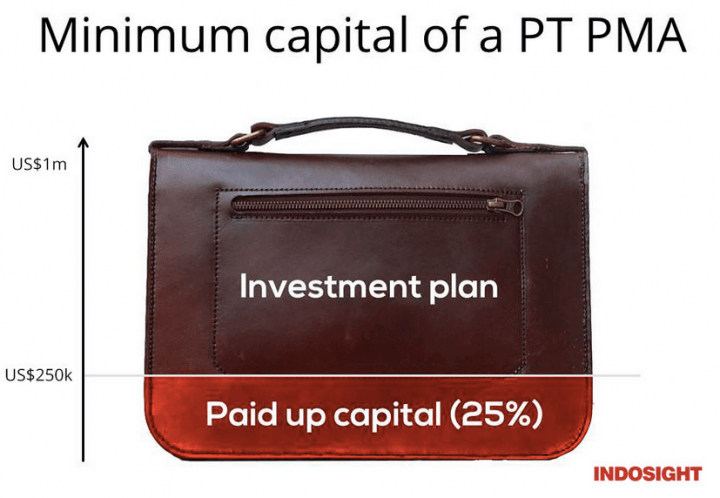
Market entry services firm Indosight says the minimum capital requirement to set up a foreign investment limited liability company (also known as PT Penamanan Modal Asing, abbreviated as PT PMA) was Rp 10 billion (roughly US$1 million). Market entry consulting firm Cekindo confirms this. The amount needs to be part of a company’s official investment plan with a quarter of it paid up front into the company’s Indonesian bank account.
It’s important to note that a PT PMA is different from an PT (Indonesian-owned limited liability company), which can be set up more easily by an Indonesian citizen, but bars foreign ownership.
Straight and narrow
Until this year, foreign firms were able to get away with just having an investment plan on paper and Indonesia’s Investment Coordinating Board (BKPM) would rarely reject it, says Indosight. Since March 2015, many company applications, especially those in the service sector, have been rejected. The main reason is that the BKPM is not convinced those companies would actually invest all their cash into Indonesia. The BKPM suspects foreign companies have been faking their investment plans, and are now more cautious of whether the proposed investment will actually be realized in the archipelago. The government is now requiring all PT PMA applications to contain officially audited financial reports.
Naturally, not all tech startups looking to make cross-border plays have a million bucks in their coffers, or even a quarter of that. for that matter. Uber does, but it’s a multinational corporation that raised more than US$2 billion from investors in June and December last year. In the grand scheme of things, establishing a limited liability company in Indonesia is more like paying a speeding ticket for the ride-hailing juggernaut.
Where do Indonesian taxes go?
Don’t be a hero like Uber





Stay updated on the go with our mobile app.
Get latest insights with smoother, more personalized experience through TIA mobile app.