- Insights This article was written by a TIA community member. Insights pieces undergo the same rigorous editorial process that newsroom-produced articles have.
 Qin En Looi · · 4 min read
How Web3 can solve community building (part one)
This piece was written by Qin En Looi and Joash Lee of Saison Capital.
Has technology brought us together or torn us apart?
Over the past two decades, social networks and communication tools have enabled seamless interpersonal interactions at scale. However, whether these platforms make relationships closer is debatable.
Image credit: Timmy Loen
We feel more disconnected than ever – a phenomenon that has been accelerated by the Covid-19 pandemic, leading to almost eight in 10 individuals feeling lonelier than before.
We believe this is exacerbated by the lack of communities. Most of us are no strangers to the benefits of community, such as a sense of belonging and camaraderie with peers based on shared interests.
Yet communities built atop Web2 technologies often fail to satisfy our desire for connection with others for the following reasons:
- Lack of ownership and participation
Participation in Web2 communities is often like movie-watching: Members have minimal input in the group’s direction and decisions, and their voices can easily be stifled by leaders. What members really want is to be part of the plot and be involved in shaping the communities they’re part of. - Benefits are accrued by owners, not members
When communities grow, owners and technology providers (such as Facebook and LinkedIn) reap the rewards, while members are products. Without a piece of the pie, there is little incentive for members to invest in a community’s betterment. - Lack of transparency and accessibility
The decision-making process in Web2 communities is often top-down and opaque. For instance, Twitter’s sudden decision to monetize account verification caused an uproar as impersonators confused users. Access to communities can also be based on existing relationships, restricting accessibility to new entrants.
In light of these challenges, Web3 communities have been touted as a game-changer, leading to the rise of token-based communities such as the Bored Ape Yacht Club and MakerDAO. There are clear benefits to communities built on Web3 technologies, particularly tokens (both fungible and non-fungible):
- Increased ownership and participation
Tokens denote ownership and involvement in a community, giving members the means to amplify their voices, vote on decisions, and join discussions. - Shared benefits
The upsides of building a vibrant community are shared between members, owners and technology providers. As communities thrive and become more attractive to non-members, the value of tokens that serve as proof of membership goes up, and members can reap the rewards. - More transparency
Web3 technologies and ethos foster transparency, with high-impact decisions made collectively and recorded on-chain so the outcome is public and immutable. Authority and control are no longer ceded to a single party.
Road blocks to full potential
While some of the benefits mentioned above have materialized in existing Web3 communities, there are hindrances to their full potential. Drawing on dozens of conversations with community leaders and founders who build community management tools, we have some key findings:
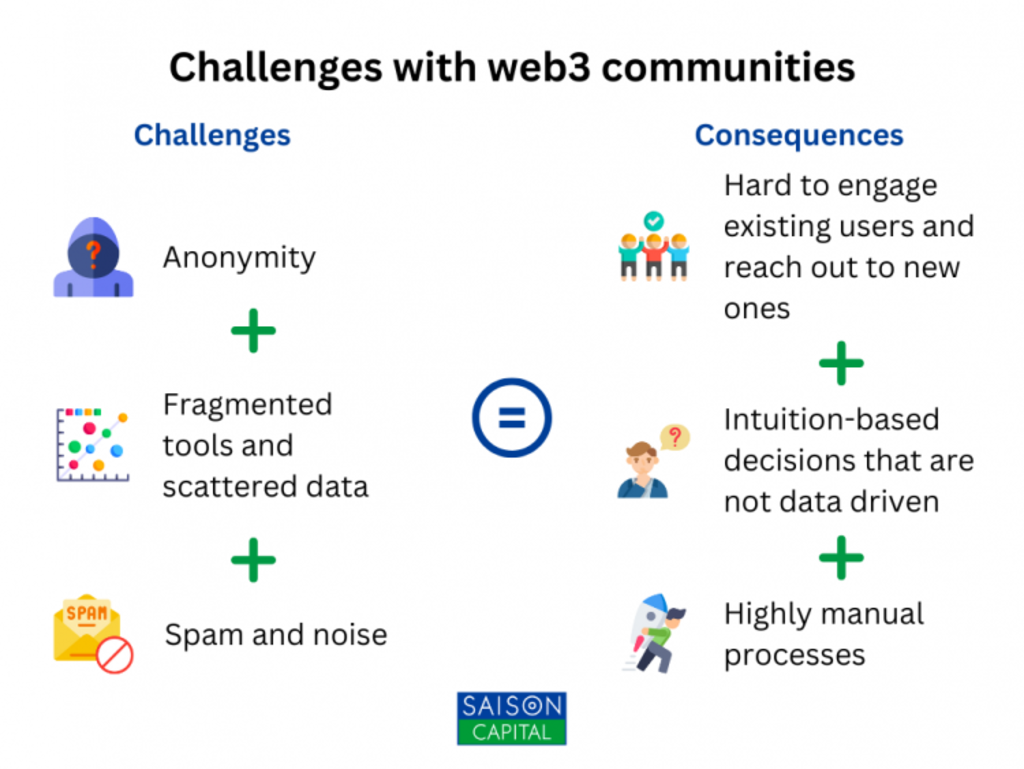
Image credit: Saison Capital
1. Anonymity
Issues with community management





Stay updated on the go with our mobile app.
Get latest insights with smoother, more personalized experience through TIA mobile app.











📅 Upcoming Events
22 October 2026
Payoneer x CSPN Summit 2026