Kul Bhushan · · 3 min read
Indonesia’s appetite for food delivery to grow by 3x, says Hangry CEO
Cloud kitchen firms are here to stay in Southeast Asia. After gaining an impetus as the byproduct of the Covid-19 pandemic, cloud kitchens are betting on the new normal of ordering food online.
Speaking at a virtual roundtable at this year’s Tech in Asia conference, Hangry co-founder and CEO Abraham Viktor said that the food delivery market in Indonesia has been growing at a faster pace than traditional restaurants in the last five years, and this trend will continue in the future as well.
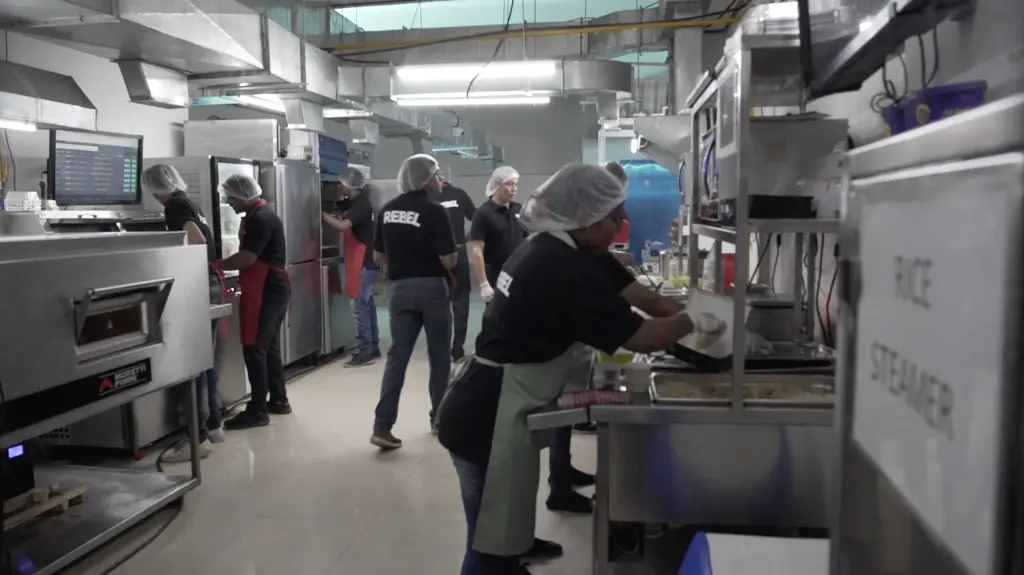
Food being prepared at a Rebel Foods’ cloud kitchen / Photo credit: Rebel Foods
“It’s a lifestyle that will continue to be more and more ubiquitous. … We’re looking at another 3x of market size in the next five years compared to where we are right now,” he added.
According to Grand View Research, Indonesia’s cloud kitchen space is estimated to grow at a compound annual growth rate of 20.7% from 2021 to 2028. The country also accounts for the biggest share in the food delivery space in Southeast Asia, with an estimated gross merchandize value (GMV) of US$3.7 billion in 2020. Completing the region’s top three food delivery markets are Singapore and Thailand, with US$2.8 billion and US$2.4 billion in GMV, respectively.
See also: Cloud kitchen operator plots aggressive SEA expansion with unique approach
Despite the Indonesian market being the largest in the region, Rebel Foods co-founder Ankush Grover said that the market is still underpenetrated. He shared that there is one restaurant for 1,000 people in Indonesia, whereas China has seven restaurants for the same number of people. He added that Rebel Foods is already the third largest player in Indonesia in terms of number of restaurants since its arrival in the market two years ago.
Grover also said that factors such as the growing penetration of internet connectivity and the habit of ordering food online will further help the cloud kitchen space. He revealed that Rebel Foods was getting good traction in tier 2 and tier 3 cities in Indonesia as well.
“We saw a similar pattern in India. In fact, we’re more bullish here, and we’re doing really well in this market,” he added.
The Rebel Foods co-founder said that the company is planning to continue focusing on the Indonesian market for at least the next couple of years. Last week, the Indian cloud kitchen firm recent raised US$175 million in its series F round to achieve unicorn status.
See also – The dark – and bright – side of cloud kitchens
On the overall Southeast Asia market, Grover said the company had taken a different approach in markets like Malaysia, Singapore, Thailand, and the Philippines. In these countries, Rebel Foods has given its “brand as a service,” where existing kitchens use the internet restaurant chain’s operating systems to carry the company’s offerings.
The Covid-19 impact
Hangry’s Viktor said that the company’s first outlet started in November 2019, just a few months before the onset of the pandemic. He added that one of the notable changes in terms of consumer behavior was the expectation of safety and hygiene.





Stay updated on the go with our mobile app.
Get latest insights with smoother, more personalized experience through TIA mobile app.