Stefanie Yeo · · 5 min read
How travel and tourism startups can keep pace with the ever-changing tourism landscape

Over the last year, digitalization has been the name of the game for the travel and tourism industry as businesses in the space to turn to digital solutions in order to adapt to the challenges brought about by the Covid-19 pandemic.
Navigating the ever-changing restrictions and guidelines has been especially challenging for tourism businesses. Even as cities begin to open up and domestic tourism picks up the pace, hotels and other related businesses have faced difficulties delivering the same quality of service in the face of manpower crunches and a situation that is constantly in flux.

Universal Studios Singapore, before the pandemic / Photo credit: Saiko3p/123RF
That’s where the Tourism Information and Services Hub (TIH) comes into the picture.
One of the biggest hurdles businesses face in digitalization is in keeping things up-to-date and scaling the information they have available for their customers, according to Joseph Ling, the founder and CEO of traveltech startup Vouch.
“We’re in a situation that changes very quickly, and people are embarking on digitalization, where you [will] run into issues about keeping stuff updated, about scaling the information,” he says.
This was something that Vouch, which offers a digital concierge and chatbot product, also struggled with before finding a solution with TIH.
All in one place
TIH is a digital resource platform developed by the Singapore Tourism Board that gives companies like Vouch easy access to content about Singapore’s wide range of tourism offerings and travel software services. Businesses can list their services on TIH, and others can tap into the platform’s repository of information to enhance their own offerings.
For example, TIH provides information about a variety of tourism and travel-related businesses in Singapore, such as ticket prices and opening hours of attractions as well as details about restaurants near a location, which Vouch integrates into its own product. With TIH, Vouch was able to address a key challenge that it faced with developing its product.
The biggest bottleneck Vouch encounters when developing a digital concierge, according to Ling, lies in gathering all the information the chatbot needs to work – a process that can take three weeks to a month to complete.

The Andaz Singapore hotel is one of Vouch’s clients / Photo credit: Andaz
This is compounded by the fact that a lot of hotels want their digital concierges to go beyond just managing internal processes like room requests. Typically, concierges have also served as a resource hub for visitors, providing information and recommending activities and eateries in the area.
“We needed to add information outside of the hotel because people often ask, ’What’s there to do around here? Where can I go shopping?’ or things like that,” points out Ling. “However, if we have to do this at an individual level, hotel by hotel, it’s very tedious. And when you consider the fact that we cover about 20% of all hotels in Singapore, it’s just unscalable.”
Putting the pieces together
Using TIH allowed Vouch to provide the extra features that its partners wanted in a much more scalable and efficient manner. Adding this information into Vouch’s platform was as simple as integrating TIH’s application programming interfaces (APIs) into its system.
“We have a standard set of API calls that we’ve already built into our systems so that the TIH API sends and pulls the information,” explains Ling. “For example, we can give the location of the hotel and ask for nearby attractions or shopping malls, and TIH sends that information to be displayed within our platform.”
For the end user, getting the answers they seek is as easy as typing a query into the digital concierge of the hotel in question. All the magic happens in the backend.
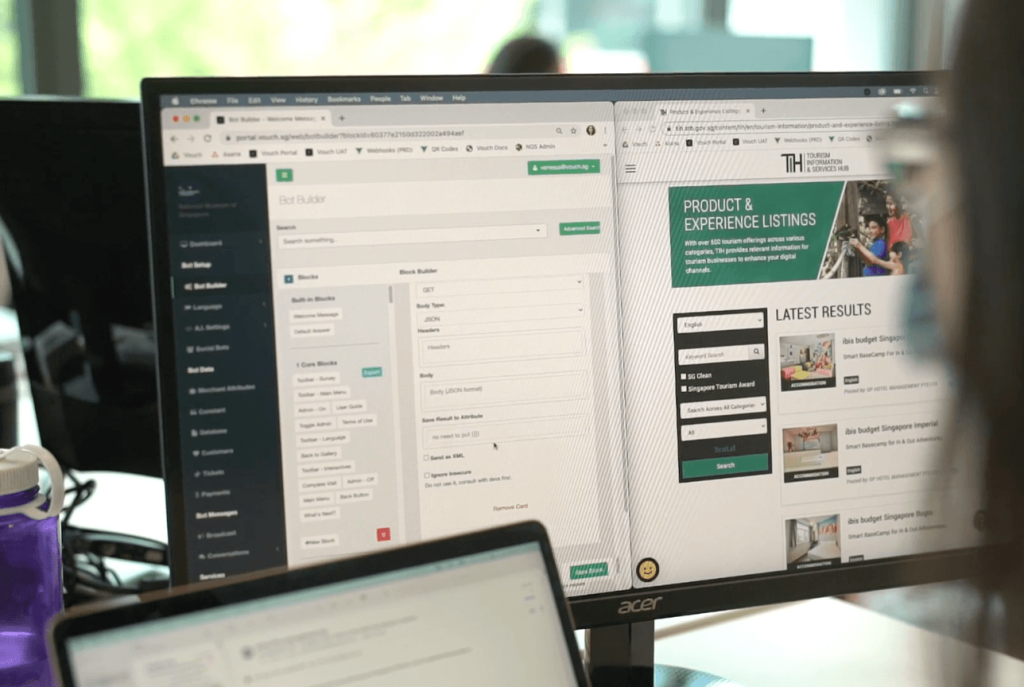
The TIH platform / Photo credit: STB
TIH offers a range of other features aside from its Enhanced Navigation Services API, which is what powers Vouch’s ability to make location-specific recommendations. Businesses also have access to other APIs focused on itinerary planning and a recommendation engine, as well as content libraries and a business analytics dashboard that generates better insights into the tourism space, allowing them to work more efficiently.
Ling says that TIH helped Vouch take its concierge platform to the next level by enhancing what the company could offer to its partners.
“TIH allowed us to scale faster across the different hotels and reduced our time to market,” he notes. “These additional capabilities that our product has differentiates us quite a bit because these hotels see it as a value add to their guests.”
By doing so, Vouch has been able to truly pool all the duties of a concierge into its digital platform, allowing its hotel partners to focus on the customer interactions that matter.
“Staff can spend more time on actually helping guests in need. If someone lost their luggage or can’t find their way to the airport, [hotel employees] can be there to guide them,” explains Ling. “You move away from trivial matters to more meaningful interactions that actually impact the guests’ experience.”
The power of information
In Ling’s view, TIH is a valuable resource, especially as it offers up-to-date information on how the pandemic has affected attractions, eateries, and other leisure spots in Singapore.
As the situation changes, technology – and platforms like TIH – help ensure that customers have access to information that’s timely and relevant. When a business updates its details on TIH, the changes are reflected across its database and can be pulled out easily with the relevant APIs.
In addition, Ling feels that having a central repository of information like TIH is an advantage to businesses in the travel and tourism space.
“The fact that anybody can just keep on pulling all this information that’s up to date… it really helps everyone because it’s like a network effect,” he says. “Much like Wikipedia, the more that people use [and] police it, the more useful it is.”
Ling thinks that as more businesses use TIH, the benefits of the platform will become even more apparent.
“As we go towards digitalization, more travel players have digital touch points. And when you pull information from TIH, it can log the frequency and the type of requests are being made,” Ling explains. “STB can share this information with the rest of the industry so that they can improve their services and products to better address the issues that customers are facing.”
The Singapore Tourism Board’s Tourism Information and Services Hub is a digital resource platform for businesses to market themselves and obtain content on the country’s tourism offerings and travel software services with ease, all in one place.
Learn more about the Tourism Information and Services Hub on its website.
This content was produced by Tech in Asia Studios, which connects brands with Asia’s tech community. Learn more about partnering with Tech in Asia Studios.
Stay updated on the go with our mobile app.
Get latest insights with smoother, more personalized experience through TIA mobile app.
Recommended reads
 Indonesian AI startup goes global
 Forrest Li on scaling Sea, building smarter bots, and founder grit
 An AI assistant that joins sales calls and scores team skills
 Beyond the check: Why VCs need more than capital
 SGX’s CEO says it doesn’t need a unicorn to win
 SMEs want AI too, but not the kind Big Tech is selling
 Oatside’s alt-milk rise hits a profitable gear
 Alibaba’s financial health in 12 charts
 Asia’s telcos bundle AI into mobile plans. Will it pay off?
 M-Daq chases bigger clients as revenue falls, losses grow





Editing by Nathaniel Fetalvero and Eileen C. Ang
(And yes, we’re serious about ethics and transparency. More information here.)