 Winston Zhang · · 5 min read
Meet the company that’s helping Malaysian restaurants tide through Covid-19 restrictions

As in most countries all over the world, food delivery in Malaysia has risen to prominence over the past year, thanks to Covid-19 and the related lockdown measures. Restaurants big and small scrambled to digitalize to varying levels of success but almost always with some difficulty.
However, for one local food and beverage (F&B) company, this was a transformation that was years in the making, so it only took a hop and a skip for it to get used to the new way of doing things.
“We’re fine, as we’ve been with engaged food delivery partners such as Foodpanda and GrabFood since 2018,” explains Vincent Lua, founder and CEO of Cravito Group, a company best known for operating MyeongDong Topokki, a fast-casual Korean food chain, in Malaysia. It also includes Eatwhatnxt, a virtual restaurant company, in its holdings.
“Food delivery has accounted for increases in our annual revenue over the past few years – it started at around a 5% increase before eventually hitting 30% just before the pandemic hit,” Lua says. The trend has revealed one thing: Diner preferences have changed. “Many just want a quick bite, especially for lunch during work days, instead of dining out for every meal,” the CEO shares.

Vincent Lua, founder and CEO of Cravito Group / Photo credit: Cravito Group
Besides enabling MyeongDong Topokki to smoothly transition to a new and very different F&B scene amid the pandemic, Cravito’s early adoption of food delivery gave it the foundation to quickly find new ways to help it and fellow F&B businesses bring in more revenue.
Virtual restaurants
About three years ago, Cravito’s plans to expand into food delivery simply amounted to setting up cloud kitchens and renting them out.
“After realizing the benefits of food delivery, we got to thinking: How do we increase the revenue we get from that channel?” Lua recounts. “We found that we could segmentize a small portion of our operations out – just kitchens with utensils and equipment – to try cloud kitchens.”
With almost a decade’s worth of experience and contacts from operating MyeongDong Topokki, the company could easily and quickly “copy and paste” these small kitchens into rural areas. This would allow it to serve residential and office spaces and set up shop away from prime locations with high foot traffic.
After looking at the financial details of the venture, however, the plan as it stood wasn’t wholly feasible. “Given the amount of capital we had to put in, the revenue projections were just not good enough and didn’t justify the investment,” Lua explains.
Instead, Cravito found another way to leverage the brand equity it had built up.
“That’s when we came up with the idea of virtual restaurants,” Lua says, referring to the 13 brands the company now manages via Eatwhatnxt. These virtual restaurants – which offer dishes ranging from rice bowls to tacos and burgers – don’t have their own physical shopfronts and are only available on food delivery platforms. In addition to using the cloud kitchens that Cravito has set up, the restaurants prepare their meals in the underutilized kitchens of other eateries, which have seen fewer customers due to Covid-19.
These partner restaurants just have to sign up with Eatwhatnxt to open up this new source of revenue for themselves. Lua says that 60% of the profit of these virtual restaurants goes to these partner establishments.
“For new franchises coming on board, it’s very simple – after they fill out the agreement and sign up with us, they get access to all the necessary training and information they need to start preparing our brands’ food,” the CEO says. “We provide guidance on everything from how to cook the food, the speed at which to complete each task, and even how to dress for hygiene purposes.”
The real challenges
The biggest hurdle to overcome in managing virtual restaurants, according to Lua, is the simple fact that these establishments are new and, as a result, have virtually no cultural cachet. Customers don’t know them and don’t know if they’re any good.
“When I look at the market, I’d say that people venturing into cloud kitchens can do it relatively quickly – you just need to renovate a location then rent it out,” he says. “But when it comes to virtual brands, it’s a bigger challenge.”
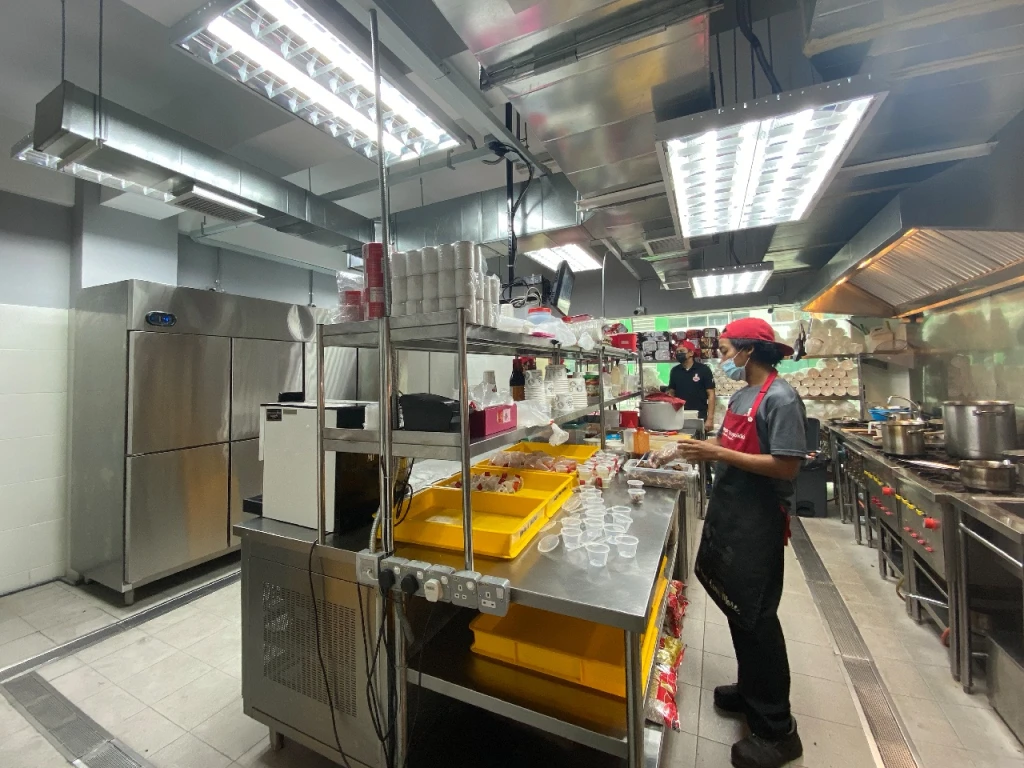
One of the kitchens that the Cravito Group oversees / Photo credit: Cravito Group
Among other things, restaurants will need a training center, a proper infrastructure in place to guide people, and the necessary tie-ups with digital platforms to help bring in revenue. There’s no existing customer base to readily sell to either.
For Eatwhatnxt, building a brand is not something that can be done overnight, and a lot of resources are needed.
In order to bring its virtual restaurants up to speed as fast as possible, the company adopts a data-driven approach. Every order it receives serves as a data point, which it uses to continually gain a better understanding of customer preferences such as the time of day a particular item receives high orders.
Besides improving its own revenue numbers, the firm sees this work as part of its promise to its partner restaurants.
“Our partners look to us to help them to bring in more revenue because their dine-in numbers are too low,” Lua says. “Our job is to ensure that revenue flows in for them and that they make a profit good enough to continue operations and even get extra income.”
What’s next?
Looking ahead, Eatwhatnxt still has a lot to improve on in terms of its analytics and automation capabilities, Lua says. It’s developing its own back-end application to replace old point-of-sale systems, one that allows it to control every single element of the order process. This includes analyzing the overall revenue of the various products and even the compound annual growth rate of each individual food item.
Despite this heavy emphasis on digitalization, the CEO insists that brick-and-mortar restaurants will persist because people will always want to be able to have the dine-in experience. However, dine-in options won’t be a source of fast-growing revenue.
“Habits and preferences are changing – customers are no longer interested in going out for low-ticket, simple meals; they can get those from the delivery platforms,” Lua says. “If they dine out, it’ll be more for things like steak or barbeque.”
Digitalization – and the various forms it takes – will play an increasingly important role in the F&B scene.
“It provides an extra revenue stream that’s going to increase exponentially,” the CEO affirms.
Cravito Group uses technological innovations to help ensure that all the products under the group are manufactured with equal emphasis on efficiency and quality. It owns Eatwhatnxt, which creates data-backed virtual-only restaurant brands that generate incremental orders for underutilized kitchens.
Find out more about its virtual restaurant business on its website.
This content was produced by Tech in Asia Studios, which connects brands with Asia’s tech community. Learn more about partnering with Tech in Asia Studios.
Stay updated on the go with our mobile app.
Get latest insights with smoother, more personalized experience through TIA mobile app.
Recommended reads
 Zimplistic flips to a profit in 2021 after troubles
 Oddle built a profitable food delivery business. Here’s how
 How the newest generation of hospitality businesses is revolutionizing the industry
 Velocity Ventures invests in Israeli robot kitchen firm
 How real-world validation helped this digibank launch its unique services with confidence
 Exclusive: Init6, East Ventures back Indonesian rental firm from ex-Listee execs
 Recession Run: Wavemaker’s Santos sees a crisis as a flight to quality
 Cold chain may be the next opportunity for Indonesia’s logistics startups
 How AI is making the future clearer for business forecasting
 SEA food delivery spending tops $16.3b in 2022: report





Editing by Nathaniel Fetalvero and Jaclyn Tiu
(And yes, we’re serious about ethics and transparency. More information here.)







📅 Upcoming Events
22 October 2026
Payoneer x CSPN Summit 2026