 Jonathan Chew · · 6 min read
We don’t have enough healthcare workers. Here’s how AI can help

Munjal Shah, CEO and co-founder of healthtech company Hippocratic AI, is alive today because he got timely medical attention as an infant.
His diet included cow’s milk at the time, but his parents didn’t realize he was allergic to it. By the time he was six months old, he was severely underweight, coming in at around 6 pounds (2.7 kilograms).
“Luckily, my parents flew me to Singapore, and within hours of getting to a hospital, they diagnosed my allergy and put me on soy milk,” Shah says. “The doctors said that if I had gotten treatment just a couple of days later, I probably would’ve died.”

Receiving treatment in Singapore. / Photo credit: Munjal Shah
Unfortunately, speed of care is still not a given in many parts of the world. In Asia, wait times in health facilities have either remained long or increased. This unwanted change hit Singapore between 2022 and 2023.
“Looking at it, I believe this problem will only get worse,” Shah adds.
Facing the crunch
Wait times in hospitals and clinics have always been an issue because there’s never been enough healthcare workers, according to Shah.
“It’s been like that for all of human history,” he says. “We’ve even designed around it – just look at the fact that triage exists.”
A report by the World Health Organization indicates that there will be a shortage of 4.5 million nurses by 2030.
The pandemic was a major contributing factor to this problem as many healthcare workers left the profession due to burnout, Shah adds.
To make matters worse, many Asian countries have aging populations. In Singapore, the proportion of citizens aged 65 and above is estimated to rise from 19.9% in 2024 to 24.1% by 2030.
Long wait times in healthcare facilities are critical as they can increase patient risk and mortality rates. But it’s not just about getting treatment – with the lack of manpower, patients won’t get proper post-treatment care, too.

Photo credit: Shutterstock / Riyan Pally
Shah then recalls his mother’s high blood pressure diagnosis five years ago. She wasn’t taking her medication and didn’t inform her family about it.
Then, six months ago, she was rushed to the emergency room because of congestive heart failure.
“If there was a system in place to constantly monitor or call her to remind her, we could’ve caught that things weren’t getting better and intervened before it got out of hand,” Shah says.
Healthcare systems are now facing two choices.
“Either open the doors to AI, or the level and quality of care for older folks will diminish,” he shares. “I believe we’re obligated to use AI to solve this demographic challenge.”
Filling the gaps
One of the biggest impacts AI can have on healthcare is handling routine tasks.
For example, one of Hippocratic AI’s customers uses its generative AI agents to reduce hospital readmission by following up with discharged patients. Lowering the rate by 0.1% or 0.2% would have been a good achievement, according to Shah.
“Early data showed that we decreased readmissions by 3%. It was such a big difference that we even asked them to double-check to make sure they pulled the data correctly,” he says.
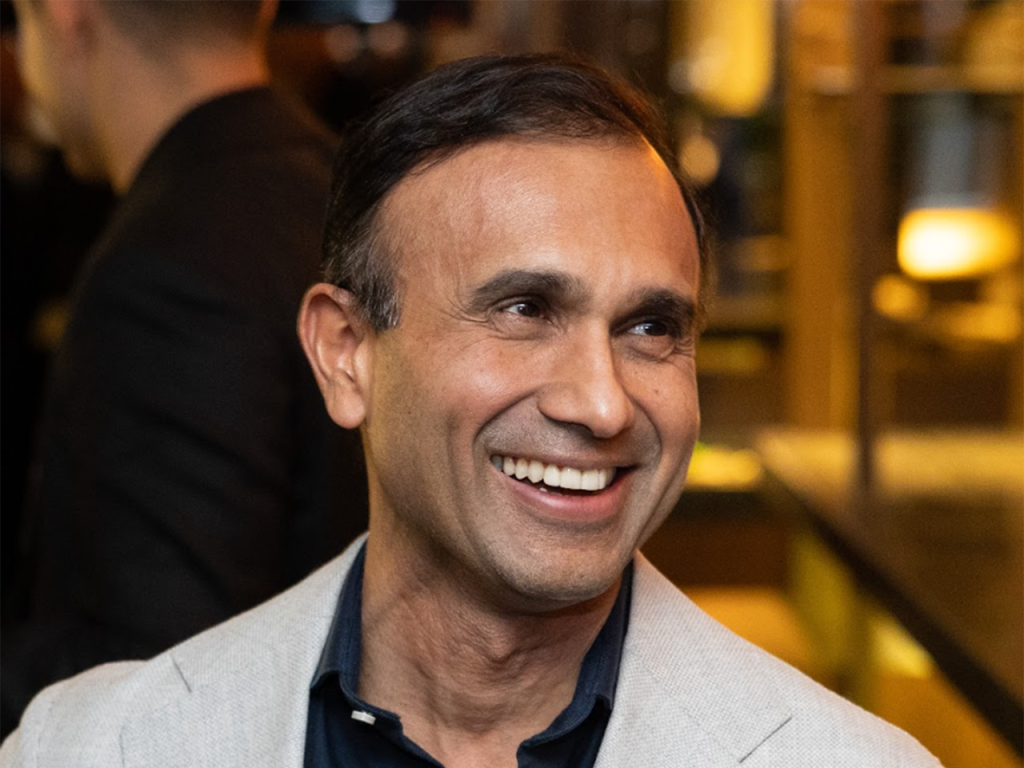
Munjal Shah, CEO and co-founder of Hippocratic AI. / Photo credit: Hippocratic AI
AI can also gather data to help human clinicians make decisions more quickly and easily.
Imagine that a typhoon – a growing occurrence in Southeast Asia – causes a dialysis center to close temporarily. How could that center reopen in a way that prioritizes patients who need more urgent help?
Shah says AI can be used to “call every patient to check in on their well-being, gather up-to-date health information, and generate concise, actionable summaries.”
He adds that this will enable clinicians to “quickly identify and prioritize those who need follow-up care first.”
Governments can also use AI to remind people above a certain age to schedule and go for health checkups.
“If we can always check in on patients, we could help everyone live longer and better,” Shah says.
AI can help people feel more comfortable by speaking to them in their own language, too. He shares that while his mother can converse fine in English, she shares a lot more and feels much more at ease when interacting with a doctor in Hindi.
Making extra sure
In an area as sensitive as healthcare, there will naturally be safety concerns over the implementation of new technologies, including AI.
According to Shah, one way to ensure safety is by using the tech only for non-diagnostic applications.
For example, Hippocratic AI currently offers AI agents that can call patients to complete intake questionnaires before operations, follow up after it’s done, and discuss medication costs, among other tasks – it does not diagnose patients or prescribe medication.
It’s also important to make sure that the baseline algorithms are tested extremely thoroughly.
In the case of Hippocratic AI, it hired 6,234 US-licensed physicians and nurses to make more than 300,000 test calls.

When the doctor and nurse council met with Hippocratic AI at its office. They helped with feedback, testing, and co-design among the firm’s larger network of clinicians. / Photo credit: Hippocratic AI
The company refined its algorithms after each round of testing, eventually reaching a point where it gave the correct response and advice 99.38% of the time. This is better than the average set by human clinicians, who only achieve an 88.16% success rate.
The firm also bolsters this feedback with functional insights, having analyzed more than 2.49 million patient calls made to date.
“If you want to change the world and be safe while doing it, it’s better to take more time to do so than rush it,” Shah explains.
Better bedside manner
Shah believes one of the most important advancements in healthcare AI should be finding ways to continuously improve its empathy.
“If you listen to our AI agents, they can sound empathetic, but they can’t actually tell the difference in how you say something,” he says. “What we’re looking for next is detecting patients’ tones more accurately to offer even more empathetic responses.”
That said, Asian hospital systems have already shown a lot of openness to incorporating AI.
In fact, Hippocratic AI recently signed a partnership deal with a Japanese healthcare company to launch its first Japanese-language generative AI healthcare agent.
“Many of them were very eager, including some government organizations,” Shah says. “It’s been great to see the warm reception and aligned mission of many organizations to provide healthcare abundance.”
The IMDA Accreditation program was launched in 2014 to accelerate the growth of promising Singapore-based enterprise tech companies. It helps them establish their credentials, build business traction, compete in the global market, and gain more opportunities to showcase their solutions to spur adoption. Learn more about how IMDA Accreditation can grow and accelerate your business.
Hippocratic AI provides safety-focused AI agents that handle non-diagnostic clinical tasks across healthcare sectors to improve patient outcomes. Find out more about its solutions here.
This content was produced by Tech in Asia Studios, which connects brands with Asia’s tech community. Learn more about partnering with Tech in Asia Studios.
Stay updated on the go with our mobile app.
Get latest insights with smoother, more personalized experience through TIA mobile app.
Recommended reads
 Tracking AI hiring in Singapore: OpenAI, Anthropic, and more
 Last to board: why travel may be AI’s final frontier
 Why ‘cheaper’ no longer wins dev deals for Vietnam
 Alibaba’s capex isn’t the full story
 Forget startups. Buy the business running on Excel
 Life’s a game, and AI agents are Animoca’s new play
 Indonesian AI startup goes global
 Forrest Li on scaling Sea, building smarter bots, and founder grit
 An AI assistant that joins sales calls and scores team skills
 Beyond the check: Why VCs need more than capital




Editing by Winston Zhang and Mina Deocareza
(And yes, we’re serious about ethics and transparency. More information here.)






📅 Upcoming Events
22 October 2026
Payoneer x CSPN Summit 2026