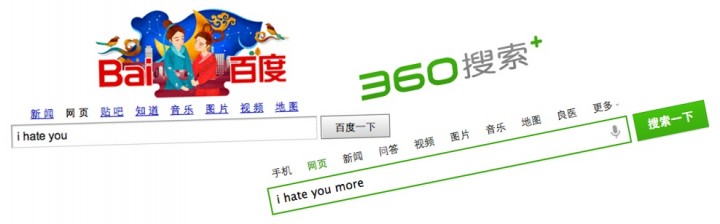
Today, I came across an interesting opinion piece on TechWeb, ostensibly written by a longtime PR professional, about the latest battle in the ongoing PR war between Baidu and Qihoo. Last Friday, we wrote that Baidu was announcing the latest version of its compensation plan for users who have been ripped off by links they found through Baidu search. Baidu’s news was that it was eliminating the compensation cap and expanding it to include all search results, not just paid advertisement links.
Apparently, just after Baidu’s announcement, Qihoo announced that it, too, had launched a compensation plan that had in fact already been in operation for a month, had processed 378 cases, and had already paid out more than 1.2 million RMB ($196,000) in total compensation including 260,000 RMB ($42,000) for a single case.
At first glance, as the article points out, it seems like a fairly successful strategy: let Baidu blaze the trail and stand on its shoulders to eclipse its announcement with an announcement of your own: we’re doing the same thing, but we’re giving out more money! But is there more to it than that? From the article (my translation):
Actually, sharp-eyed media folks can easily see some of the PR issues here: first, if Qihoo’s compensation plan has been around for a month, why hasn’t anyone heard about it? It’s such a good program for consumers, yet somehow no one in the media got wind of it. Second, why weren’t the police called in response to the 260,000 RMB case? Third, if in one month Qihoo has had 378 reported cases, 202 of which resulted in compensation payments that add up to more than 1.2 million RMB, that means Qihoo gets 12.6 complaints and pays out 40,000 RMB each day, and in a year it will pay out 14.52 million RMB! Is this same the company that started out as security experts?
The day after the initial announcements, Qihoo CEO Zhou Hongyi wrote on his microblog that the reason there were fraudulent links in Qihoo’s search results was mostly due to its partnership with Google. Even so, the author of the piece quoted above wonders — with good reason, I think — whether Qihoo has really done itself any favors here. Baidu has done more or less the same thing, of course, but Baidu’s brand and reputation is not based on being the leader in web security. Qihoo’s is. Is it really an effective long-term branding strategy for a security company to be announcing to the public that people are getting conned out of thousands of dollars using its search engine, no matter whose fault that ultimately is?
Probably not.
The other question, though, is whether the PR posturing and branding matters at all at this point when it comes to Qihoo. I make a point of reading through the comments on articles like the one I’ve quoted above, and what I usually see is a fairly even number of comments strongly praising and strongly condemning Qihoo. Obviously comments tend to be written by the people who feel strongest, but Qihoo has been involved in so many PR battles at this point that I wonder how many people are left in China who haven’t already formed an opinion on the company one way or another. Many seem to have picked either Tencent or Qihoo during the 3Q War in 2010, and the dislike or love for Qihoo (depending on which side they picked) has only grown stronger in the intervening years. It’s enough to make me wonder sometimes whether anything Qihoo’s PR department does matters at all.





Stay updated on the go with our mobile app.
Get latest insights with smoother, more personalized experience through TIA mobile app.