 Bree Chan · · 6 min read
From kidney care to patient meals: firms reinventing healthcare

In healthcare, small delays can have lasting consequences. A kidney condition detected too late can mean damage that cannot be reversed. Likewise, a hospital patient who struggles to finish their meals may take longer to recover, spending more days in care than necessary.
Singapore-headquartered Mesh Bio and Hong Kong-based My Care Healthcare are addressing these challenges by intervening earlier in the care journey or providing nutritional support in the patient’s recovery process.
The work of these companies reflects a broader shift in healthcare innovation. Instead of concentrating value at the point of treatment through new drugs or devices, they have taken a more holistic approach – where earlier insight and timely support can protect patients from harm rather than attempt to reverse it later. By acting sooner, both firms are changing the trajectory of care, not just the response to illness.
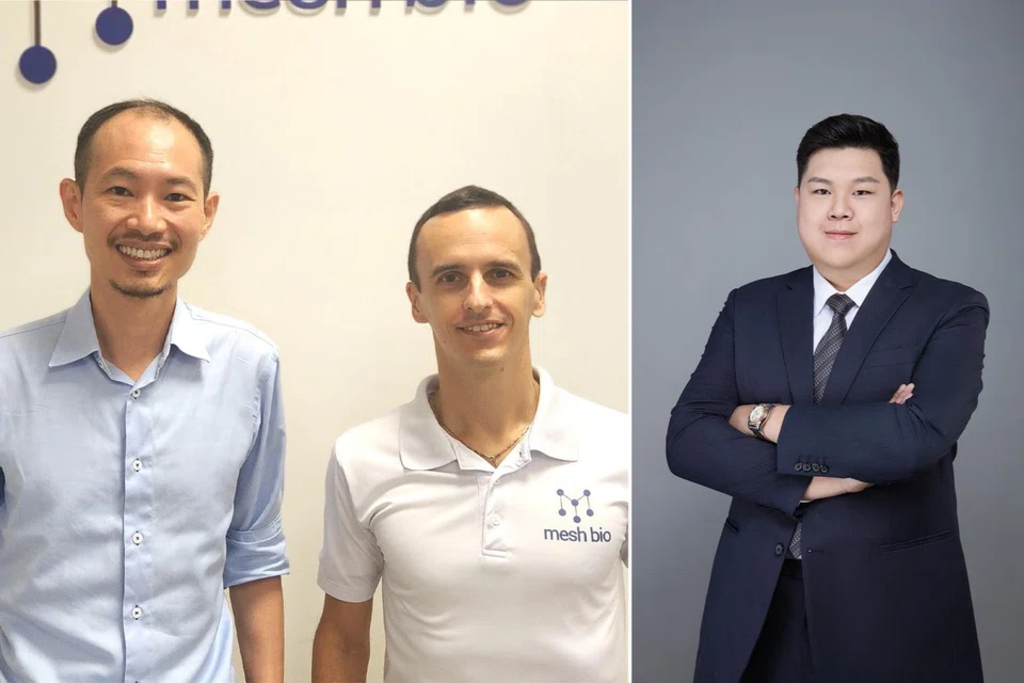
(From left) Andrew Wu, co-founder and CEO, and Arsen Batagov, co-founder and CTO of Mesh Bio; Francis Ho, general manager of My Care Healthcare. Photo credit: Mesh Bio, My Care Healthcare
For Mesh Bio, it all began with the question of whether kidney disease could be spotted years earlier, before symptoms appear and treatment options narrow. My Care Healthcare, on the other hand, wanted to look into a familiar issue in hospitals: patients with swallowing difficulties or chronic conditions who simply cannot eat the meals they are served, delaying recovery.
In solving these problems, both companies found more than clinical answers. They built viable businesses around prevention and recovery – an approach that has earned each of them recognition at the 2025 Emerging Enterprise Awards, jointly organized by The Business Times and OCBC.
As Asia’s populations age rapidly, these two firms show how addressing decline sooner helps reduce strain across the healthcare system.
When AI meets kidney disease tsunami
For Mesh Bio, the mission is urgent. Singapore’s rapidly aging population and rising diabetes rates are fueling a silent epidemic: chronic kidney disease, one of diabetes’s most serious complications. By the time symptoms appear, irreversible damage has already occurred.
Enter HealthVector® Diabetes, the company’s breakthrough digital twin tech that not only tracks health but also predicts it.
Unlike static health records that only show what has already happened, digital twins are dynamic, virtual replicas of the human body that can be updated with real-time data. They mirror a patient’s physiological state and forecast what is coming next.
Tapping advances in analytics, modeling, and applied research, the HealthVector® Diabetes software can flag chronic kidney disease risk up to three years in advance, creating a critical window for life-saving intervention. After securing approval from the Health Sciences Authority in 2023, the tech is now undergoing clinical trials.
“This is a large and important healthcare concern for Singapore as we think about the aging population and rising chronic diseases,” says Mesh Bio founder and CEO Andrew Wu. He founded the company in 2018 to harness AI’s growing power for patient care.
The company’s innovation does not stop there. Its DARA software – already deployed across Singapore, Indonesia, Malaysia, Hong Kong, and the Philippines – assesses clinical data and provides personalized health management suggestions within seconds. For time-strapped doctors and clinicians, it is a game-changer.
The numbers tell the story: Over 40 healthcare groups now use Mesh Bio’s tech, with hundreds of thousands of patients assessed. At a cost of just a few dollars per patient, DARA makes precision medicine accessible at scale.
Indeed, the software serves as what Wu calls “a beachhead for introducing predictive analytics and AI solutions such as digital twins” across Asia.
Wu attributes the acceleration of this trajectory to the company’s Emerging Enterprise Award, citing catalysts such as the $200,000 interest-free OCBC loan and heightened media visibility, which were among the prizes offered to the winners.
“This award really helps to highlight the work that we’re doing,” he further notes. “Ultimately, we hope that this increased visibility would lead to more interest, especially amongst healthcare providers, and also patients.”
Restoring appetite during recovery
When Francis Ho and his mother, Peggy Cheung, saw the difficulties a relative experienced after developing dysphagia – the medical term for swallowing difficulties – they decided to help others living with the same challenge.
In 2019, they founded My Care Healthcare. The company initially imported texture-modified meals from Japan, but Ho and Cheung soon realized that the food did not suit Chinese patients, making it harder for them to finish their meals.
What they had to do next was obvious: make their own. My Care then set up a factory in Guangdong to produce meals tailored specifically for local palates.
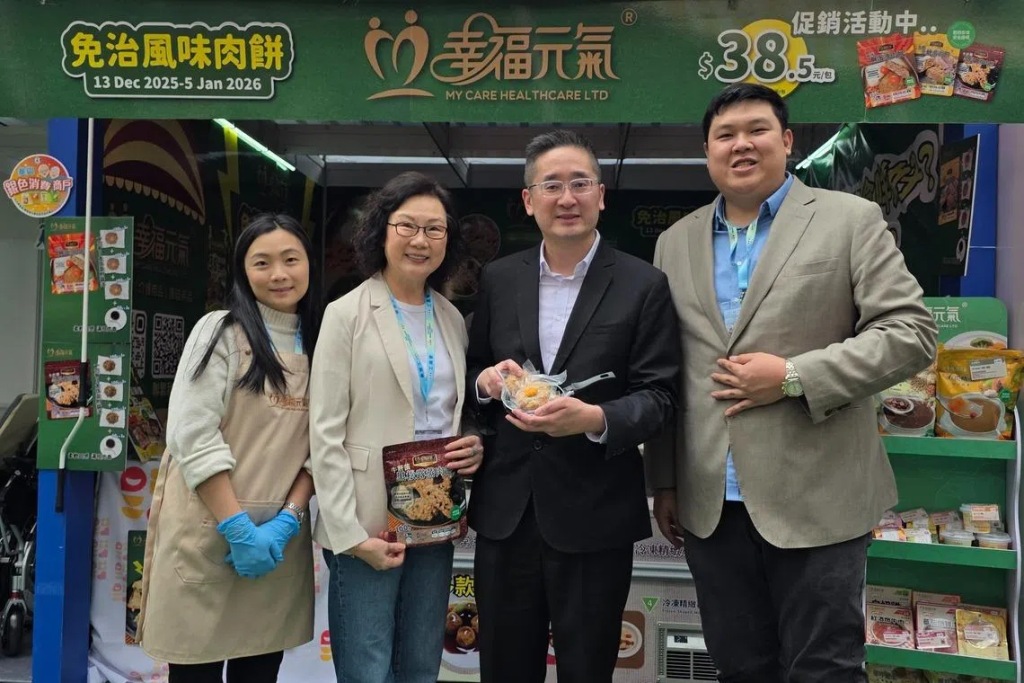
(From left) My Care Healthcare customer manager Sanmie Leung, co-founder Peggy Cheung, Under Secretary for Commerce and Economic Development of Hong Kong Bernard Chan, and general manager Francis Ho at the 2025 Hong Kong Brands and Products Expo, showcasing the company’s texture-modified meals designed to help patients with swallowing difficulties recover more effectively. Photo credit: My Care Healthcare
The Hong Kong-based company did more than alter food textures – it rethought the entire eating experience.
With nearly 50 employees at its Guangdong facility, My Care produces meals using natural ingredients that are carefully mashed and molded into familiar forms, so they look, smell, and taste like the dishes patients recognize.
These include steamed pork patties and macaroni soup – comfort food that appeals to Chinese taste buds and meets International Dysphagia Diet Standardisation Initiative standards. Just as importantly, the meals are priced below what a typical cha chaan teng – or Hong Kong diner – would charge, making them viable for hospitals and care facilities.
The results are clear: Patients eating My Care meals consume about 350 grams of food per serving – a huge improvement from the usual 180 grams to 200 grams logged previously.
This is a good indicator because, according to Ho, who serves as the company’s general manager, better nutrition helps patients recover faster. It shortens hospital stays and reduces complications and readmissions.
“We’re now operating in over 50 hospitals across mainland China, and we aim to grow that to between 100 and 125,” he adds.
Beyond dysphagia, the company has expanded its product range to serve patients with diabetes and kidney disease, adjusting protein levels based on the severity of their condition.
With annual revenue in the tens of millions of Hong Kong dollars, My Care shows that improving patient care and building a sustainable business can go hand in hand.
This year, its expansion is gathering pace. Winning the Emerging Enterprise Sustainability Award has brought more than recognition to the firm, says Ho. Having built its business primarily by supplying hospitals and nursing homes, the company is now using that credibility to reach consumers directly.
Specifically, My Care is entering markets such as Thailand and Australia through joint ventures, with partners already secured. At the same time, it is launching packaged meals through Hong Kong supermarkets and its own website, catering to patients recovering at home.
Sustainability is also part of the equation. When patients can finish their meals, food waste is reduced sharply.
Combined with energy-efficient factory operations, the company keeps waste to a minimum. But the biggest environmental gain, Ho notes, comes from faster recovery – shorter hospital stays and fewer repeat treatments, which together reduce the overall footprint of inpatient care.
Recognizing bold ambition
Now in its 19th year, the Emerging Enterprise Awards, a joint initiative by The Business Times and OCBC Bank, continue to champion the innovation, resilience, and excellence of businesses under 10 years old. The awards celebrate emerging businesses from across Asia, reflecting a sustained commitment to highlighting entrepreneurial talent far beyond Singapore.
The Emerging Enterprise Sustainability Awards honor enterprises that embrace opportunities in the green economy, whether by embedding sustainable practices in their operations or leveraging tech and innovation to drive the transition to low-carbon economies.
Additionally, the Most Promising Sustainability Startup Awards laud businesses with unique, commercially viable ideas and significant long-term potential.
The application for the 2026 Emerging Enterprise Awards is opening soon. Learn more about the submissions here.
This story was republished with permission from The Business Times. It was moderately edited to reflect Tech in Asia’s editorial guidelines.
This content was produced by Tech in Asia Studios, which connects brands with Asia’s tech community. Learn more about partnering with Tech in Asia Studios.
Stay updated on the go with our mobile app.
Get latest insights with smoother, more personalized experience through TIA mobile app.
Recommended reads
 Tracking AI hiring in Singapore: OpenAI, Anthropic, and more
 Why ‘cheaper’ no longer wins dev deals for Vietnam
 Alibaba’s capex isn’t the full story
 Forget startups. Buy the business running on Excel
 Life’s a game, and AI agents are Animoca’s new play
 Indonesian AI startup goes global
 Forrest Li on scaling Sea, building smarter bots, and founder grit
 An AI assistant that joins sales calls and scores team skills
 Beyond the check: Why VCs need more than capital
 SGX’s CEO says it doesn’t need a unicorn to win





Editing by Mina Deocareza
(And yes, we’re serious about ethics and transparency. More information here.)






📅 Upcoming Events
22 October 2026
Payoneer x CSPN Summit 2026