 Marie Brinkman · · 4 min read
Study says talent war in China may be cooling off, but just a little
The Chinese technology sector continues to grow at a rapid pace.
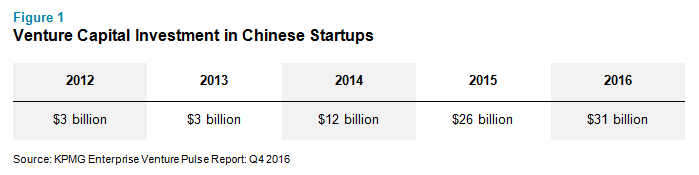
According to the National Bureau of Statistics in China, overall investment in the sector grew by 15.8 percent in 2016, far outpacing overall GDP growth in the country. Figure 1 below also illustrates that venture capital funding for Chinese startups has accelerated dramatically, accounting for roughly one-fifth of global venture capital investment.
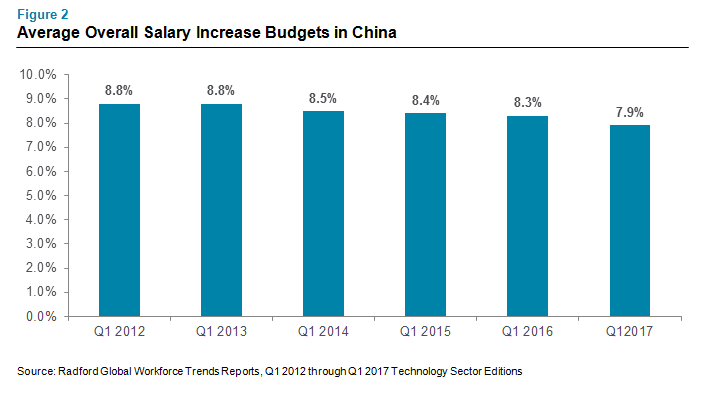
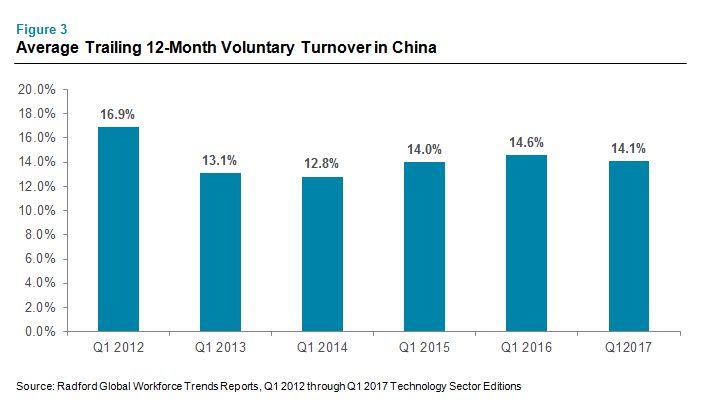
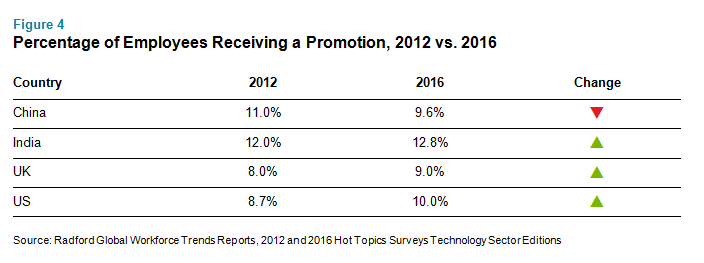
However, despite this, new data from our Global Technology Survey suggests that employees and employers in China are less bullish than outside observers might expect. As of the first quarter of 2017, average salary increase budgets in China fell below 8 percent, and voluntary turnover rates have dropped compared to the same time last year. Employee promotion rates in China also declined.
Before exploring the reason for these shifts, let’s look at the data. Below, figure 2 displays average overall salary increase budgets including both merit and annual pay adjustments in China over the past six years. Figure 3 displays average trailing 12-month turnover rates over the same six-year timeframe.
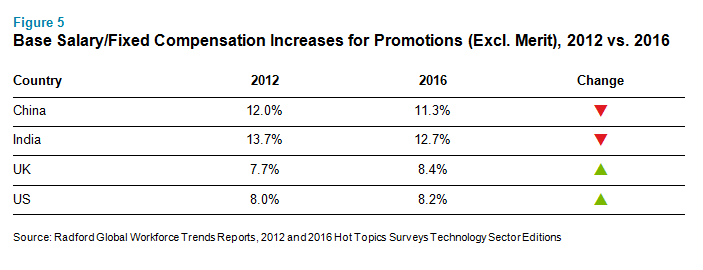
Finally, figures 4 and 5 compare promotion practices in China to those in India, the United Kingdom (UK), and the United States (US).
All data below reflects practices from across the entire technology sector, including companies of various sizes and in multiple industries.
What does this all mean?
On one hand, we have to take this information at face value. This data suggests the incredibly fierce competition for talent in China could be easing slightly. That’s the good news for employers in the country.
However, although salary increase budgets and turnover rates in China are falling, they remain very high relative to most of the rest of the world. For example, in France, Germany, the UK, and the US, average overall merit budgets continue to hover between 3 and 4 percent. Similarly, average voluntary turnover rates in the same four countries sit between 7 and 12 percent, all below China at 14.1 percent. This is the bad news.
Next steps





Stay updated on the go with our mobile app.
Get latest insights with smoother, more personalized experience through TIA mobile app.











📅 Upcoming Events
22 October 2026
Payoneer x CSPN Summit 2026