- Insights This article was written by a TIA community member. Insights pieces undergo the same rigorous editorial process that newsroom-produced articles have.
 Filbert Richerd Ng Tsai · · 4 min read
How startups could be affected by the tax reform in the Philippines

Photo credit: Pixabay.
A few days ago, House Bill No. 5636 or the Tax Reform for Acceleration and Inclusion (TRAIN) was approved by the House of Representatives in the Philippines.
While the Philippine government’s propaganda to disseminate information about the tax reform is focused on the lowered personal income tax rate resulting from the bracketing changes (see image below), these changes affect more than your personal income tax.
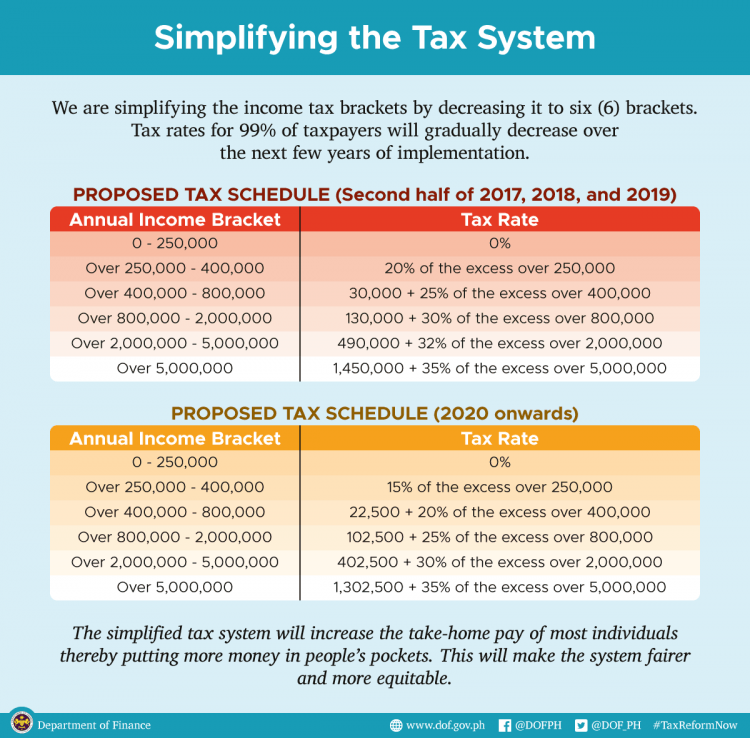
For businesses, the effect of the changes in the personal income tax rate is subtle. The government released a lot of articles and materials to propagate the impact of the tax changes on personal income tax, but this article will focus on the impact on businesses.
Fringe benefit tax
Most startups pay fringe benefits (car allowances, groceries, housing benefits, etc.) aside from salaries to the founders and key management personnel. Under the current tax regulations, fringe benefits are subjected to a fringe benefit tax (FBT) of 32 percent of the grossed-up monetary value of the fringe benefit paid to the employee (ex. US$0.65 of FBT for a US$1.37 worth of fringe benefits).
The new tax code proposes lowering the FBT to 30 percent come 2018. This would reduce the overall tax burden of a company (i.e. the FBT in the example above would be US$0.59 instead of US$0.65).
While this sounds positive for startups, the proposed change also includes a poison pill for employees. Under the current tax code, FBT is considered a final tax, meaning the benefit received by the employee is not subject to personal income tax. However, TRAIN proposes that effective 2022, “fringe benefit shall form part of the gross income of its recipient employee subject to the regular income tax rates.” This would heavily change the dynamics of how employees would welcome receiving benefits in kind in lieu of benefits in cash.
Moreover, current tax regulations allow businesses to take as an expense the grossed-up monetary value of the fringe benefit as a deduction (i.e. US$2 is allowed as deduction from income tax instead of the amount actually paid to the employee—US$1.37). The proposed changes would allow the actual amount paid to be claimed as a deduction.
Subjecting fringe benefits to personal income tax erases the benefit of receiving salaries. This could perhaps be the most crucial aspect of how you can retain top talent without the non-cash benefits that employees previously enjoy. Reducing the tax deductible amount to the actual fringe benefit paid also eliminates the benefit that the total payment (US$1.37 of fringe benefit and US$0.65 of FBT) can be claimed to reduce income tax. In essence, this is double taxation, subjecting the fringe benefit to both fringe benefit tax and corporate income tax.
Transactional taxes
A lot of startup founders still hire freelancers in order to sustain their bootstrapping business, and the tax reform also proposes changes in this area. I can’t say for sure if it’s for the better or worse since it depends on your business.
Self-employed and freelance professionals are subject to the 3 percent other percentage tax (OPT) in lieu of VAT (when gross sales or gross receipts do not exceed the VAT threshold of US$38,734).
Under the proposed tax changes, self-employed and/or freelancers are no longer subject to the 3 percent OPT. Here’s a quick summary of the changes:
Conclusion





Stay updated on the go with our mobile app.
Get latest insights with smoother, more personalized experience through TIA mobile app.









📅 Upcoming Events
22 October 2026
Payoneer x CSPN Summit 2026