- Insights This article was written by a TIA community member. Insights pieces undergo the same rigorous editorial process that newsroom-produced articles have.
 Tim Romero · · 4 min read
This biotech company struggled to get early funding. 7 years later, it went public
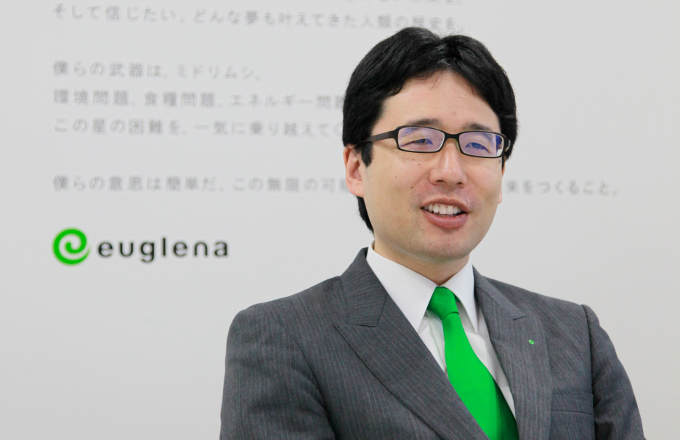
A photo of Mitsuru Izumo, CEO and founder of Euglena
This article is part of Tech in Asia’s partnership with Disrupting Japan where we publish the revised transcripts from the show’s podcast interviews with Japanese entrepreneurs. This is heavily revised from the original transcripts. For the full interview, go here.
I sat down with Mitsuru Izumo, CEO and founder of Euglena. Founded in 2005, his company is cultivating an organism—also called euglena—turning it into everything from nutritional supplements to jet fuel.
Some of you may be thinking: university research labs and crowdfunding sites are packed with companies claiming that their pet organism is the key to solving a wide variety of mankind’s problems. Euglena, however, operates not in a lab, but rather commercially and at a massive scale.
In this interview, Izumo shares how he overcame initial market skepticism to get financial backing and how and why he decided to take his company public in 2012.
What is euglena?
Euglena is a microorganism that is just 0.1 mm long. It is a kind of algae that has both plant and animal characteristics. So, it can produce both plant and animal nutrition: dietary fiber, fruits and vegetable vitamins, animal protein, and dietary fatty acid. Euglena can be cultivated under the sunlight like a normal plant.
How did you achieve production at scale?
Since the 1980s, a lot of scientists in the United States and Japan were very interested in cultivating euglena because it has a wide range of nutrients. But it was absolutely impossible. It was tremendously difficult to cultivate it purely and protect it from biological contamination. The scientists set up special facilities like green domes, but they were very expensive. The production capacity was also extremely limited—only 100 grams of euglena can be cultivated in a year.
In 2005, we invented a new cultivation liquid that could prevent biological contamination. We didn’t need expensive green domes or special facilities.
For the past five years, we’ve been doubling our production every year. In 2017, we produced around 100 tons of euglena. We have cultivation factories in Okinawa and Ishigaki Island, where there is a lot of sunlight.
What was the inspiration for the business?
When I was a student in 1998, I visited Bangladesh, which was regarded as the poorest country in Southeast Asia. That trip was a very shocking experience for me. In Bangladesh, there was a huge supply of rice, but people couldn’t access fresh vegetables, egg, milk, fish, and meat. The problem was malnutrition.
I came back to Japan and decided to solve malnutrition in developing countries. But I didn’t have any reputation to do so. Everyone wouldn’t believe that euglena can solve malnutrition, and massive cultivation was regarded as impossible. We wanted to raise money but we couldn’t find any financial sponsor. So, I temporarily got into banking to save some money.
You initially struggled with sales. How did you overcome that?
We had a deal with Itochu Corporation, one of the leading trading companies in Japan. They have many good subsidiaries like Family Mart, one of the largest convenience store chains there. They have over 8,000 retail stores nationwide.
We were just a small startup back then coming out of the University of Tokyo. We didn’t have a good sales channel or a marketing plan. For three years, from 2005 to 2008, I approached over 500 companies to persuade them to use our euglena food supplements.
Then, after six months of due diligence, Itochu decided to invest in our company. We agreed that we’d exclusively supply them with euglena dry powder as a raw material for producing euglena green smoothies and euglena-infused yogurt. These products were only available at Itochu companies.
Why did you decide to IPO?
Do you plan on licensing the technology globally?
What would you change to make Japan better for startups?





Stay updated on the go with our mobile app.
Get latest insights with smoother, more personalized experience through TIA mobile app.